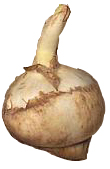
Tuber
The Bungling Host (§20 of the Trickster Cycle)
Hocąk-English Syllabic Interlinear Text
(413) Then he went to the place that he meant. When he got there, sure enough, there was a human village there. He went and joined up with them. In time, he also got married. (414) Then, after the passing of some time, a child was born to this one. Then they went on the fall move, so he went and lived in a place by himself. There thus he would be. (415) Then indeed, he made his permanent home there. He would never move back to the village. Then this one finally said, "About now I will go and visit my younger brother," he said.
| |
|
| The Arrowleaf Tuber |
(416) There Little Muskrat lived. There he went. They were very glad. The children kept saying, "Uncle has come!" (417) "Hohó, my older brother, it is he who has come!" he said. Then right away, "Old woman boil something right away for my older brother," he said. "Also boil some lilies of the lake for him," he said. She handed him a kettle. (418) Little Muskrat took it and went on out. A waik ("awl") they call it, and taking one of those, he went out on the ice and began whacking away at it. (419) After awhile, he brought back a bucket full of ice. The chipped ice she put on the kettle hook over the fire. After awhile, it was dished out. The kettle was filled with arrowleaf tubers. (420) It had been filled with ice. Trickster was delighted with it. There he ate a lot of arrowleaf tubers. Then he came away.
He had left one of his mittens under the matting. (421) He did this on purpose so he could say this. He started away, but when he had gone only a short distance, he said, shouting back, "My dear brother, I forgot and left behind my other mitten. (422) Let the children bring it over for me," he said. "Take it over for your uncle. He's one who's always saying things. Go only part way and throw it," he said. (423) He went part way, and when he was about to throw it, he said, "Because I dread to go back, is why I asked," he said. So he took it over to him there. (424) He said, "In the morning, your father must come over," he said. Then when he got back, he said, "Father, my uncle says that you must go over in the morning," he said. (425) "Yes, that is what he would say, so that is why I said to go part way and throw it." "I went part way, and I did try to throw it, but he forbid me, 'Because I dread to go back, is why I asked, so bring it to me,' he said. (426) So I came to take it up to him," he said. And when he had been about to go home, he had told him to pack some of the lilies of the lake tubers, but he had not done it. (427) "Never mind, my little brother, there is some to eat," he said. He told a lie. They were hungry, yet he said that.
Then the next morning, Little Muskrat went there. (428) "Hohó, it seems impossible to travel, yet my younger brother has arrived," he said. "Old woman, give me my coarse bag," he said. (429) "My awl also."  The old woman was embarrassed. Finally, she found what he meant. He went whacking on the ice. (430) After awhile, he brought back a bag full of ice.
Then he put a kettle on there, and poured it in there. He made his wife ashamed. (431) "This one, my brother-in-law, must have seen you do something, that is why he is doing this," she said. After awhile, as the water got warm, the ice melted, and the water flowed out of the kettle. (432) There was a great deal of water. It also put out the fire. Then it was poured outside. Then he said, "Why did he do that?" "Hišją́ge, that's the way I've always done it," he said. (433) Then Little Muskrat took his bag and was gone. He brought it back full of ice. Then he poured it at the side of the lodge, then the arrowleaf tubers piled up. (434) He went again a second time. Again he brought the bag full of ice. There he poured it. They were arrowleaf tubers. (435) Four times he poured for them. Trickster's wife thanked him profusely. "You bad old woman that speaks, how often have I done that, but she has never thanked me. (436) Now you are doing this, giving thanks," he said. Then Little Muskrat went home. And he was saying, "This is the way to do it, and we will have plenty of arrowleaf tubers," he said. (437) "Old woman, with this there, the children will eat for some time," he said. They were continually eating that.
The old woman was embarrassed. Finally, she found what he meant. He went whacking on the ice. (430) After awhile, he brought back a bag full of ice.
Then he put a kettle on there, and poured it in there. He made his wife ashamed. (431) "This one, my brother-in-law, must have seen you do something, that is why he is doing this," she said. After awhile, as the water got warm, the ice melted, and the water flowed out of the kettle. (432) There was a great deal of water. It also put out the fire. Then it was poured outside. Then he said, "Why did he do that?" "Hišją́ge, that's the way I've always done it," he said. (433) Then Little Muskrat took his bag and was gone. He brought it back full of ice. Then he poured it at the side of the lodge, then the arrowleaf tubers piled up. (434) He went again a second time. Again he brought the bag full of ice. There he poured it. They were arrowleaf tubers. (435) Four times he poured for them. Trickster's wife thanked him profusely. "You bad old woman that speaks, how often have I done that, but she has never thanked me. (436) Now you are doing this, giving thanks," he said. Then Little Muskrat went home. And he was saying, "This is the way to do it, and we will have plenty of arrowleaf tubers," he said. (437) "Old woman, with this there, the children will eat for some time," he said. They were continually eating that.
Finally, they ate it all up. (438) He said, "Hąhą́ old woman, I'm going to my younger brother's place to visit." "You may do so," his wife said. There Kingfisher lived, and there he went. (439) Finally, he got there. "Hohó my younger brother, it seems impossible to travel, yet he are about," he said. Kingfisher and his children were very glad. (440) "Hihó," his wife said. "Old man, what will brother-in-law eat? Why don't you try to do something about a little fish," she said. (441) "Hand me some fiber twine," he said. Then he took it and went on out. At the edge of the water a tree was leaning out, and there he went and stood, crying, "Jikriririk!" he went and said.
(442) Before long, there were a great many fish. Then as a very big one opened its gills, he went through its mouth, and (443) out through its gills. He had strung its gills. He brought it back. Trickster was delighted with him. Right away they boiled it for him. There Trickster ate a lot of fish. (444) When he had finished eating, he thanked them.  "Hohó my younger brother, it is good how you also have the fish that you like," he said. (445) "My older brother, you ought to go take some fish to pack home for your children. I can get some out for you," he said. "My younger brother, we have fish to eat," he said. They were famished, but he said this.
(446) Then he did this. He put one side of his mittens under the matting. Then he went off. After he had gone a short distance, he shouted back there, (447) "My younger brother, let the children bring it over to me. I forgot one of my mittens," he said. "I put it under the matting," he said. "Some distance away, stand and throw it. (448) He is always saying things," Kingfisher said. There they brought it in his direction. They were about to throw it when he said, "Šiši, my children, the reason why I asked is because I dreaded to go back. Bring it on over to me," he said, (449) so they took it right to him. Then he said, "Your father must come over in the morning," he said. (450) They returned. "Father, our uncle said that you should go over in the morning," they said. "For that very reason, I told you not to go clear over to him," he said. (451) "Well, we stood some distance away, and we threw it to him. That he dreaded to go back is why is asked, he said, so we took it right up to him as he had asked," they said.
(452) The next morning he went out. Unexpectedly, he got there. "Hohó my younger brother, it would seem impossible to travel, but travel you did," he said. The children were also delighted. "Our uncle has come," they said, (453) and he said, "Hąhą́ old woman, hand me the fiber string. What will your brother-in-law eat?" he said, but she wondered why he would say that, (454) but there was a piece of fiber string there, so she handed it to him. He had it, and went on out. He stood on the bank and said, "Cikrixježe!" "Hihó, Trickster has said something," the fish said. (455) Many fish came under him. He was choosing among them, and one there was unusually large, so when it opened its gills, he intended to go on through, is why he did it, (456) but he stepped into its throat instead. There the fish swallowed Trickster. The children cried a good deal. (457) Then the woman said, ""My brother-in-law, he did it because he must have seen something. He has never done such a thing before," she said. Then he said, "My sister-in-law, is there a piece of twine remaining?" he asked. (458) She gave him a piece. There by the shore stood a leaning tree. There he stood and began to cry. Many fish appeared, but they did not bring him for some time. (459) Finally, unexpectedly, they brought him. It was a big fish. (460) Finally, a small place opened up there, so there he went. He laid out something long. Trickster laughed, "Hagagasgéžą, my younger brother, never have I done that to myself before. (461) This is the first time that I did this to myself. I thought that you must have come very hungry, so I hurried, and that's how I did this to myself," he said. Then he got a lot of fish out. Trickster had plenty of fish for them there. (462) Then Kingfisher went home. Then Trickster said, "Old woman, I am good at learning how to do things, and for a long time we will eat fish," he said. (463) There they barbecued fish on a frame that they made for themselves, and they made a lot of barbecued fish. For a long time they ate fish there. Finally, as time went on, they ate them up.
(464) "Hąhó old woman, only when I visit one of my younger brothers, do we have food there to eat. I will go visit my younger brother Woodpecker," he said. (465) "You may do so," his wife said. Again he went off to visit brothers. Finally, he arrived. (466) "Hohó my older brother, it seems impossible to travel, yet you're about," he said. "Hohó my younger brother, I have been about," he said. Just then Woodpecker's wife said, (467) "Old man, what will brother-in-law eat? The fresh meat is all gone," she said. "Old woman, hand me my awl," he said. She gave him an awl. He fastened it on his bill. (468) Thus he did, and in the center of the lodge, where a pole stood, he hopped on. "Kowąk, kowąk, kowąk!" he said. Then he looked around the pole here and there. (469) As he was doing this, he used his bill and pecked it. "Kok!" was the sound he made. And he knocked a bear down. They threw him into the fire. (470) They singed him right away. They cut it up and put it in the kettle. Before long, they had cooked it. They dished it out. Guwa, Trickster ate a lot, as he was weak with hunger. (471) When he was finished eating, he said to him, "My older brother, you may pack some home for the children," he said. (472) "Never mind, younger brother, you mean well, but I also usually use my awl," he said. Just then, he put one of his mittens under the matting. (473) As he left, he went a certain distance and shouted back, "My younger brother, I had put one small mitten under the matting, and forgot it. Let them bring it over for me," he said. (474) "Take it over there for your uncle. Stand some distance away and throw it. He always saying things," he said. They went to take it to him, but stopped prematurely, (475) and tried to do it, but he said to them, "Šiši my children, bring it on over for me. It's because I dread to go back is why I've asked," he said. (476) Therefore, they took it over to him. He said, "My children, in the morning your father must come to my place," he said. When they got back, they told it. "Father, in the morning, you must go over to his place, our uncle said," he said. (477) "Yes, that is what he would say, so I told you to throw it before you get there," he said. "We tried as much some distance away, but he forbade us, (478) 'I asked you because I didn't want to go back,' he said, so we took it clear over to him," they said.
Then by the next morning, he had already gone. He was looking very anxiously for him to arrive, (479) but he spoke like, "Hohó my younger brother, you are about even when it seems impossible to travel," he said. The old woman said, (480) "My brother-in-law has come to eat," she was saying. Just then, Trickster said, "Hą old woman, there must not be much fresh meat, so hand me my awl," he said. (481) Then, as she knew by now what he was up to, why he was speaking this way, she gave him an awl. Right away, he stuck it on his nose, and he came and hopped on the vertical of the lodge. "Kowąk, kowąk, kowąk!" he said, (482) and he pecked at the upper part. He struck it hard. The awl knocked in his nose, and he knocked himself unconscious. He knocked himself down. He fell to the floor unconscious. (483) The blood flowed very freely from his nose. The children began to cry loudly. The old man gradually became conscious. (484) "Hagágasgéže, my brother-in-law, he must have seen you do something, that is why he has done this again. He has never done this," she said. "Hagagasgeižą, my younger brother, never has this happened to me before. This is the first time that I've done this to myself. (485) It only happens when you come here," he said. Then Woodpecker asked for the awl. After they had given it to him, he came and hopped on the center pole. He looked around here and there. "Kowąk, kowąk, kowąk," he said, (486) and he struck the top of the lodge hard. He knocked off a bear which fell to the floor. Again, a second time, he pecked it. (487) Again he knocked one down. Again the third time he did it. He knocked down another one. Again the fourth time he did it. He knocked down another one. He had knocked down four bears. (488) And thus he did, and came home. "Hąhą́ old woman, thus men do, and they eat fat. And we have plenty of white lard," he said. (489) Sure enough, they skinned them and made robes of their fur. They came near to singeing these things. And they also fixed up the entrails, (490) and they also unraveled the bear intestines. And they also stripped out the rectums, and they had a lot of white lard. (491) The bones they made into bone soup. They did not throw away anything. All they threw out was the dung. (492) They had a lot of bear. And there for the duration they wintered and ate it. Thus they would be.
Then, in time, they used it up. (493) It must have been sometime afterwards, as bears are very large things. Finally, when they had no more, he said, "Old woman, we have lived on something, even this much, for a long time. (494) About now, I ought to go and visit my younger brother Little Skunk, I think," he said. "Do so. The only way things will happen is if you can obtain something there. (495) The fat that the children have been living on is all gone. What will they eat?" she said. Trickster went on. He went to visit his younger brother Little Skunk, this he did. (496) He went there. "Hohó, my older brother has come.  It would seem impossible to travel, yet my older brother is about. You did right, my older brother," he said. (497) The children were also very glad. The family of Little Skunk was a member of a very good natured group of people. (498) Also his wife and children did what they could do for Trickster there. The old woman said, "Old man, what will brother-in-law eat? The fresh meat is all gone. (499) Is there not something that you can try and do?" she said. "Well old woman, do we have some little bit of acorns left?" he asked. "There is some left," she said. She handed him the bag of acorns. (500) He opened the door and said, "Deer, come and eat!" he said. And there were many deer. He scattered the acorns out the door and said it. (501) Many deer came. As they did thus, he turned his anus towards the thickest of them, and broke wind. Sure enough, he caused many to lie dead. (502) He killed the deer. There they attended to them diligently. Right away, there they boiled them. Before long, it was cooked. They had already dished it out for him. (503) There Trickster ate a lot of deer. He said to him when he had finished eating, "My older brother, as much as you can pack, go and take it for your children," they said to him. (504) "My younger brother, there is still some left. I did one final one and then I came," he said. "The reason that I came here is that I shot off all of my own ammunition. (505) I came to request about four loads of ammunition from you. I shot all my ammo away," he said. "Alright," he said, and did something to his rectum. Then he came home.
After he had gone a short distance, he said, (506) "Koté, he used to be unreliable. Perhaps he has fooled me, but I have yet to discover it," he said. And there sat a knoll. He thought that he would shoot it. (507) So now, he turned his back towards it and broke wind, and he made that know suddenly disappear. "The unreliable guy did say something of the truth," he said. (508) He thought to himself over and over again, "Perhaps that was the only one." 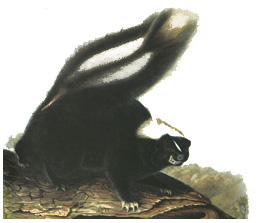 He constantly thought to himself, "Perhaps there was only one load." He thought that he would try it again there. (509) He thought he would shoot a big tree that stood there. Again he began to turn his buttocks towards it and broke wind. He knocked the tree over. He blew over the entire butt end of the tree. "Korá, he did say something of the truth, that little bastard," he said, (510) and again he went on. Again, as he went on, he was bothered by it. "Perhaps there were only two rounds," he was continually thinking. "Hąhó, what am I doing? (511) Even now, I'll try it," he thought. There sat a large stone. He would shoot it, he thought. So now he began to turn his buttocks towards it and broke wind. He obliterated the stone. (512) "Korá, that little bastard apparently told the truth," he said. Again he went on. "However, he did not give me the full amount. (513) Inasmuch as he is such a peculiar guy, hoją́, he did a lot in giving me three rounds," he said. "Hihó, what am I saying? Even now, I will find out," he said. (514) There stood the point of a hill. It was a rocky point. That's what he will shoot, he thought. He made the rocky point disappear. (515) "Hohó, my little brother may have told the truth after all, but I thought there was something wrong with him," he said, and he went on.
Right away in the morning, Little Skunk arrived. (516) "Hohó my little brother, it seems impossible to travel, but he is about," he said. They were very delighted, as were the children. "It's your uncle," they told them. (517) When their uncle is the one who goes there, and they are told of it, he usually obtains food for them. It is because they learned this, that the children were overjoyed. (518) Then the woman said, "Old man, will my brother-in-law eat?" she said. "Aren't there any acorns left?" he said. These few acorns which they used to boil were left. "Some of it is here, (519) but it may be that he does not eat that sort of thing," she said. "Give it here. Niží, the reason why I'm saying this is that I think that I want to try something," he said, so she gave it to him. (520) He left the door open and scattered the acorns there. Then he sat there under cover. He sat with his buttocks facing the door. Then he said, "Deer, come and eat," he said. (521) "Hąhó, Trickster has said something," they said, and many deer came running. Even now they were also coming to the lodge, (522) but there was nothing there. Finally, the deer saw him. Unexpectedly, there was his butt, and he held his rectum towards them. As he tried to blow out all his gas, Trickster strained mightily. (523) He tried hard, but all he did was to soil himself. How could he help it? There they all left him. They stepped on him and also bruised him up. (524) He was covered in blood, and had also soiled himself, and Little Skunk said, "My sister-in-law, are there no more acorns left?" he said. (525) "There are a few here," she said. "Given them here," he said. After she handed them to him, he placed the door open. Then he scattered the acorns there. Then he said, "Deer, come and eat!" he said shouting. (526) And a great many deer came. There among the thickest, he broke wind, and in its path there lay many dead deer. (527) Despite their numbers, only a few escaped. Thus he did there, and went home.
Trickster said, "Old woman, thus they do, and they have plenty of deer," he said. (528) There they skinned a lot of deer. And they also did barbecuing, and roasting on sticks, and deer boiling and they did a great deal. They poured deer fat into a hole in the ground (to freeze it), and they did a lot of that. (529) From the bones they also made bone soup. They also tanned the deer hides, and they singed the deer hooves as well. (530) It was done, and they also placed packs of meat here and there. They also got a lot of fresh lard. (531) And from the omentum of the deer, they also made deer sausages.1
Commentary. All the stories in this group have a clear isomorphism which is too obvious to detail.
"waik" — in the syllabic text, the word wok is written above the syllabic wyK. This latter spelling unambiguously yields waik rather than wok. The word wok means "awl." The translation has a parenthetical, "sharp instrument," but the context of subsequent actions make it clear that it is an awl or ice pick. We should probably conclude that waik is another form of the word wok.
"arrowleaf" — Radin has "lilies of the lake," a picturesque term for pond lilies. However, all other sources agree that it is the arrowleaf (Sagittaria latifolia), whose tubers were eaten, not only by humans, but by muskrats.2
 |
|
| Muskrat | |
| D. Gordon E. Robertson |
"ice" — during the winter, muskrats will feed under the ice. They occasionally bring back a few underwater tubers to their lodge. To the naive, it may seem as if the muskrat had magically converted ice into food.
"my uncle [says that] you must go over in the morning" — the Hocąk is, nukisiga haihainigiži, hijarahikje [eną]. Virtually none of these words can be found in the master wordlist, which suggests that they represent children's speech.
"Kingfisher" — the Hocąk is Cošerekega. Radin had erroneously translated this as "Snipe," but the word for this latter bird is cuék or cwék. All other sources agree that cošereke denotes the kingfisher. The first syllable co denotes its color, blue; -ke is a suffix indicating "kind." The šere, šerek is obscure.
"for that very reason" — this word, žežesgege, from the stem žesge, represents an emphatic reduplicated front formation (že-že) and an emphatic reduplicated back formation (ge-ge).
"Woodpecker" — in Hocąk, his name is Gąkeka (< Gąkek-ka). Elsewhere, gąkek refers to a kind of hawk, as the word means "the twisting one," in reference to the hawk's twisting flight pattern. Yet, clearly, the subsequent actions of Gąkeka show that he is a woodpecker. Therefore, the raconteur chose the wrong word for the bird that he had in mind.
"when their uncle is the one who goes there" — this line has an alliteration worthy of "Beowulf," both in initial syllables (hi-) and terminal vowels (-a): Hižą hija higa, hinųgás hireže.
"they are told of it, he usually obtains food for them" — the next clause alliterates in initial /wa-/ and continuing the ending of the previous clause in /-a/ — wawigairega, warúc wahijera.
Comparative Material. The closely related Ioway have a story much like this which they tell about their trickster Ictinike. 'Ictinike shortly after took his leave of the Beavers, and pretended to forget his tobacco-pouch, which he left behind. The Beaver told one of his young ones to run after him with the pouch, but, being aware of Ictinike's treacherous character, he advised his offspring to throw it to the god when at some distance away. The young beaver accordingly took the pouch and hurried after Ictinike, and obeying his father's instruction, was about to throw it to him from a considerable distance when Ictinike called to him: 'Come closer, come closer.' The young beaver obeyed, and as Ictinike took the pouch from him he said: 'Tell your father that he must visit me.' When the young beaver arrived home he acquainted his father with what had passed, and the Beaver showed signs of great annoyance. 'I knew he would say that,' he growled, 'and that is why I did not want you to go near him.' But the Beaver could not refuse the invitation, and in due course returned the visit. Ictinike, wishing to pay him a compliment, was about to kill one of his own children wherewith to regale the Beaver, and was slapping it to make it cry in order that he might work himself into a passion sufficiently murderous to enable him to take its life, when the Beaver spoke to him sharply and told him that such a sacrifice was unnecessary. Going down to the stream hard by, the Beaver found a young beaver by the water, which was brought up to the lodge, killed and cooked, and duly eaten. On another occasion Ictinike announced to his wife his intention of calling upon her grandfather the Musk-rat. At the Musk-rat's lodge he met with the same tale of starvation as at the home of the Beaver, but the Musk-rat told his wife to fetch some water, put it in the kettle, and hung the kettle over the fire. When the water was boiling the Musk-rat upset the kettle, which was found to be full of wild rice, upon which Ictinike feasted. As before, he left his tobacco-pouch with his host, and the Musk-rat sent one of his children after him with the article. An invitation for the Musk-rat to visit him resulted, and the call was duly paid. Ictinike, wishing to display his magical powers, requested his wife to hang a kettle of water over the fire, but, to his chagrin, when the water was boiled and the kettle upset instead of wild rice only water poured out. Thereupon the Musk-rat had the kettle refilled, and produced an abundance of rice, much to Ictinike's annoyance. Ictinike then called upon his wife's grandfather the Kingfisher, who, to provide him with food, dived into the river and brought up fish. Ictinike extended a similar invitation to him, and the visit was duly paid. Desiring to be even with his late host, the god dived into the river in search of fish. He soon found himself in difficulties, however, and if it had not been for the Kingfisher he would most assuredly have been drowned. Lastly, Ictinike went to visit his wife's grandfather the Flying Squirrel. The Squirrel climbed to the top of his lodge and brought down a quantity of excellent black walnuts, which Ictinike ate. When he departed from the Squirrel's house he purposely left one of his gloves, which a small squirrel brought after him, and he sent an invitation by this messenger for the Squirrel to visit him in turn. Wishing to show his cleverness, Ictinike scrambled to the top of his lodge, but instead of finding any black walnuts there he fell and severely injured himself. Thus his presumption was punished for the fourth time."3
The Fox have a story that is fairly close to the Hocąk skunk episode. As he was traveling along, Skunk met Wasa'ka (the trickster). The two of them engaged in a shooting contest in which Skunk used his odiferous spray to hit his target. In order not to offend Skunk, Wasa'ka complimented him on his marksmanship. Skunk was flattered and gave Wasa'ka found rounds of his special ammunition. When Wasa'ka returned home, his grandmother told him to get out of the lodge and get rid of his smelly "ammunition," but Wasa'ka was not going to throw them away without at least trying them out. He shot at a tree and other object and by the time he fired the fourth and last round, the whole countryside stunk. However, when he fired this lost shot in vain, the power that Skunk had to shoot things at a long distance suddenly vanished. That is why today skunks can only hit things at close range.4
The theme of the bungling host is also found in the corresponding tale of the Ponca trickster cycle. Radin mentions this story in summary: "Ictinike visits beaver, muskrat, kingfisher and flying squirrel and tries to reciprocate their hospitality, but is unsuccessful."5
Two variants of a story from the Osage match the skunk episode. Wolf persuades Skunk to give him some of his ammunition. To make sure it works, Wolf tried it on a hickory tree, and sure enough it knocked down the tree. Then he tried it on a grape vine, and was able to eat the grapes. He then tried it on an elk, but by then had run out of ammunition. When the elk saw Wolf turned towards him, he said, "There's my friend Red Rump." Wolf replied, "I'm just cooling my rump."6 In the second variant, Wolf gets four rounds from Skunk. He tries two rounds out on a tree and a rock. Then he found a turkey, which he killed and ate. Then he decided now was the time to pursue big game, so he tried to shoot a buffalo, but missed. Now he was out of ammo, so when he tried it on an elk, the elk merely said, "There's my friend Red Rump." Wolf replied, "I'm just cooling my rump."7
The skunk episode has an Assiniboine parallel described briefly by Radin: "Sitcóⁿski borrows some of Skunk's power, but wastes it splitting a tree stump." What follows in the Assiniboine tale seems to have no relationship to the Hocąk story.8
The Arapaho have a story of almost the same structure, but with different incidents. Nih’āⁿçaⁿ visits a man and his wife who give him food. The man makes the meat from bark. To make tallow the man split his wife's head open and used her brain. This had no ill effect upon her [as the heart is the seat of intellect]. Nih’āⁿçaⁿ invites the man over to his place and tries to perform the same feat, but ends up killing his wife. The man brings the unfortunate victim alive again, and correctly performs the feat on her with beneficent results.9
The Kickapoo version also has different incidents that develop the same overall theme. First Wiza'ka'a visits Beaver, who kills one of his own children so that they can eat. When they are done, the bones of the little beaver are thrown into the water, and immediately the beaver comes back to life. When Beaver returns the visit to Wiza'ka'a, the latter attempts the same with one of his children, but predictably the child does not come back to life, leaving Beaver to perform the resurrection for him. Then Wiza'ka'a visits Kingfisher. Kingfisher dove from a high tree overlooking the water and speared a fish, which they had for their meal. When Kingfisher came to visit Wiza'ka'a, he found that Wiza'ka'a and his whole family had attached sticks to their noses. Wiza'ka'a invited Kingfisher to sit down while he went out and did some fishing. Wiza'ka'a climbed a crooked tree, but when he attempted to dive into the water, he hit a branch instead and was knocked senseless. In the end, Kingfisher had to do the fishing before they could eat.10
The Tlingits of the Pacific Northwest, tell a story in which "Raven came to the bear, and the latter fed him on some of his own flesh, a proceeding which Raven tried to imitate in vain a little later."11 The Tlingit tale recalls the episodes in which the special power of an animal permits him to get food in a magical way, but when someone else imitates him, nothing goes as planned.
The Chinook tribe of the same region tell a similar story. "[A tale] tells how Blue Jay and Ioi went to visit their friends. The Magpie was the first to receive the visitors, and by means of magic he provided food for them. Putting a salmon egg into a kettle of boiling water, he placed the kettle on the fire, and immediately it was full of salmon eggs, so that when they had eaten enough Blue Jay and Ioi were able to carry a number away. On the following day the Magpie called for the kettle they had borrowed. Blue Jay tried to entertain his visitor in the same magical fashion as the latter had entertained him. But his attempt was so ludicrous that the Magpie could not help laughing at him. The pair's next visit was to the Duck, who obtained food for them by making her children dive for trout. Again there was twice as much as they could eat, and Blue Jay and Ioi carried away the remainder on a mat. During the return visit of the Duck, Blue Jay tried to emulate this feat also, using Ioi's children instead of the ducklings. His attempt was again unsuccessful. The two visited in turn the Black Bear, the Beaver, and the Seal, all of whom similarly supplied refreshment for them in a magical manner. But Blue Jay's attempts at imitating these creatures were futile. A visit to the Shadows concluded the round, and the adventurers returned home."12
The Cherokee have an abbreviated version of the story. When Rabbit visited bear to eat with him, Bear discovered that he had no cooking oil, so he took a knife and punched a hole in his side, and all kinds of oil came out. They had a fine meal, so Rabbit invited Bear over to his place. Rabbit wanted to impress Bear with his own ability to provide oil, so he took a knife and stuck it into his own side. Nothing came out but blood. Bear had to explain the obvious — he had the fat under his skin to do that, but Rabbit did not.13
The Cree tale of Monster Skunk has some affinities to our skunk episode. Monster Skunk was of giant proportions and used to go about the world breaking wind at his fellow creatures with such force that he slew scores at a time. Finally, one day Wildcat and Coyote got together and decided to ambush him. After many depredations, Monster Skunk came upon the pair. They attacked him, but weren't getting anywhere until Coyote stuffed a boulder into Monster Skunk's anus. This cause so much bloating in the giant that he disintegrated in a massive fart-explosion.14The Abenaki have an exact parallel to the woodpecker episode. Ableegumooch, Hare, was too lazy to get his food the ordinary way. One day he saw some female woodpeckers fill a whole plate with food just knocking their beaks against a tree. They invited Hare to the feast, and he judged the food to be delicious. Hare thought that this would be an easy way to get a meal. So he invited the woodpeckers to his own lodge for dinner. That day he told his grandmother Noogumee to get ready to prepare a meal, but she replied, "You foolish rabbit, there's nothing to eat." Nevertheless, he insisted that she start the water boiling while he went out to get the food. Hare strapped a stone point from an eel spear to his face and climbed a tree. He knocked his head against it over and over again until finally he bloodied his face, loss his balance, and crashed to the earth. The woodpeckers all laughed, as his grandmother told them that they might as well go home as there would be no dinner tonight.15
The Micmac also have a woodpecker episode. Once Hare visited Woodpecker. They were going to eat but had no food to cook, so Woodpecker went out and pecked on a nearby tree and came back with an abundance of food. When Woodpecker visited Hare, the rabbit had to go get some food himself before they could feast. Hare tried the same thing, but it did nothing but flatten and split his nose. Indeed, to this day, all rabbits have a flat, split nose. Woodpecker had to return home without a meal.16
Links: Trickster, Bird Spirits, The Sons of Earthmaker, Skunks.
Links within the Trickster Cycle:§19. The Scenting Contest, §21. Mink Soils the Princess.
Stories: featuring Trickster as a character: The Trickster Cycle, Trickster Gets Pregnant, Trickster's Warpath, Trickster's Anus Guards the Ducks, Lake Winnebago Origin Myth, The Mission of the Five Sons of Earthmaker, Baldheaded Warclub Origin Myth, Trickster Soils the Princess, Trickster, the Wolf, the Turtle, and the Meadow Lark, Soft Shelled Turtle Gets Married, The Medicine Rite Foundation Myth, Trickster Concludes His Mission, The Abduction and Rescue of Trickster, The Elk's Skull, Trickster and the Plums, Trickster and the Mothers, The Markings on the Moon, The Spirit of Gambling, The Woman who Became an Ant, The Green Man, The Red Man, Trickster Takes Little Fox for a Ride, Trickster Loses His Meal, Trickster's Tail, A Mink Tricks Trickster, Trickster's Penis, Trickster Loses Most of His Penis, The Scenting Contest, Mink Soils the Princess, Trickster and the Children, Trickster and the Eagle, Trickster and the Geese, Trickster and the Dancers, Trickster and the Honey, Trickster's Adventures in the Ocean, The Pointing Man, Trickster's Buffalo Hunt, Trickster Eats the Laxative Bulb, Trickster Visits His Family, The Coughing Up of the Black Hawks, The Petition to Earthmaker, Waruǧábᵉra, Hare Secures the Creation Lodge;.in which skunks are characters: The Skunk Origin Myth, Trickster and the Mothers, Hare Recruits Game Animals for Humans, The Boy and the Jack Rabbit; mentioning woodpeckers: Holy One and His Brother; about Bird Spirits: Crane and His Brothers, The King Bird, Bird Origin Myth, Bird Clan Origin Myth, Wears White Feather on His Head, Old Man and Wears White Feather, The Boy who was Captured by the Bad Thunderbirds, The Thunderbird, Owl Goes Hunting, The Boy Who Became a Robin, Partridge's Older Brother, The Woman who Loved Her Half-Brother, The Foolish Hunter, Ocean Duck, Earthmaker Sends Rušewe to the Twins, The Quail Hunter, Baldheaded Warclub Origin Myth, The Hocąk Arrival Myth, Trickster Gets Pregnant, Trickster and the Geese, Holy One and His Brother (kaǧi, woodpeckers, hawks), Porcupine and His Brothers (Ocean Sucker), Turtle's Warparty (Thunderbirds, eagles, kaǧi, pelicans, sparrows), Kaǧiga and Lone Man (kaǧi), The Old Man and the Giants (kaǧi, bluebirds), The Red Feather, Trickster, the Wolf, the Turtle, and the Meadow Lark, Waruǧábᵉra, The Race for the Chief's Daughter, Black and White Moons, The Markings on the Moon, The Creation Council, Eats the Stinking Part of the Deer Ankle, Earthmaker Blesses Wagíšega (Wešgíšega), The Man Who Would Dream of Mą’ųna (chicken hawk), Hare Acquires His Arrows, Keramaniš’aka's Blessing (black hawk, owl), Heną́ga and Star Girl (black hawk), The Stench-Earth Medicine Origin Myth (black hawk, kaǧi), Worúxega (eagle), The Arrows of the Medicine Rite Men (eagle), The Gift of Shooting (eagle), Hocąk Clans Origin Myth, Hawk Clan Origin Myth, The Hocąk Migration Myth, Blue Jay, The Baldness of the Buzzard, The Abduction and Rescue of Trickster (buzzards), The Shaggy Man (kaǧi), The Healing Blessing (kaǧi), The Medicine Rite Foundation Myth (kaǧi), Spear Shaft and Lacrosse, Įcorúšika and His Brothers (Loon), Great Walker's Medicine (loon), Roaster (woodsplitter), The Spirit of Gambling, The Big Stone (a partridge), Trickster's Anus Guards the Ducks, The Story of the Medicine Rite (loons, cranes, turkeys), The Fleetfooted Man, The Journey to Spiritland (v. 4) — see also Thunderbirds; about flatulence: Why Dogs Sniff One Another, Trickster Eats the Laxative Bulb, Trickster's Anus Guards the Ducks.
Themes: starvation: The Brown Squirrel, White Wolf, The Red Man, The Old Man and His Four Dogs, A Man and His Three Dogs, Sun and the Big Eater, Bird Clan Origin Myth, Kaǧiga and Lone Man, The Shaggy Man, The Twins Retrieve Red Star's Head, Jarrot and His Friends Saved from Starvation; someone uses flatulence as a weapon or deterrent against animals: Trickster's Anus Guards the Ducks; someone's rectum is prepared for a very special function: Trickster's Tail; someone flatulates with superhuman force: Trickster Eats the Laxative Bulb; being swallowed whole: The Hill that Devoured Men and Animals, Hare Gets Swallowed, The Great Fish, The Waterspirit of Rock River, The Baldheaded Warclub Origin Myth, The Dipper; a woodpecker uses an awl for a bill: Holy One and His Brother; someone strikes a post or pillar with a sharp instrument and a game animal falls out dead: Little Children Spirits, The Twins Retrieve Red Star's Head.
Notes
1 Paul Radin, The Trickster: A Study in American Indian Mythology (New York: Schocken Books, 1956) 41-49. The original text is found in "Wakdjukaga," in Paul Radin, Winnebago Notebooks, Freeman #3897 (Philadelphia: American Philosophical Society, ca. 1912) Winnebago V, #7: 413-531.
2 H. Randolph Perry, Jr., "Muskrats," in Wild Mammals of North America: Biology, Management, and Economics. ed. Joseph A. Chapman and George A. Feldhamer (Baltimore: The Johns Hopkins University Press, 1982) 282-325 [297-298 Table 15.4].
3 Lewis Spence, Myths of the North American Indians (London: George G. Harrap & Company, 1916) 269-271.
4 William Jones, Ethnography of the Fox Indians, Smithsonian Institution, Bureau of American Ethnology, Bulletin 125 (Washington: United States Government Printing Office, 1939) 32-33.
5 Radin, The Trickster, 129, #13; the Ponca trickster cycle is found in James Owen Dorsey, ¢egiha Texts, in Contributions to North American Ethnology (Washington, D. C.: 1890) vol. 6.
6 "6. The Skunk and the Wolf," in George A. Dorsey, "Traditions of the Osage," Field Columbian Musem, Anthropological Series, 7, #1 (Feb., 1904): 12.
7 "7. The Skunk and the Wolf," in George A. Dorsey, "Traditions of the Osage," Field Columbian Musem, Anthropological Series, 7, #1 (Feb., 1904): 12.
8 Radin, The Trickster, 191, #43. These tales are collected in Robert H. Lowie, The Assiniboine, in The Anthropological Papers of the American Museum of Natural History (New York: American Museum of Natural History, 1909) 4:239-244.
9 Adopted, "Nih’āⁿçaⁿ Imitates His Host," in George A. Dorsey and Alfred L. Kroeber, Traditions of the Arapaho (Lincoln: University of Nebraska Press, 1997 [1903]) Story 60: 118-120.
10 Kickapoo Tales, collected by William Jones, trs. by Truman Michelson. Publications of the American Ethnological Society (Leiden: E. J. Brill, 1915) IX:7-9.
11 Radin, The Trickster, 104. Tlingit trickster tales are collected in J. R. Swanton, Tlingit Myths and Texts, Bureau of American Ethnology (Washington, D. C.: Bureau of American Ethnology, 1909) Bulletin 39, 416-419.
12 Spence, Myths of the North American Indians, 326-327.
13 "The Rabbit Dines the Bear," in James Mooney, History, Myths, and Sacred Formulas of the Cherokees (Asheville, North Carolina: Bright Mountain Books, 1992 [1891/1900]) Story 19: 273-274.
14 Richard Erdoes and Alfonso Ortiz (edd.), American Indian Trickster Tales (New York: Penguin-Putnam, Inc., 1998) 83-85.
15 Glenn Welker, "Ableegumooch, the Lazy Rabbit," in "Stories," at the Indigenous Peoples Literature Website.
16 Glenn Welker, "Ableegumooch, the Lazy Rabbit," in "Stories," at the Indigenous Peoples Literature Website.