Flint
by Richard L. Dieterle
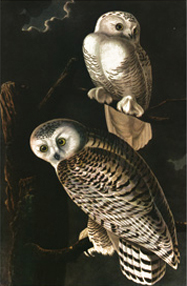
There are a number of spirits who are said to be made of flint, and it is probably true that they are not all identical. One of these, who has no name, is described more than once as an owl.
Where he is the protagonist he is simply called "Grandfather." He is the grandfather of the Forked Man as well as of Wears White Feather on His Head. He possessed a sword which had the virtue of cutting in two anything that crossed in front of it. Unfortunately, his youngest grandson ran out in front of it and was cut in two lengthwise. He gave his remaining grandsons a baldheaded warclub which had teeth. When his grandsons were captured, they used it to eat up their enemies. After this incident, Grandfather had a prophetic nightmare, and when he awoke, he told his grandsons that they must all flee to an island in the Ocean Sea, otherwise they would be overcome by their enemies. They came to the shore across from a green island, but no one would ferry them across, so they took out a magical hook and the hook automatically homed in on a boat and pulled it back to the shore. By this means they were able to gain the island. There Grandfather met his older brother. One day a giant man whose body was painted completely red appeared standing in the Ocean. He was about to inundate the island. So Grandfather had them use the hook, which wended its way out to the giant red man and hooked him. Gradually, it dragged him back to the island, where they killed him and then ate his head. Grandfather was a Hįja Owl, and his family were the Carucge, "Head Eaters."1
In almost all his myths, however, he is the chief antagonist. The same grandfather whose grandson is a forked man occurs again in the tale, The Chief of the Heroka. The sister of Grandfather married Heroka, who is one and the same as Redhorn. He was such a great hunter that she was overwhealmed with work, so she undertook to ruin his traps. On the verge of starvation, he killed her. As a consequence, Grandfather, after loosing some of his own brothers in the fight, eventually killed Redhorn and took his head. This he put in the fireplace of his lodge and let it roast, while the body of Redhorn wandered about. One day his grandson, the Forked Man, came home with a wife, but unbeknownst to Grandfather, this wife was the granddaughter of Redhorn. One day she was stoking the fire as Grandfather had instructed her, when she saw a weeping face in the flames. She fished it out and when the Forked Man returned, she produced the head which then told him all that had transpired. They made a sweat bath and were able to reattach the head to the body and revived Redhorn. Then Redhorn in retaliation turned Grandfather into an owl.2
|
In another version of the same story, The Red Man, he is again identified as the grandfather of the Forked Man. Here Redhorn is called "the Red Man." After Grandfather kills him, he take his head a places it in the fireplace of his lodge. Later he captures Red Man's son, and urges him to stoke the fire. The son's wife discovers the weeping head in the fire, but Grandfather persuades her and his stepson that it is the man-in-the-fire, who is weeping because the flames have not been made intense enough. While the son is out, he encounters Hare and Trickster. They confronted Grandfather, who said that the man in the fire would be made to suffer for his crime. But Hare declared that the victim was one of the Great Ones, and that he must therefore desist or he would die. However, Grandfather scoffed at him, and as a consequence, Hare struck him, and as he did, pieces of flint flew everywhere, as he was covered in them. Finally, Hare struck his core, which was made of steel. Then he fell over dead. This shows that the steel man covered in flint is also an owl, which makes it obvious that the "flint" being referred to is the arrowhead-like markings so frequently found on owls and other birds of prey. As in the other story, the Red Man is revived by a sweat bath.3 This shows that the Red Man is one and the same as Herokaga (Redhorn).
In the story "The Baldheaded Warclub," an expedition led by Heroka, also called "Redhorn," goes to an island in the Ocean Sea. There they find a number of evil spirits who had been created by Herešgúnina. One of the chiefs has a body made of steel. He also has as an aid, a longed billed bird that skewered anything that attacked from below. This is rather like Wears White Feather, but portrayed in an antagonistic light. In the climax of the battle, the steel man and his fellow leaders make an attack on Herokaga as he stands on the shore, but Herokaga shoots them down, killing them.4 Like the "Red Man," this story ends with the man of steel being killed, but like the "Chief of the Heroka," the killer is Herokaga himself.
Another version of this episode is found in the "Adventures of Redhorn's Sons." The sons of Redhorn go after two iron spirits who live on the other side of the Ocean Sea beyond the edge of the sky. They went after them because they were plotting to attack Redhorn. They were able to capture them both, and when they got back, they made them "play with fire" until they turned red hot and died.5 One of these iron spirits may have been Grandfather (Flint).
Who is the man of flint? His sons and grandsons are the forked men, who marry into the Heroka. The Heroka are arrow spirits, and it seems reasonable that the forked men are bows. This would leave the obvious role for the man of flint as the arrowhead. This hypothesis dovetails nicely with a story from the Hare Cycle. Hare enlarged himself and went to his grandfather's place to get arrowheads. When he saw Hare coming, grandfather Flint became fearful and offered Hare an arrowhead from his wrist and another from his ankle. However, this were the least valuable ones that he had, so Hare, reprising his role in Red Man, proceeded to club him to death, scattering flint all over the face of the earth.6 This story leaves little doubt as to the identity of Flint as the spirit of the arrowhead.
Genealogy of Flint

Links: Wears Sparrows for a Coat, The Forked Man, Redhorn, Redman, Heroka, Owls, Iron Spirits, Rock Spirits, Sons of Redhorn, Hare, Trickster, Herešgúnina, The Redhorn Panel of Picture Cave. An American Star Map.
Stories: about Flint: Hare Kills Flint, Wears White Feathers on His Head, The Red Man, Chief of the Heroka, Baldheaded Warclub Origin Myth, The Adventures of Redhorn's Sons; about Wears White Feather (Wears Sparrows for a Coat): Wears White Feathers on His Head, Old Man and Wears White Feather; in which the Forked Man is a character: The Red Man, Chief of the Heroka, The Spirit of Gambling, Wears White Feathers on His Head; featuring the Heroka as characters: The Chief of the Heroka, The Red Man, The Oak Tree and the Man Who was Blessed by the Heroka, The Baldheaded Warclub Origin Myth, Little Human Head, Morning Star and His Friend, The Claw Shooter, Redhorn's Sons, The Origins of the Milky Way; mentioning Redhorn: The Redhorn Cycle, Redhorn's Sons, Įcorúšika and His Brothers, The Mission of the Five Sons of Earthmaker, Redhorn's Father, Baldheaded Warclub Origin Myth, The Twins Join Redhorn's Warparty, The Medicine Rite Foundation Myth, Morning Star and His Friend, The Spirit of Gambling, The Green Man, The Hocągara Contest the Giants, cp. The Cosmic Ages of the Hocągara, Heroka, Redman; in which owls are mentioned: Owl Goes Hunting, Crane and His Brothers, The Spirit of Gambling, He Who Eats the Stinking Part of the Deer Ankle, The Chief of the Heroka, Partridge's Older Brother, Waruǧábᵉra, Wears White Feather on His Head, Keramaniš’aka's Blessing, Old Man and Wears White Feather, The Annihilation of the Hocągara I, The Green Man; featuring Iron Spirits as characters: The Adventures of Redhorn's Sons, How the Thunders Met the Nights, Šųgepaga, The Raccoon Coat, Baldheaded Warclub Origin Myth, cf. Iron Staff and His Companions; featuring the sons of Redhorn as characters: The Redhorn Cycle, The Adventures of Redhorn's Sons, The Sons of Redhorn Find Their Father, The Seduction of Redhorn's Son, Redhorn's Father.
Themes: head hunting: White Fisher, Big Thunder Teaches Cap’ósgaga the Warpath, A Man's Revenge, How Little Priest went out as a Soldier, Little Priest's Game, Bluehorn's Nephews, The Twins Retrieve Red Star's Head, The Boy who was Blessed by a Mountain Lion, Young Man Gambles Often, Morning Star and His Friend (v. 2), The Dipper, The Four Slumbers Origin Myth, Porcupine and His Brothers, Turtle's Warparty, Ocean Duck, The Markings on the Moon, Wears White Feather on His Head, The Red Man, The Chief of the Heroka, Thunderbird and White Horse, The Man with Two Heads, Brave Man, The Sons of Redhorn Find Their Father, Redhorn's Sons, Fighting Retreat, The Children of the Sun, Heną́ga and Star Girl, Mijistéga’s Powwow Magic and How He Won the Trader's Store, The Were-Grizzly, Winneconnee Origin Myth; a spirit is of a red color: Wears White Feather on His Head, The Red Man, The Chief of the Heroka, The Man who was Blessed by the Sun; men whose bodies are (partly) covered with pieces of flint: Bluehorn's Nephews, Hare Kills Flint, Hare Gets Swallowed, The Children of the Sun, The Twins Retrieve Red Star's Head, The Red Man, The Chief of the Heroka; as a punishment, a spirit decrees that someone be transformed into an animal: The Skunk Origin Myth (skunk), The Brown Squirrel (squirrel), How the Hills and Valleys were Formed (v. 3) (worm), Old Man and Wears White Feather (owl), Brass and Red Bear Boy (grizzly), Waruǧábᵉra (owl), The Chief of the Heroka (owl), Hare Kills a Man with a Cane (ant); an evil spirit is turned into an owl: Old Man and Wears White Feather, Waruǧábᵉra, The Chief of the Heroka; a severed head (in a fireplace) is not dead: The Chief of the Heroka, The Red Man, The Children of the Sun; a severed head speaks: The Human Head, The Red Man, The Chief of the Heroka, The Twins Retrieve Red Star's Head; the reviving sweat bath: The Shaggy Man, The King Bird, The Red Man, The Chief of the Heroka, The Dipper, Snowshoe Strings, The Old Man and the Giants; a man reunites the still living head and body of his relative: The Red Man, The Twins Retrieve Red Star's Head, The Man with Two Heads, The Children of the Sun, The Chief of the Heroka; an evil spirit is smashed to pieces by a club: The Red Man, Waruǧábᵉra, Hare Kills Flint, Hare Kills a Man with a Cane, The Big Stone; anthropophagy and cannibalism: A Giant Visits His Daughter, Turtle and the Giant, The Witch Men's Desert, The Were-Grizzly, Grandfather's Two Families, The Roaster, Redhorn's Father, Hawk Clan Origin Myth, The Lost Blanket, Young Man Gambles Often, White Wolf, The Shaggy Man, The Twins Get into Hot Water, Partridge's Older Brother, The First Fox and Sauk War, The Fox-Hocąk War, The Hocągara Contest the Giants, Morning Star and His Friend, Baldheaded Warclub Origin Myth, The Seven Maidens, Šųgepaga, The Reincarnated Grizzly Bear, The Woman who Loved Her Half-Brother, The Blessing of a Bear Clansman, Shakes the Earth, The Stone Heart, Thunder Cloud is Blessed; a warparty attacks evil spirits whose bodies are made of iron: Baldheaded Warclub Origin Myth, The Adventures of Redhorn's Sons, Šųgepaga.
Notes:
1 Paul Radin, "Wears White Feather on His Head," Winnebago Notebooks (Philadelphia: American Philosophical Society) #4: 1-50.
2 Paul Radin, "The Chief of the Heroka," Winnebago Notebooks (Philadelphia: American Philosophical Society) Notebook #33: 1-66.
3 Paul Radin, "The Red Man," Winnebago Notebooks (Philadelphia: American Philosophical Society) #6: 1-72.
4 Paul Radin, "A Wakjonkaga Myth," Winnebago Notebooks (Philadelphia: American Philosophical Society) Notebook #37: 1-70. Informant: John Rave (Bear Clan).
5 Paul Radin, Winnebago Hero Cycles: A Study in Aboriginal Literature (Baltimore: Waverly Press, 1948) 132-134.
6 Paul Radin, Winnebago Hero Cycles: A Study in Aboriginal Literature (Baltimore: Waverly Press, 1948) 93-98.