Three Deer
by Richard L. Dieterle
The fundamental puzzle raised by Hall is how a name like "Three Deer," which is a calendar name in Central Mexico (< 3-Mazatl), could come to be applied to stars in Orion among more than one Siouan tribe. At Cacaxtla, "Three Deer" is the calendar name of an Olmec-Xicalanca god. The calendar name originated along with 4-Motion and 5-Flower in the 1-Cipactli Calendrical System found in Year I of the Toltec count beginning in +726. The Olmec-Xicalanca deity Three Deer derived his name from the date of the Vernal Equinox. The Olmec-Xicalanca god was a precursor to the Maya God M, generally agreed to have arisen from a Central Mexican merchant god of the Yacatecuhtli type. All of these gods find a prototype in the Maya God L, who had a seat in Orion among the Hearthstones. In addition, God L was the ruler of the underworld and therefore of the spirits of the departed. Also having a placement in Orion, specifically in the Cingulum, is Yohualtecuhtli and his associate, Yacahuitztli. In Year I of the Toltecs, Yohualtecuhtli in the Cingulum, can be associated with the day 7-Water. The first 7-Water day fell on the Autumnal Equinox, and aligns with Yohualtecuhtli as the Night Sun. Yacahuitztli is probably a version of Yacatecuhtli, and therefore a form of Three Deer, the (merchant) god of the opposite equinox. The Toltec tribal god Mixcoatl-Camaxtli is said to be guardian of one of the Hearthstones. The Cingulum in Central Mexico was connected with the transit of souls being born on earth, and Mixcoatl was the stellar deity of the souls of departed warriors, making Orion the site of spiritual transit. The Hand constellation of the boreal tribes, which included the Cingulum of Orion, had the same status as a portal of souls. The identical concept seems to have been pervasive in the earlier Mississippian cultures. The origin of this hand is told in a widespread Twins myth whose oldest prototype is found among the Maya. The Maya equivalent to the day sign Mazatl is Manik, which the Maya do not represent as a deer, but as a hand. The occurrence of a star with the calendrical name "Three Deer" in a constellation whose origin myth is that of a detached hand, mirrors this alternance. ... Transmission by means other than emigration is discussed.
Table of Contents
§1. Three Deer in Mexico and the Far North
§2. The Identity of Three Deer
§3. Mamalhuaztli and the Gods of the Cingulum
§4. Seven Water
§5. The Suns of Tula
§6. The Stars of the Wrist and Hand
§7. The Hearthstones
§8. The Portal of Souls
§9. Redhorn, Orion, and the Long Nosed God
§10. Transmission
§1. Three Deer in Mexico and the Far North. Many cultures see the three stars of the belt of Orion as three animals,1 and more than one culture sees them as a group of three deer.2 Judging from the name "Three Deer" given to the Belt Stars,3 it appears that the Osage have the same view, but upon closer inspection the matter is found to be more involved. Robert Hall explains why —
The Osage see the nebula in the sword as female and the three stars of the belt as a male named Three Deer. While it is common for the three stars of the belt to be seen as three deer (plural) or other beings (e.g., Tres Marías), seeing the three stars as a single person named Three Deer looks Mesoamerican. At least, Three Deer is a calendar-based name in Mesoamerica ...4
The calendar upon which the name Three Deer appears to be based is the Aztec 260 day Tonalpohualli calendar, which because of its length is radically out of sync with the solar calendar of 365 days. Consequently, this calendar is purely ritual. In the Tonalpohualli calendar there are 20 day-signs which are paired with 13 numerals, each of which represents a day in a "week" or trecena (as it is now called). The 20 day signs are, in order, (1) Cipactli (Caiman), (2) Ehecatl (Wind), (3) Calli (House), (4) Cuetzpalin (Lizard), (5) Coatl (Serpent), (6) Miquiztli (Death), (7) Mazatl (Deer), (8) Tochtli (Rabbit), (9) Atl (Water), (10) Itzcuintli (Dog), (11) Ozomahtli (Monkey), (12) Malinalli (Grass), (13) Acatl (Reed), (14) Ocelotl (Jaguar), (15) Cuauhtli (Eagle), (16) Cozcacuauhtli (Buzzard), (17) Ollin (Movement), (18) Tecpatl (Flint Knife), (19) Quiahuitl (Rain), (20) Xochitl (Flower).5 There are 20 trecenas of 13 days each in a 260 day Tonalpohualli year, one for each day-sign. If the year were to begin on 1-Caiman, then there will be 13 days carrying the name Mazatl, one of which will be Yei Mazatl, 3-Deer. If it is true that the Belt Stars of Orion had been given a calendar name, it would be the name of that day.
How could a day name be given to stars? Day names were routinely given to gods in Mesoamerica by virtue of when their feast day fell on the Tonalpohualli calendar, or in mythology when the god was said to have been born. For instance, Quetzalcoatl was born on Ce Acatl (1-Reed), and is often referred to by that name. If a set of stars was identified with a god, such as Mamalhuaztli, then they could be named indirectly by use of the god's calendrical name. So Three Deer would have to be a god identified in some way with the Belt Stars of Orion, and he would have to have a ritual or mythological association with the day 3-Deer on the Tonalpohualli calendar. The Osage god Ṭa Thabthiⁿ, Three Deer, bears such a name.
It is important to stress that among the Osage the Belt Stars are not three deities, as among the Hocągara, but just one. This is what forces us to take seriously the connection to the Tonalpohualli calendar of Mesoamerica. However, there is another striking example of a single being called by this very same name. Among the Oglala Lakota there exists a massive constellation known as Ta Yamni.6 This was mistranslated by Buechel who first recorded its identity in the XIXᵀᴴ century. This constellation stretches from its head in the Pleiades to its tail in the star Sirius. Orion is found in its spine and ribs. It is presently seen as a buffalo, which the Lakota call ta-taŋka.7 However, ta by itself denotes the black deer or moose,8 and in earlier stages of the language, ta referred to the deer, as many words relating to deer still contain ta- as a prefix,9 and we can easily reconstruct a proto-Central Siouan *ta, "deer." Not only are the two occurrences of the word ta in both Ṭa Thabthiⁿ and Ta Yamni cognate, but so too are thabthiⁿ and yamni, both of which mean "three," and like the word *ta, can be traced all the way back to Common Siouan. It is because the plain translation of Ta Yamni as "Three Deer" seemed to make no sense, that Buechel was unable to translate it. The Lakota constellation is broken into subsets that correspond to the various parts of the animal. It reveals its true origin as a white tail deer from the fact that Ta-Yamni-Siŋte, Ta-Yamni's Tail, is the bright white star Sirius. Ta-Yamni's head is the star cluster the Pleiades.10 Both the Omaha and Osage call the Pleiades "Deer Head," which in both languages is rendered Ta-Pá.11 It is immediately evident that this matches the Ta-(Yamni)-Pa by which the head of Ta-Yamni is known to the Lakota. The Hocągara call the Pleiades Ca-Šįc, "Deer Rump,"12 since it is so shaped and is of the bright white color of the white-tailed deer. It is easy to see how by a kind of folk etymology, that the Hocągara could have changed this from an original Ca-Pa (< *Ta-Pa). When we treat the Belt Stars as Redhorn flanked by his two ear-faces, this trio of stars may be viewed as a single deity. Redhorn, so conceived, corresponds exactly with the Osage Three Deer in making a unit of the same trio of stars. At Picture Cave, Redhorn appears to have exactly three tines on the single horn that he wears on his forehead; his occipital headdress has precisely three feathers; in addition to his own head, he has the two ear-head maskettes (tricephaly). So we have a theme of triadicy rather clearly exemplified on the person of the Picture Cave Redhorn. This strongly suggests the unity of the three Belt Stars in his person, and considering the three-tined deer horn, his asterism is at least consistent with having the name "Three Deer." Since no one but the Lakota have Sirius as Three-Deer-Tail, it seems probable that the Lakota branch innovated, making the Deer Head fit the Three-Deer body with its white tail being assigned to Sirius. With the evolution of the Lakota language and the change of habitat to the prairie, the deer morphed into a buffalo.
This constellation or its variants may have been passed on to the Pawnee, for whom most of Orion was Rahurahki, "The Deer." Here again, we are not dealing with three deer, one for each star of the Cingulum, but a single cervid whose body, at least in part, is outlined by a set of stars. Williamson remarks,
The stars called the Deer present an interesting puzzle. They are said to be three stars in a line, following one another, which rise late in autumn in the southeast. Although this description fits the belt of Orion quite well, they were identified on the star chart by an informant as a group of seven stars. The seven stars resemble Taurus more than they do Orion. With the data available today, it is impossible to be sure which fits the original Pawnee conception more closely."13
However, Murie, a much older source, describes the constellation as the sword and belt of Orion plus Betelgeuse.14 This would be seven stars. Therefore, it seems likely that the Pawnee, who have an association with the Central Siouan tribes that appears to go back to ancient Cahokia, also call Orion a deer. Indeed, Cahokia presents itself as a good geographical source whence this asterism may have spread. The tendency has been to understand the original name "Three Deer" as referring to the animal that it seems to denote. Among the Lakota, the "three" (yamni) has become an incomprehensible atavism, and among the Pawnee it was dropped altogether. The surviving atavism in all these evolved cases is the fact that three or more stars are viewed as a single animal.
Three Deer, in one evolved form or another, has had an interesting geographical distribution. The Pawnee and the Dhegiha are peoples who, in antiquity, seem to have been associated with Cahokia. The Dakotan branch in this context is a bit of a surprise, but as we recede into the past they must have been ever closer geographically and linguistically to their Central Siouan cousins. Where could the Mesoamerican calendar name "Three Deer" have come from? ... Therefore, it is from the Toltec calendar that we must seek the significance of the name "Three Deer." We are informed by an old source, “1-Rabbit [726] is when the Toltecs began. Their year count started in 1-Rabbit.”17 We can show that some divine calendar names found among the Aztecs, who began their count on a different date, derive from the old Toltec calendar (q. v.). While it is true that the Toltecs used this calendar, and that in this sense it is their calendar, it is not at all certain that it was they who invented it. The problem arises from the fact that the Toltec state arose ca. +845,17.0 whereas the calendar begins in our year +726. While we may call it the "Toltec calendar," we must remain aware that it may well have been borrowed from an unknown source, who set their count to begin at a time not long after the demise of Teotihuacan.
We can prove that there are a number of important deities who derive their calendar names from this particular count. The Aztecs, another Nahuatl nation that ultimately succeeded the Toltecs, had several deities who were identified with the Sun, or some aspects of that celestial body. The generic word for Sun among the Aztecs was tonatiuh. They believed that there had been Suns that came into being and passed away in the history of the cosmos, and that Tonatiuh was the Fifth Sun and the one destined to be the last in the series.17.1 Tonatiuh goes by the calendar name "Four Motion" (Naui Ollin).19 It is easy to demonstrate that this calendar name arose in Year I of the Toltec calendar.19.1 It shows that Tonatiuh's birthday is exactly what we might have predicted for a Day Sun in most any culture.19.2
| Date | 726 Dec. 13 | 726 Dec. 14 | 726 Dec. 15 | 726 Dec. 16 | 726 Dec. 17 | 726 Dec. 18 | 726 Dec. 19 | 726 Dec. 20 |
| 13-Reed | 1-Jaguar | 2-Eagle | 3-Vulture | 4-Motion | 5-Flint | 6-Rain | 7-Flower | |
| Azimuth @ Sunrise | 114° 48.291' | 114° 50.422' | 114° 52.064' | 114° 53.183' | 114° 53.767' | 114° 53.856' | 114° 53.420' | 114° 52.493' |
| Azimuth @ Sunset | 245° 10.681' | 245° 8.748' | 245° 7.384' | 245° 6.512' | 245° 6.130' | 245° 6.277' | 245° 6.914' | 245° 8.128' |
| Direction | Southward ➠ ➠ | ø | ø | Northward ➠ ➠ | ||||
At Tula, the Sun reached an ecliptic longitude of 270° 0.00' at 23:15:34 hours on December 17, which by modern criteria, establishes that date as the Winter Solstice. In measuring along the horizon, the observed difference in azimuth between 4-Motion and 5-Flint at sunrise is a mere 5.3 seconds, probably too close to call. At sunset the difference is 8.8 seconds. As we see, the sun reached its farthest southward motion at sunset on 726 December 17, which is the first Winter Solstice in the Toltec calendar. In any case, by the next night, they will have been able to say that the Winter Solstice had begun at sunset of 4-Motion as determined by viewing the Sun at the horizon. It is, quite obviously, the time at which the Sun is suspended in its motion, at its darkest point, and weakest power, before it begins its gradual ascent for the year. The fact that this change of motion occurred on a Motion day must have been considered of the greatest religious significance. Here we have the origins of the calendar name "Four Motion." We can now see that the Sun was not likely called "Four Motion" prior to 726 December 17, as there are only six dates in history on which 4-Motion fell on the Winter Solstice.19.3 The astronomy of the Sun's calendar name explains why in mythology he was said to have stood still:19.4 At the solstice the Sun stops all its motion along the horizon, then reverses course. The discovery of the origins of the calendar name "Four Motion" also reveals to us that in addition to being the Day Sun, Tonatiuh was also the Sun of the Winter Solstice. It is at this time that the ascendancy of light over darkness begins, as each day becomes longer until at the Vernal Equinox, the triumphant light finally reaches parity with darkness. Therefore, this period of the birth and ascendancy of light can be homologized to the dawn of the diurnal Sun (≈ the Winter Solstice) and its gradual ascent to its apogee in the day sky (≈ the Summer Solstice).
It should be noted that Tonatiuh's birth date of 4-Motion (Naui-Ollin) is also shared with another promminent solar diety, Yo[hu]altecuhtli, "Lord of the Night." In Primeros Memorialles, Sahagún tells us of the fiesta deste Yoaltecutli,19.5
| Auh in iquac tlapoyava tlenamacoya, tlapaloloya yn yoallj mitoaya. Ovalçouh ȳ yoaltecutj, y yacaviztlj, auh quẽ ovetziz yn jtequiuh. | And when it became dark, incense was offered: The night was greeted. It was said: "The Lord of the Night [Yohual-tecuhtli], the Sharp-nosed One [Yaca-huitztli], has unfolded himself. What will his work bring?" | |
Auh in ilhuiuh quicaya ipā cemilhuitonally naui olly, matlacpoallj omey yca. |
And his festival fell on the day Four Movement, every two hundred and [sixty] days. |
This shouldn't be too surprising. While it is true that the Sun begins its ascent with the Winter Solstice, it is equally true that that date represents the lowest ebb of light in its struggle with darkness. In one way, it can be thought of as dawn, since the sun begins its ascent; but it is just as appropriate to think of it as midnight, since the Sun has reached the center of the temporal span ruled over by darkness. Yohualtecuhtli seems to be a variant of Yohualtonatiuh, the Night Sun. This is the Sun of the underworld that descends into the lower world when the diurnal Sun sets. That Yohualtecuhtli and Tonatiuh are born on the same day, 4-Motion, shows that they were considered (at least in their origins) two aspect of a single solar deity.
Furthermore, the coefficient "4" was particularly appropriate for the Sun who defines the four quarters of the world through his motion, both in space and time. Indeed, four days prior on 13-Reed (726 December 13), the Sun made a display of its power over the Moon. "Thirteen Reed" is also a calendar name for Tonatiuh.20 As shown on the NASA Eclipse Website,21 there was a total eclipse of the Moon on 13-Reed, but at Tula this eclipse began below the horizon. When the Moon rose (18:04:18) just about a minute after the Sun set (18:03:26), it was still in partial eclipse, and continued in penumbral eclipse for over an hour until 19:14, as shown on this table set at the coordinates of Tula.
| Calendar Date |
Ecl. Type |
Pen. Mag. |
Umbral Mag. |
Pen. Eclipse Begins |
Alt | Partial Eclipse Begins |
Alt | Total Eclipse Begins |
Alt | Mid. Eclipse |
Alt | Total Eclipse Ends |
Alt | Partial Eclipse Ends |
Alt | Pen. Eclipse Ends |
Alt |
| 726 December 13 | Total | 2.597 | 1.613 | 13:50 | -43 | 14:46 | -36 | 15:45 | -27 | 16:32 | -19 | 17:19 | -10 | 18:17 | +02 | 19:14 | +14 |
Events shown in gray occur below the horizon and are not visible. The calendar date of an eclipse refers to the start of the penumbral eclipse, even if this phase is not visible (i.e., Moon is below the horizon). If an eclipse begins before midnight and ends after midnight, the latter phases occur on the following calendar date. |
Therefore, it seems very likely that Tonatiuh gained the calendar name "Thirteen Reed" from the astronomical events of that date in Year I, a date preceding 4-Motion by four days.
When we reverse the discovery procedure, and look up the opposite time of the year, the Summer Solstice in year 1-Rabbit, what do we find?
| Date | 727 June 16 | 727 June 17 | 727 June 18 | 727 June 19 | 727 June 20 |
| 3-Flint | 4-Rain | 5-Flower | 6-Caiman | 7-Wind | |
| Azimuth @ Sunrise | 64° 27.847' | 64° 26.731' | 64° 26.084' | 64° 25.873' | 64° 26.134' |
| Azimuth @ Sunset | 295° 32.846' | 295° 33.664' | 295° 34.097' | 295° 34.010' | 295° 33.542' |
The actual Summer Solstice, measured by when the Sun reaches an Ecliptic Longitude of 90° 0.00', actually occurred on June 19 at 04:51:16 hours. The difference in solar position on the horizon between sunrise of 5-Flower and sunrise of 6-Caiman is just 12.7 seconds of arc. However, at sunset their difference is even less at 5.2 seconds. The name "Six Caiman" has become attached to the earth goddess Ixcuina who is not a solar deity. It may be the case that the measurement taken at sunset was was considered definitive since it occurred first. In any case, the god that has come down to us under the calendar name "Five Flower" is without doubt a solar god. Five Flower (Mācuīl-xōchitl) and his intimate counterpart, Xochipilli, were gods of gaming, dance, and flowers (xōchitl). As a consequence, they are very close to the goddess Xochiquetzal. June is the month that first experiences the heavy rains during the monsoon season (see table) that are necessary to revitalize the floral world.22 It is during this period that flowers fluoresce, and inasmuch as the solar deity of the Summer Solstice originally stood at the head of this seasonal period, it is altogether proper that he should be denoted by names containing the word "flower" (xochitl). His early association with the Summer Solstice goes together with his florid nature, and helps to explain why in later times "Xochipilli is prominent in rainy-season images ..."23Some maintain that "Five Flower" is just the calendar name of Xochipilli,24 but the prevailing opinion is that Five Flower was an old and independent god who strongly overlapped with Xochipilli.25 Convergences with Tezcatlipoca have also been noted.26 The general consensus is that both Xochipilli27 and Five Flower28 were solar gods. In Sahagún's description of the latter, his solar attributes stand out: "His face was red and burnt. ... A wing was the burden on his back, on which was the sun-flag. ... He wore sun sandals."29 Nowotny refers to the god-impersonator in Laud 1 as representing "Macuilxochitl-Tonatiuh."30 The lyrics of a song dedicated to Five Flower also make reference to his solar attributes: "From where flowers stand, I have come, the priest, red lord of eve ..."31 The expression "red lord of eve" (tlamocoioaleua) occurs yet again at the end of the song, and a similar expression, "lord of the dawn" (ocoyualle) is used to describe Xochipilli.32 Five Flower is connected to a night bird called the (quetzal)cocoxtli, which appears before dawn,33 and "sings through the night."34 Klein describes Xochipilli and his counterpart, Pilzintecuhtli, as "night suns."35 If, as some have suggested, Xochipilli was introduced to the pantheon from the south,36 the earlier god of the Summer Solstice may have been Five Flower or Piltzintecuhtli. In the Histoyre du Méchique,37 Piltzintecuhtli is even said to be the father of Xochipilli, and Seler goes so far as to say, "Piltzintecuhtli is but another name for Xochipilli, but as it seems, in the special role as the sun god."38 Klein convincingly argues that Piltzintecuhtli (whom she conjoins with his counterpart as Xochipilli-Piltzintecuhtli) is the night sun.39 We can be confident, no matter how intertwined these gods are, that the solar god bearing the name "Five Flower" was known from at least Toltec times when he acquired a very specific connection to the Sun. We can now even determine the advent of his name: no earlier than 727 June 18 (5-Flower of 1-Rabbit). It will have been appropriate for a Night Sun to have been born when the sun "sets" (begins its descent into darkness) for the year at the summer solstice.
Due to calendrical drift, the vigesimal veintenas of the solar (Xiuhpohualli) calendar had flipped seasons by Post-contact times, so that the veintena that once hosted the Autumnal Equinox now contained the Vernal Equinox. Some festivals kept to the veintena, others kept to the season. The result was something of a jumble. In post-Contact times, Tecuilhuitontli (Little Feast of the Lords) fell during the veintena in which the Summer Solstice occurred. It was then that Xochipilli was honored as people bedecked themselves with flowers,40 and decorated the city with water flowers. The fact that Xochipilli was honored in a strictly seasonal context during the Summer Solstice, which in these later times fell within the veintena Tecuilhuitontli, shows that his connection to the solstice was more fundamental than to the veintena, which by then had drifted considerably on the calendar.
**********calendar and count. Occurs at Xochicalco.***************
Our next step is to calculate the date of 3-Deer using the Toltec calendar and its count. The results are surprising.
| Date | 727 March 15 | 727 March 16 | 727 March 17 | 727 March 18 | 727 March 19 |
| 1-Snake | 2-Death | 3-Deer | 4-Rabbit | 5-Water | |
| Azimuth @ Sunrise | 90° 39.923' | 90° 14.856' | 89° 49.747' | 89° 24.692' | 88° 59.628' |
| Azimuth @ Sunset | 269° 32.693' | 269° 57.800' | 270° 22.911' | 270° 48.004' | 271° 13.027' |
This was measured from the site of the ruins of Tula at coördinates 20°04'01.8" N, 99°20'09.5" W. When the sun set the day before (2-Death), it had not quite reached the vernal equinoctial point on the horizon (about 2.2 minutes short), and the next day the sun passed the 90° mark (due east, at 14:27:15 hours), suggesting that during the day 3-Deer, the Vernal Equinox had taken place. There would, in any case, be a strong prejudice against recognizing the day 2-Death as an auspicious day in the ascent of the sun, as Sahagún points out:
He who was then born [1-Snake or 2-Death] they did not yet bathe; they bathed him later, on 3-Deer, and then gave him a name, for the reason already many times told: the day sign of the third place, when they waited for the day, the readers of day signs considered favorable. So they took this following one for him; this time they arranged and postponed it in order to gave him a very strong day sign.40.1
Properly measured in the modern way by ecliptic longitude, the Sun reached 0° 0.000', the vernal equinoctial point, at 16:27:15 hours on March 17 at Tula (although we are not sure that this is from where the equinox was calculated). Therefore, the date 3-Deer of 1-Rabbit is no ordinary day, but marks the Vernal Equinox. Consequently, the god that bears this as his calendar name is in some way the god of the "first" Vernal Equinox.
We have seen that on the One Rabbit Calendar, the solstitial dates answer to two gods whose calendar names have survived among the Aztecs, and the deity of the Vernal Equinox seems to exist only in the stars recognized in the far north, very distant indeed from Central Mexico where this calendar must have originated. Setting Three Deer aside as for the present unidentified in Mexico, the next step is to calculate when the Autumnal Equinox fell on this same calendar.
| Date | 726 Sept. 18 | 726 Sept. 19 | 726 Sept. 20 | 726 Sept. 21 | 726 Sept. 22 |
| 5-Deer | 6-Rabbit | 7-Water | 8-Dog | 9-Monkey | |
| Azimuth @ Sunrise | 88° 59.489' | 89° 24.802' | 89° 50.183' | 90° 15.534' | 90° 40.932' |
| Azimuth @ Sunset | 270° 47.700' | 270° 22.372' | 269° 57.030' | 269° 31.674' | 269° 6.318' |
In fact, in the year +726 on the OS calendar, according to computer calculations set at the coordinates of the ruins of Tula (Hidalgo), as well as for the city of Xochicalco (Morelos), the Autumnal Equinox fell precisely on September 19 at 22:36:28 hours.41 This would be 1 hour and 24 minutes before midnight, that is, just before September 20. The modern technique of determining the equinox is by finding the exact time that the sun would reach 180° 0.0' of ecliptic longitude. This is rather difficult to do at eight-thirty at night after the Sun has set. The method then available would be to mark the equinoctial point on the horizon (90° azimuth at sunrise, 270° at sunset). As can be seen from the table, when measured this way, the closest the Sun came to the 90° mark was on September 20, both at dawn and sunset. Consequently, for the Toltecs, the date 7-Water1 of 1-Rabbit1 was the Autumnal Equinox. This means that any god who was to be identified with this Autumnal Equinox should bear the calendar name "Seven Water." The four corners of time would therefore look as they are shown on the table.
|
We would certainly expect that if the calendar names of two solar deities were given on the basis of the turning points of the Sun on the solstice, then the same ought to have been the case at the equinoxes. Although the calendar name "Three Deer" persists in the far north, it is not a name for the Sun, but for an asterism that contains the Belt Stars of Orion; nor is it found as a name for anything among the Aztecs.41 The calendar name "Seven Water" fares even worse, since nothing answers to it at all.
|
|
| Three Deer and Seven Reptile-Eye | |
| South Portico Jamb, Structure A, Cacaxtla |
§2. The Identity of Three Deer. Once again, it was Robert Hall who, having raised the issue to begin with, made the initial foray into tracking down the Central Mexican connection to the Three Deer of the far north.
| At least, Three Deer is a calendar-based name in Mesoamerica, occurring, for instance, as the name of the Jaguar Captain featured on the murals of the Cacaxtla site in the state of Tlaxcala, Mexico.1 |
Cacaxtla was a Central Mexican city inhabited by an obscure people known as the "Olmeca-Xicalanca," an ethnos neither Maya nor Nahuatl.2 The famous murals of Cacaxtla date from +650-950, what archaeologists have termed the "Epiclassic period."3 In Structure A, on the south jamb, is the mural seen at the left, whose chief figure is clearly labeled "Three Deer."4 This glyph is not its Maya equivalent, Manik, but belongs to a Central Mexican system of calendar symbols. Besides the standard deer head surmounted by antlers, the Deer day sign can be rendered as a whole deer,5 a head without antlers,6 a hoof,7 or simply an antler,8 as it is in two instances at Cacaxtla.9 Judging from the standard use of discs to express coefficients, we must conclude that there are a fair number of dates and calendar names displayed in the murals. However, in most cases, the symbols being used as day signs appear to belong to neither the standard Central Mexican system, as later used by the Toltecs and Aztecs, nor to the Maya. Nevertheless, since they function in a calendar of the general Mesoamerican format, we know that there are precisely 20 such signs and that each has a correlate among the corresponding set of signs among the Maya, Nahua, Mixtecs, Zapotecs, etc. Indeed, in the case of Three Deer, we have exactly the same sign as occurs in the Nahua calendars. The day sign glyph for Three Deer is both realistic and obvious in its meaning. There can be no doubt that it is a deer, and that it belongs with the typical representations of the day sign Mazatl, "Deer." So the name of the large black figure in the painting, "Three Deer," should be uncontroversial.
The status of Three Deer in Cacaxtla is a bit muddied by the fact that the murals contain three figures called "Three Deer." In the "Battle Murals" of Cacaxtla there are two separate depictions of the "Jaguar Captain" mentioned above by Hall. He is a human actor in a drama perhaps best described as a massacre of bird warriors by jaguar warriors. Is our Three Deer just another portrait of the Jaguar Captain of that name? In the jamb picture in which the completely black figure is labeled "Three Deer," an unnaturally small adult man with an unnatural hair color is being poured out of an unnaturally large conch shell. This suggests a supernatural scene, which would make the great black figure a supernatural being in his own right. Therefore, the Three Deer of the door jamb painting is the eponymous deity with whom the Jaguar Captain shares a calendar name. Here we have at least a candidate for the Three Deer of the Vernal Equinox, who belongs to a calendar and a count that originates in the same Epiclassic period as the painting at Cacaxtla. The manikin figure with flowing red locks being poured out of the gigantic seashell is also labeled with a name. If we suppose that the central figure of the jamb painting is the Three Deer who takes his name from the Vernal Equinox, then in a temporally ordered schema, we might well expect that any companion would be connected to either the next solstice or the next equinox. In short, we might expect to see the calendar name Seven Water. Indeed, we do get the precise coefficient 7 (twice), perhaps a 1-in-13 chance "luck of the draw." The manikin figure is easily enough identified as the red haired Bacab, either Canzicnal or Hobnil. The Bacab represents the quarters of space, and certain day signs on the calendar that could be taken as temporal counterparts to the cardinal points. The Olmeca-Xicalanca scheme certainly suggests a better homology for the temporal cardinal points in the solstices and equinoxes, which are also four in number, equidistantly distributed, and defined by the Sun.
| March (VE) | ||||||
| 0° EL | ||||||
| North | ||||||
| Dec. (WS) | 270° EL | West |
|
East | 90° EL | June (SS) |
| South | ||||||
| 180° EL | ||||||
| Sept. (AE) |
Here the solstices and equinoxes are aligned with the compass directions by ecliptic longitude (EL). The preeminent red haired Bacab is associated with the east among the Maya. The glyph bearing his calendar name is conventionally called "Reptile-Eye" (RE). To align the Bacab with either the Autumnal Equinox or the Summer Solstice, it would be necessary to assert the identity of RE with the day sign Water. This is difficult to do, but not impossible. In connection with this problem and others, a more in depth discussion of the murals of Cacaxtla can be found here.
| The Murals of Cacaxtla |
Since there already exists a day sign for water, it is less likely that 7-RE = 7-Water. Nevertheless, our primary concern is not what the people of Cacaxtla or other Olmeca-Xicalanca cities identified as a deity of the Autumnal Equinox, but what the people of Tula may have thought on this subject. Although the Olmeca-Xicalanca have a strong tie to the Maya, we do, nevertheless, see at least some shared day signs with the neighboring Nahua peoples, who must have been among their primary trading partners. In the end, as it happens, Cacaxtla itself fell to the Toltecs.
[Three Deer is the common ancestor to Yacatecuhtli and God M, later Ek’ Chuah. God L is the ancestor of Three Deer. Whatever "Three Deer" meant to the Olmeca-Xicalanca people, in the Toltec count it would have denoted the original Vernal Equinox. None of the Cacaxtla material is really needed for this abbreviated argument.] The most conspicuous aspect of Three Deer is that his skin is totally black. There are just two prominent black gods among the Maya.10 The oldest of these, dating from the early Classic period,11 is given the Schellhas designation, "God L."12 God L is usually portrayed in black, often wearing a black cape.13 He differs from Three Deer in being an aged god,14 but like him, he has associations with the jaguar.15 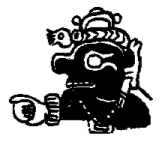 God L, on the other hand, has a distinctively Maya feature lacking in his Central Mexican counterparts: a broad brimmed headdress over which is fastened a moan, or screech owl.16 He also has underworld associations.17 His most important role, however, is as a god of merchants,18 in which capacity he is separately depicted on another panel at Cacaxtla replete with feathers and other valuable objects of trade.19The other prominent black god of the Maya is God M [inset], who is also a god of merchants and travelers, as demonstrated by the trumpline often seen on his forehead.20 In the post contact period, God M was called Ek’ Chuah (Ek Chuwah, etc.).21 The word ek’ means either "black," or "star"; and chuah denotes the scorpion.22 So the name has the double meaning, "Black Scorpion," and "Stellar Scorpion." God L and God M are counterparts of one another, the latter having gradually replaced the former.23
Michael Coe notes that Gods L and M appear to be closely related entities.24 Because of the shared black body coloration, God M, God L, and black Chacs have frequently been confused. On Madrid pages 79a to 84, there is such a complex merging of God L with God M that it is difficult to keep them apart. Cyrus Thomas identifies God L as Ek Chuah,25 the black merchant god. Thomas may not be far off the mark, God L was in large part the Classic Maya counterpart of God M. It appears that as God M became of increasing importance in the Maya region, he supplanted God L and in doing so, acquired some of his particular characteristics.26
Miller and Taube observe, "This deity [God M] is a Maya form of Yacatecuhtli, the long-nosed merchant god of Central Mexico."27 It seems reasonable to suppose that the ascendancy of the Toltecs and other Central Mexicans, led to the displacement of God L by Yacatecuhtli in the form of Ek’ Chuah.28 In Maya codices Ek’ Chuah is usually portrayed with a bulbous nose and a pendulous lip. Bulbous or repoussé noses are also frequently found on Yacatecuhtli. In fact his name means, "Nose Lord" (< yacatl, "nose").29 This seemingly essential characteristic is lacking in Three Deer. The reason for this is simply his age. The convention of portraying Yacatecuhtli and God M with unusual and conspicuous noses arose only in Post-Classical times (after the end of the Xᵀᴴ century),30 which post-dates the mural at Cacaxtla. At the time of this painting, God M was just beginning to evolve, and had not yet acquired his stylized attributes; nor had the process of assimilating the attributes of God L taken its course. Three Deer is youthful like Yacatecuhtli, but being Mayanized, he is black like God L (and the future God M), and expresses the Maya god's jaguar affinities through his costume. In Central Mexico, the major jaguar god is Tepeyollotl, the god of caves, and a form of Tezcatlipoca. He has a Maya equivalent. [God of the #7.] God L sometimes has a face with jaguar features.31 Some artifacts from Chichen Itza show a couple of instances of God M with jaguar spots around their mouths, and one has a large canine tooth.32 Later Central Mexican merchant gods have "jaguar whiskers" and a beard forming an oval around their chin, although this is not unique to them. As Thompson observes,
In some cases it certainly derives from a jaguar prototype. That is the case in representations of Tepeyollotl and his Maya equivalent, the god of number seven, of the earth's interior, the night sun in the underworld and probably the night sky. The fact that on a stela from Pomonal, the pack glyph replaces the normal portrait of this same god of the number seven suggests that the merchant gods of southeastern Mexico either derived from jaguar gods or had a very close connection with them. The oyoualli pectoral of some merchant gods supports this conclusion, for this often has animal associations.33
This at least shows that the jaguar motif is not only consistent with merchant gods, but may lie near their roots.
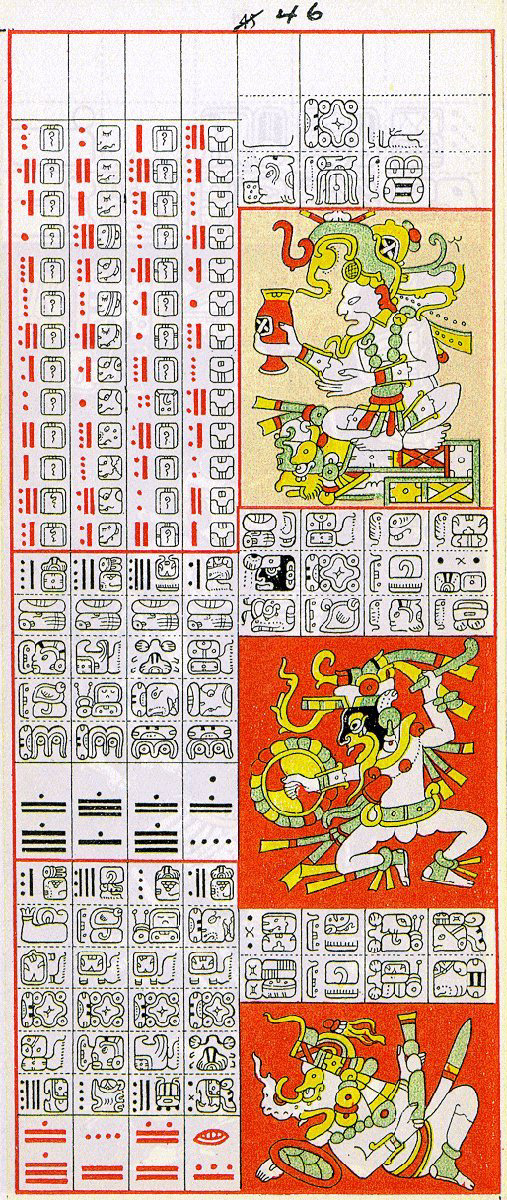
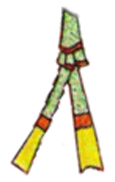
Three Deer's decorative loin cloth and the upward pointing ornaments placed in the garter belts show some resemblance to those of God L in the Dresden Codex.
 |
 |
 |
 |
|||
| Garter Ornament, God L |
Garter Ornament, Three Deer |
Loin Ornament, God L |
Loin Ornament, Three Deer |
|||
| Dresden Codex 46 | Cacaxtla | Dresden Codex 46 | Cacaxtla |
A stiff ornament that rests in the garter belt but points up the leg is rather unusual, but is found in both cases here. Both the strips of cloth which fan out from a higher tied ornament, are fixed to the belt in the position in which a loin cloth might hang. Since the painting of God L shows him in warrior garb and presenting himself as an attacker, it may be that these regalia were more typical of the Maya warrior.34 The war theme is integral to Gods L and M, and to Yacatecuhtli as well.
The hairstyle is an important indicator of this god's identity.
There were two different ways, as the pictures show, in which it was customary to arrange the hair on these occasions. One was to draw the hair together on the crown and wind round it a leather strap, to which, on gala occasions, large tassels of ornamental feathers were fastened, while the rest of the hair as it seems, stood out short and stiff all around the face. It is worn thus by the figures of warriors in the Mendoza codex and on the head of Yacatecuhtli, the god of traveling merchants and caravan leaders, in the Sahagún manuscript of the Biblioteca del Palacio. This manner of wearing the hair was called temillotl, "stone pillar hair dress," and the great tassels were called quetzallalpiloni, "ornamental feather band." The name temillo, "wearing the stone-pillar hair dress (warrior's hair dress)," occurs frequently in the list of names from Uexotzinco. ... In the other manner of wearing the hair it was made to stand up high over the forehead and allowed to hang down from the crown of the head over the neck, where it was wound by a strap, into which a feather ornament was stuck on gala occasions. ... The chieftains of the Tlaxcaltecs are also drawn with this hair dress on the lienzo of Tlaxcala, in the representation of the festivities which the republic of Tlaxcala prepared for the reception of the conqueror Cortes, whom they hailed as their ally. This manner of wearing the hair was called tzotzocolli, and the feather ornament stuck into the strap, consisting of a furcated plume of heron feathers, was called aztaxelli. [In the inset,] I give a picture from the Sahagún manuscript in the Biblioteca del Palacio, in which warriors are represented executing a dance at the feast of Ochpaniztli, where these two modes of wearing the hair are to be seen side by side, distinctly drawn.35
We can see that the hairstyle is that of Yacatecuhtli, but arranged in the tzotzocolli fashion used at Cacaxtla, a city of Tlaxcala. With this painting of Three Deer, we see his tzotzocolli pitched forward, but clearly in a column fixed by a large strap.
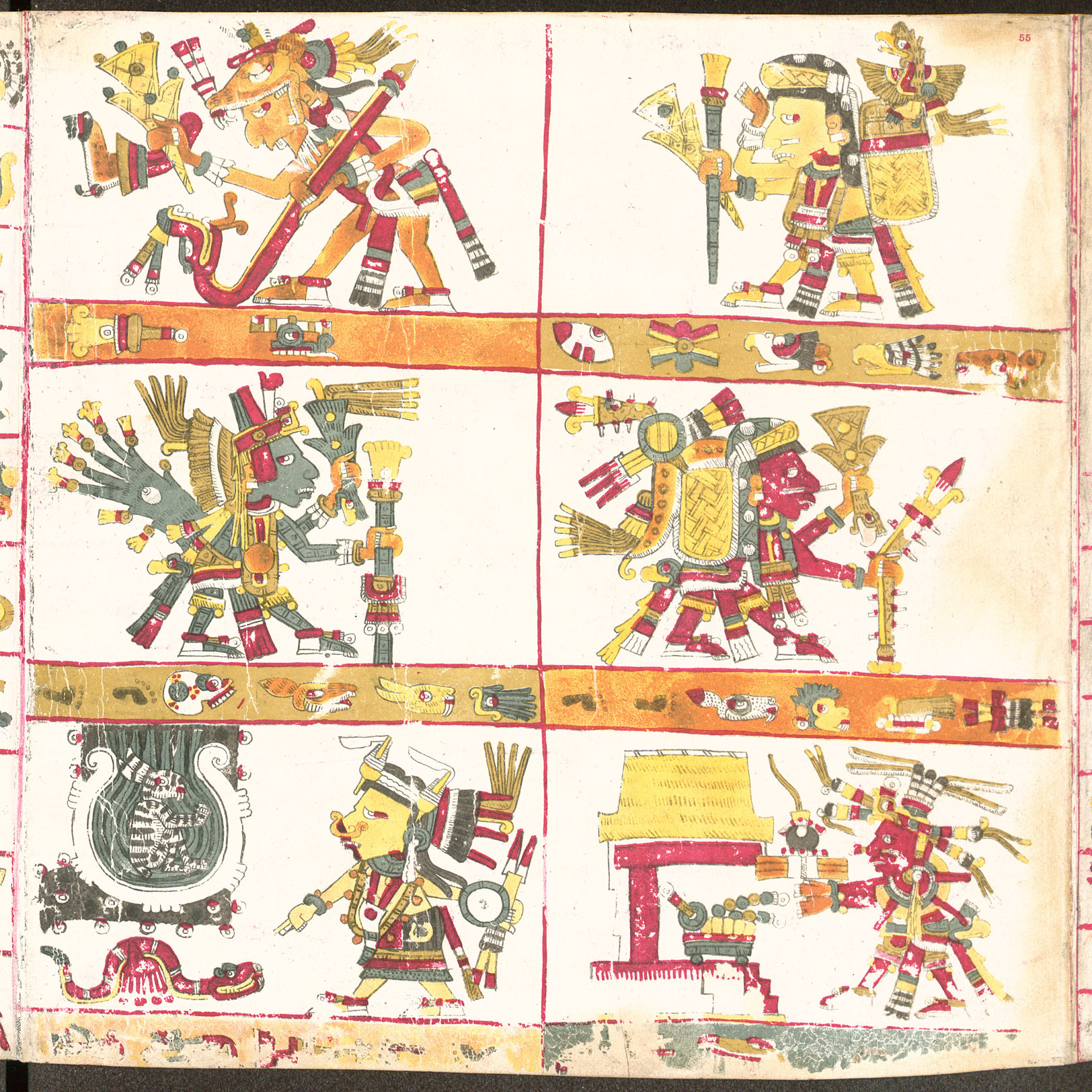
In Codex Borgia 55, we see the tzotzocolli hairstyle incorporated into what may be a hat. The raptorial birds of his lower back ornament matches the avian fly whisk that he holds in the distal of his two (!) left hands.36 Elsewhere on this same page, the bird of the fly whisk is transformed into what appears to be a mace. Left-handedness is a salient attribute of Huizilopochtli, so its appearance here, if it is not simply a mistake by the artist (committed elsewhere on this page), could be a symbol of war. The pochtecas were viewed as harbingers of war.
 |
| A Merchant God, Probably Yacatecuhtli |
| Codex Borgia, 55 |
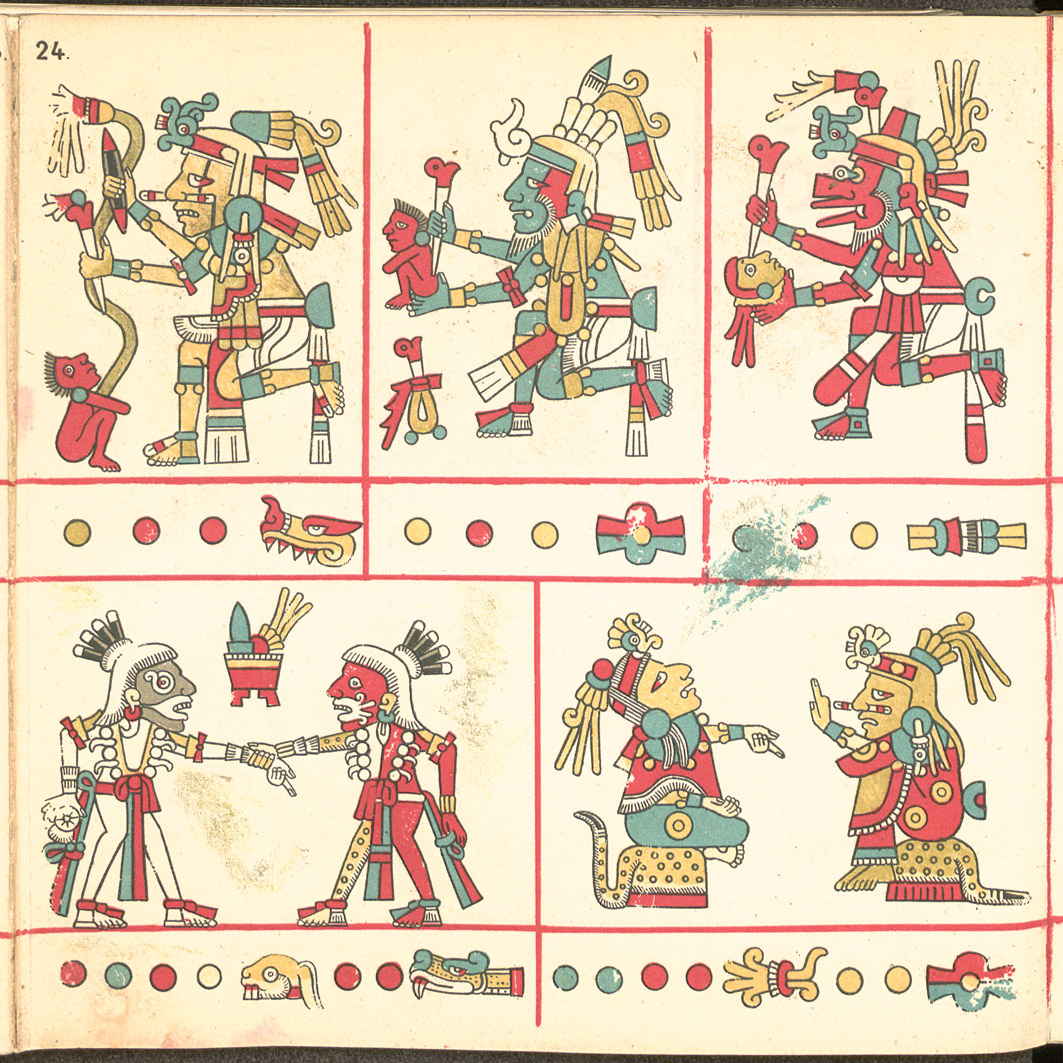
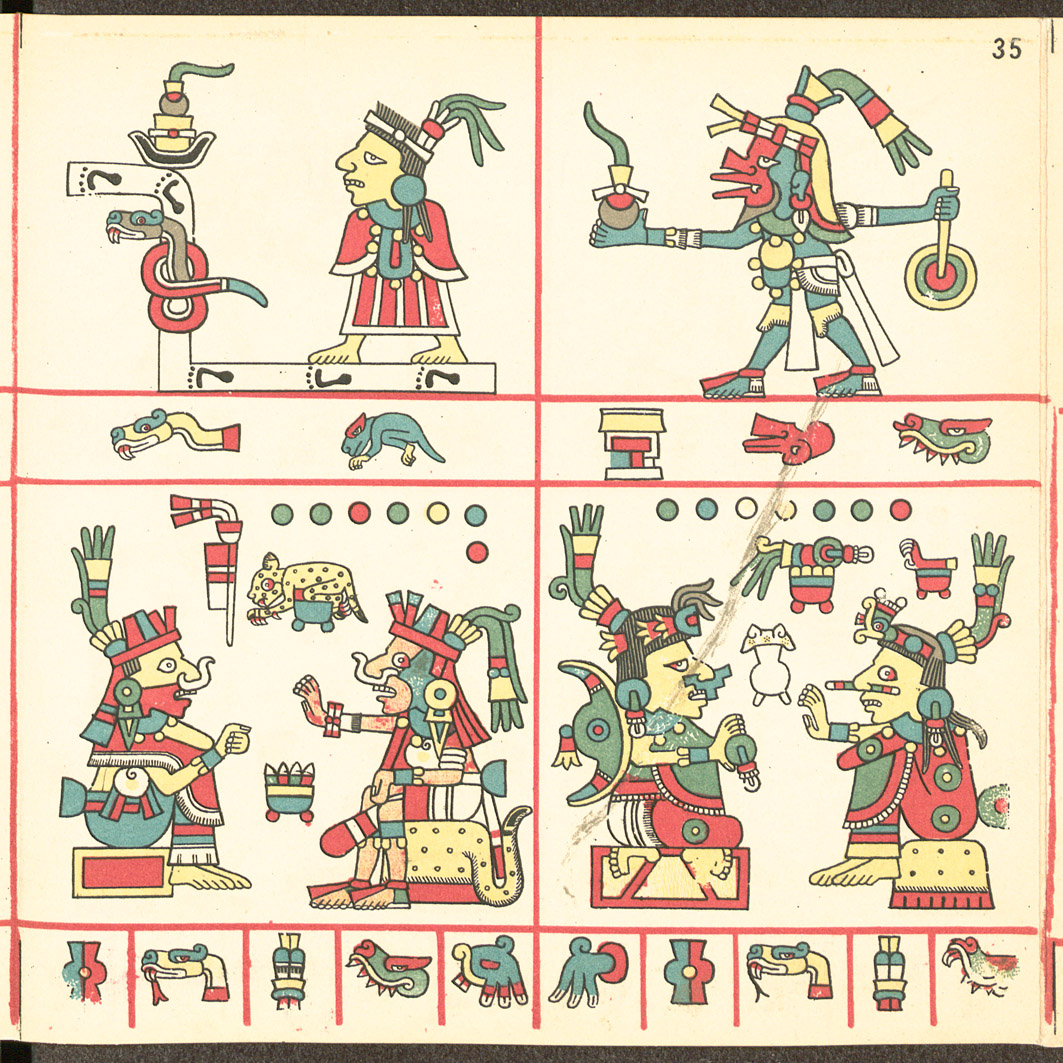
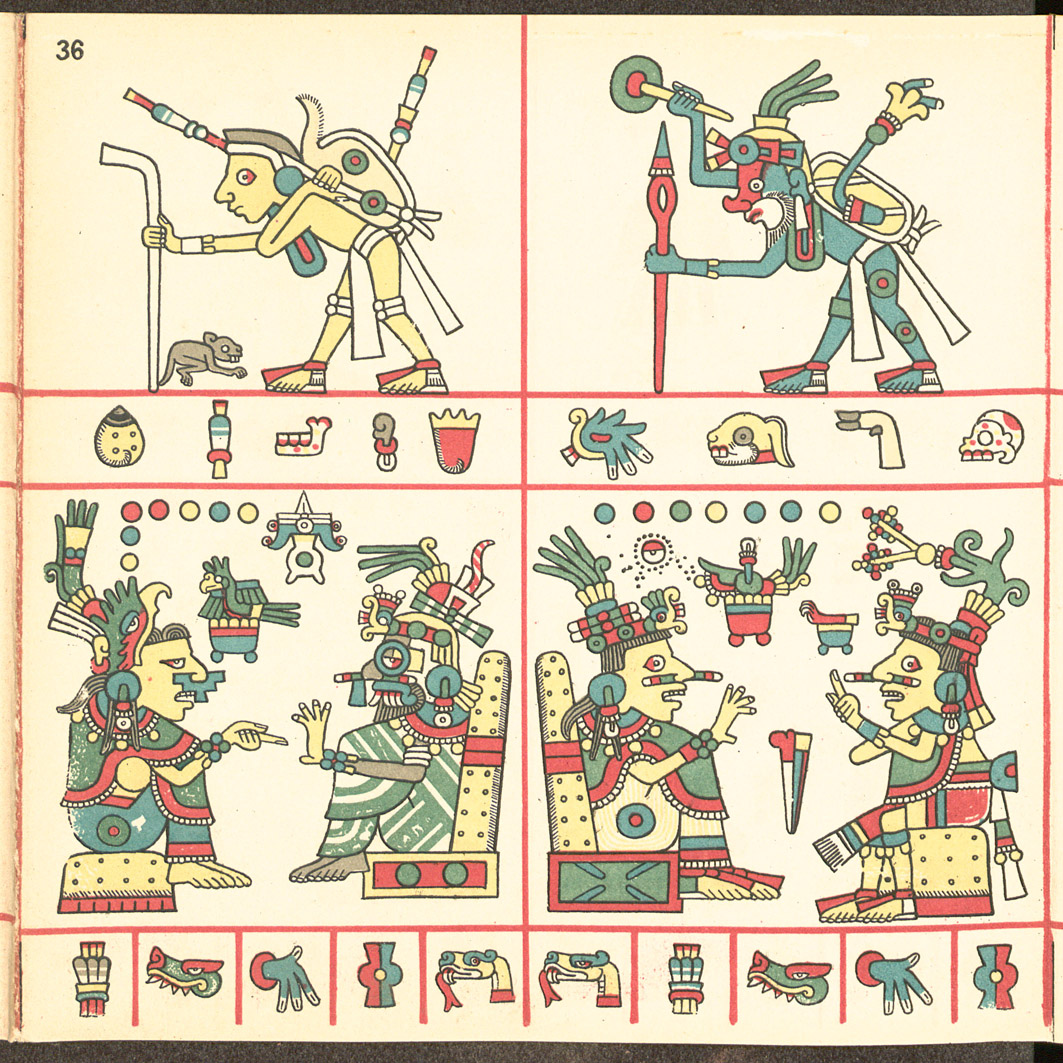
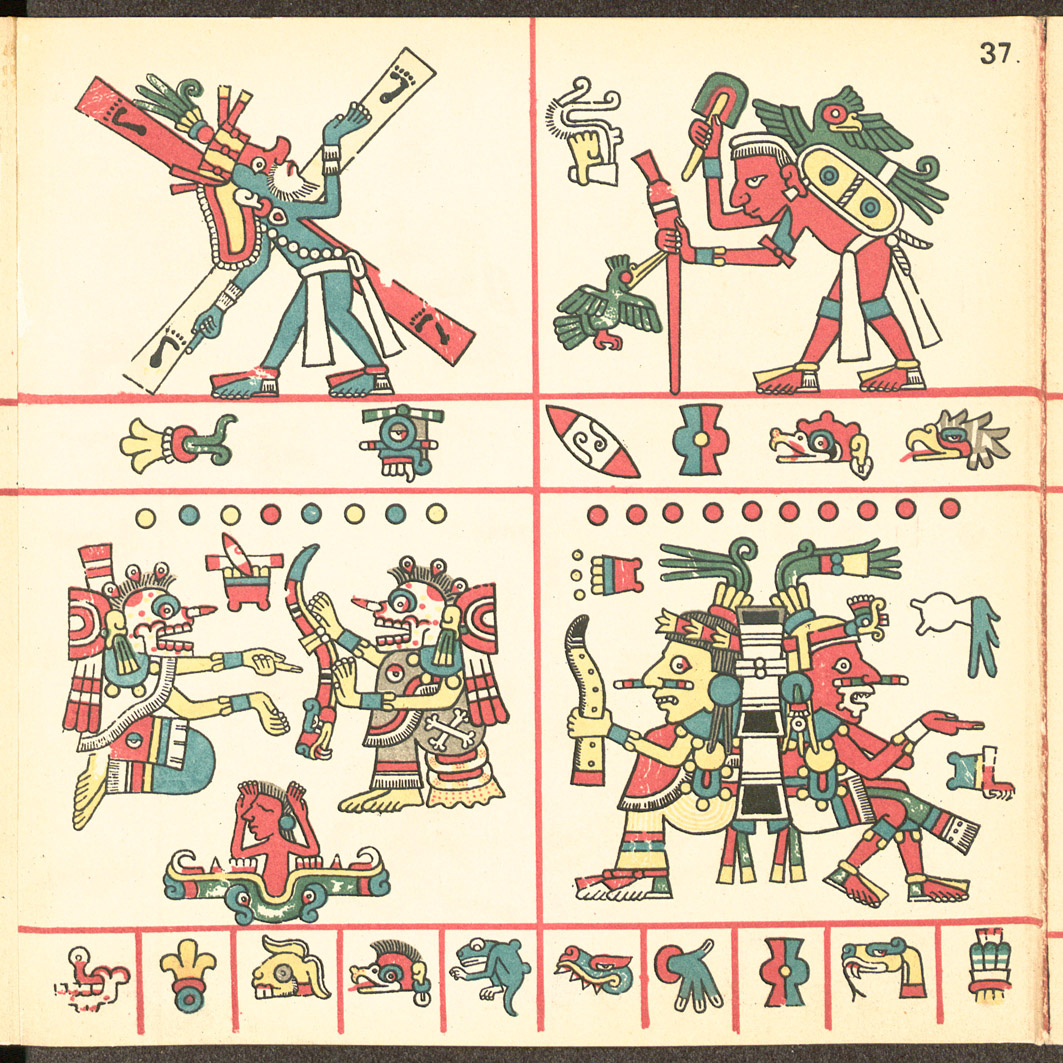
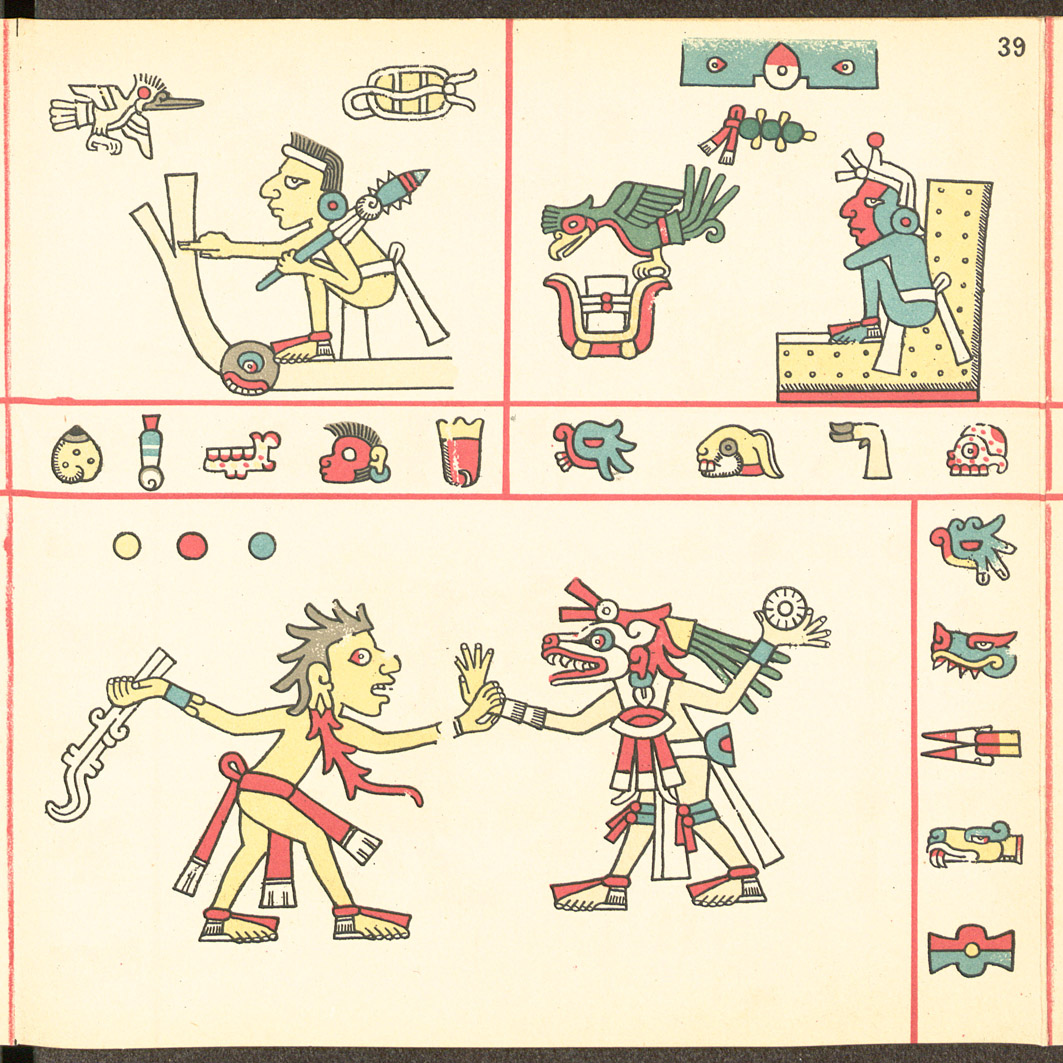
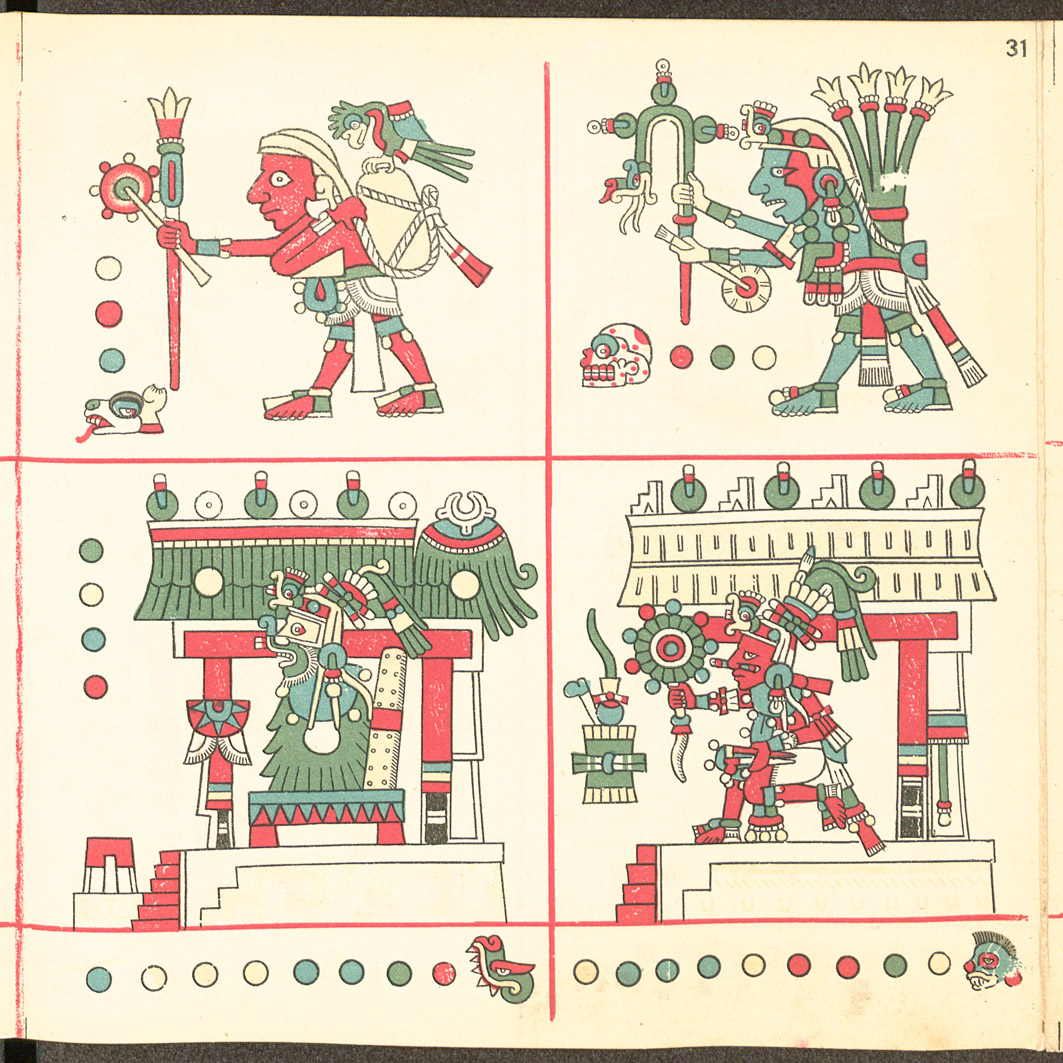
The head gear is usually an identifier for Quetzalcoatl, both the "hat"37 and this style of feathered headdress, but there are a fair number of exceptions.38 This connection derives from the fact that Quetzalcoatl, among so many other things, is also patron of merchants.39 The object slipped into his headband is a penance bone.40 Although Spranz classifies this image under the heading "Figuras Indefinidas," the parallels that he adduces can allow us to identify this god as Yacatecuhtli. What we see in Codex Borgia 55 is a vertically bifurcated color scheme41 of red and blue/green which elsewhere is expressed in patterns of facial paint (although it is hard to tell whether the red patch behind his eye is is an extension of his hat or paint on his skin).42 The vertically bifurcated facial paint in blue/green and red may have more to do with pochtecas, long distance travelers, than with Yacatecuhtli per se. In Codex Fejérváry-Mayer 24, Tecciztécatl is painted like Yacatecuhtli in the same codex, probably because the Moon is himself a long distance traveler. The same is true of Ehécatl in Codex Fejérváry-Mayer 35. This bifurcated painting scheme is seen on Yacatecuhtli in Codex Fejérváry-Mayer 36, 37, and 39. Spranz recognizes Codex Fejérváry-Mayer 31 as cognate to 36, and both as cognate to this merchant god of Codex Borgia 55.43 The latter, for instance, has the same set of day signs listed underneath it as do Codex Fejérváry-Mayer 31 and 36. Thompson equates our Borgia 55 to Codex Laud 5, Codex Fejérváry-Mayer 31, 36, and 39.44Although Spranz never isolated Yacatecuhtli for analysis, Thompson was able to present an iconographic typology for the merchant gods of the codices.45 However, most of the attributes tendered by Thompson represent later developments in the evolution of this deity's iconography. 
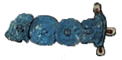 One of these older attributes that does appear in the Borgia group is the fillet made up of precious stone discs. We see this also as a separate item in Codex Fejérváry-Mayer 39, where its green color suggests jade rather more than turquoise. Boone describes our deity from Borgia 55 as, "... a turquoise-covered Quetzalcoatl-like figure who exudes preciousness ..."46 The quetzal bird itself, whose presence is reiterated in this painting, as Thompson points out, is a symbol of preciousness.47 To say he "exudes preciousness" would be an apt description of Cacaxtla's jade-laden Three Deer, as well we might expect from a god of the wealthy merchant class. Since Codex Fejérváry-Mayer 36 is almost paradigmatically Yacatecuhtli, and Codex Borgia 55 is its cognate, it follows that the figure of the latter codex is Yacatecuhtli.
The most salient feature of the whole composition at Cacaxtla is its aquatic theme. The shell from which the black god pours out Seven RE, itself leaks water out its opposite end. The snakes and turtle in the lower border, as well as the general turquoise color of the background, reinforce this theme. The yellow flowers, depicted in a highly stylized fleur-de-lis form, with their enormous stalks, are most consistent with water lilies. Taube took note of God L's connection to water, a theme we find strongly expressed at Cacaxtla, and attributed it to the god's association with the more humid regions to the southeast.48 However, as we shall see, the counterpart of Three Deer found in Borgia 55 will help us to see the origins of the god's water associations. What's of special interest in the Borgia rendering of Yacatecuhtli is that where we would expect to see him with a cacaxtli pack on his back, as in Codex Fejérváry-Mayer 37, instead we find a representation of flowing water hardly discernible from like images of the water goddess Chalchiuhtlicue, save that the water branches out into streams that terminate in water lilies. That this turquoise colored extension is indeed water is shown by the mollusc shell determinative placed in its center, an icon that barely differs from the Maya XE1 hieroglyph denoting water (q. v.). In the Cacaxtla painting, long streamers of his hair, banded by blue jade, extend down near his knees, most terminating in water lilies. A very odd feature is the meandering stream of turquoise color that springs from the center of an earpiece and terminates in a water lily below his shoulder. This golden discoidal earpiece differs little from the gold disc that hangs in front of the Borgia Yacatecuhtli as a pendant. The whole picture, with its aquamarine background, expresses the theme of water, focusing especially on the strombus seashell, of giant proportions unseen in nature, that gushes water out of its spire. The water lily is the aquatic flower par excellance. In Codex Fejérváry-Mayer 31 (cf. 36), Yacatecuhtli is seen packing a whole bundle of long-stemmed yellow flowers that belong together with Cacaxtla's aquatic theme. Long distance trade in general, however, could only be effected during the dry season, since those who traveled by foot could hardly protect their goods for a long period during the course of a monsoon, not to mention during the huricanes that may occur at this time. Swollen streams and muddy roads presented another impediment. Therefore, a god of merchants, and especially of the pochtecas, ought be strongly connected to the dry season. The pochtecas start off on their expeditions with the advent of the dry season, and start to return not too much later than the Vernal Equinox. The rainy season in Central Mexico generally lasts from May through September.49 Once the pochtecas have returned, the rainy season commences. It's as if the deity of the returning pochtecas causes the rainy season (post hoc ergo propter hoc). No wonder he handles a huge lunar strombus shell that spills out water.
Three Deer's relationship to the Vernal Equinox is a revelation that immediately clarifies the very strange display of flowing water found in the portrayal of Yacatecuhtli in Borgia 55. This occurs where we would expect his cacaxtli or pack to be. 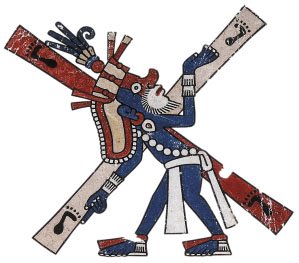 To the viewer of the time, it says, "He is packing water." Of course, no one literally packs water for the purpose of trade. We know from other lines of reasoning that Yacatecuhtli metaphorically packs water, since it is he who initiates that half of the year in which the rainy season occurs. With respect to his Maya counterpart Ek’ Chuah (God M), this is shown explicitly in a scene from Codex Tro-Cortesianus 15b, where he strikes the sky with his battle ax and causes the rain to fall (cf. 31a). The moan owl, the avian symbol of his predecessor God L, is "closely identified with rain."50 The art work at Cacaxtla expresses the same theme by saturating the painting with the symbolism of water. The astronomy of his calendar name also shows that Three Deer is born at the crossroads of the sun, when day and night are equal. At this crossroads, the career of the sun is on the ascent. This gives added meaning to the crossroads carried sometimes on Yacatecuhtli's back as an emblem (as in Codex Fejérváry-Mayer, 37, cf. 36).51 Naturally, in the Aztec context, this is viewed as a spatial crossroads that exemplify the crossing of boundaries and proficiency in guidance through the help of the god. However, we can now see that the Toltec version expressed this boundary in temporal terms by making the moment of his birth a crossroads of time. The red and blue coloration of this depiction of Yacatecuhtli is most likely the standard color symbolism for fire and water. Water-and-fire (atl-tlachinolli) is the standard kenning for war. As a de facto scout, the pochteca represents the tip of the war spear, and both he and his god are therefore considered warriors. The water and fire metaphor arises from the crossroads of space, where the pochteca crosses the boundary to intrude on other competing city states; but his situation at the crossroads of solar time is a literal expression of the divide between the dry and the wet seasons, the red and blue, a transitional period of crucial importance to the pochtecas.
§3. Mamalhuaztli and the Gods of the Cingulum. What do our sources tell us concerning what the Central Mexicans thought about the three stars of Orion's Belt? Robelo says in his dictionary that there is a star called Yoaltecuhtli that is identified with one of the stars in the Cingulum, and furthermore, "all ancient authors agree in pointing to a spirit of one of the stars of Orion."1 Sahagún contends that Yoaltecuhtli is one of the stars of an asterism known as Mamalhuaztli, the "Fire Sticks" or "Fire Borer." In his Nahuatl text he says, "Mamalhoaztli – When [these] appeared and set forth, incense was offered and burned. Thus was it said when Yoaltecutli , Yacuitztli, had come forth: "What will the night bring? How will the day break?"2* This suggests that Yohualtecuhtli is the deity of all three stars (like Three Deer among the Osage), and that he bears the surname Yacahuitztli, "Spine Nose." The Spanish notes to the Nahuatl text say that yoaltecutli "is the name of these stars." Rather more is said in the Spanish text:
These people paid particular reverence and [made] special sacrifices to the Mastelexos in the sky, which move near the Pleiades, which are in the sign of Taurus. They made these sacrifices and ceremonies when they newly appeared to the east after sunset. After having offered incense, they said: "Now [has] Yoaltecutli come forth, and [y] Yacauiztli. What will come to pass this night? or what end will the night have — fortunate or adverse?" Three times they offered incense and this was due to the fact that there were three stars.3
Sahagún's sources here make it clear that they thought of Yohualtecuhtli and Yacahuitztli. as two gods, and that they were associated with the three stars making up one of the Mastelexos. Mastelexos is usually translated "Castor and Pollux,"4 and a number of early scholars identified the sidereal sticks as these two stars.5 The Gemini (Castor and Pollux) might be considered to be the Mamalhuaztli for two reasons. When the sun enters into the zodiac constellation Gemini, it aligns underneath the twin stars, which themselves are oriented upright like a stick. It is as if the stars are the spinning bore stick being applied to the horizon, and the sun is the resultant fire. The other reason for this identity is a confusion arising out of the Spanish word used to describe such a fire stick. Molina translates the word mamalhuaztli into the Spanish astillejos, "sticks of wood." However, in Spain the Gemini are known as the Astillejos. Seler is certainly right when he says, "The translation 'astillejos' is probably intended to convey only the literal sense of the word mamalhuaztli." The constellation Mamalhuaztli has become confounded with the Spanish Astillejos simply because both names have a very similar meaning. The Spanish asterism, the Gemini twins, "however, seems out of the question here, since they lie too far distant from the Pleiades."6 The Gemini are, of course, two stars, but Sahagún says that the Mastelexos were three stars. For these reasons we can be confident that Mamalhuaztli is not the twin Gemini stars.
Nevertheless, it is odd that there are just two gods mentioned; yet it is clearly said that there are three stars (tres estrellas). In another context, the placing of a newborn in his cradle, Clavigero (1731-1787) mentions Yoaltecuhtli and a different stellar companion.
The midwife then clothed him and laid him in the cozolli, or cradle, praying Joalticitl, the goddess of cradles, to warm him and guard him in her bosom, and Joalteuctli, god of the night, to make him sleep.7
In the rite for female infants, he says further,
Joalteuctli, the god of night, who seems to us to have been the same with Meztli or the moon. Some think him the same with Tonatiuh, or the sun, while others imagine him to have been quite a distinct deity. They recommended their children to this god, to give them sleep.
Joalticitl (nightly physician), goddess of cradles; to whom they likewise recommended their children to be taken care of, particularly in the night time.8
Sahagún, in reference to this same rite, does mention three deities. The midwife addresses the cradle, saying,
... thou hast arms, thou hast a lap, even though it is true that our mother, our father Yoaltecutli, Yacauitzli, Yamanyaliztli sent it [the baby].9
Here Sahagún restores the name Yacahuitztli ("Spine Nose"), and we find the female name Yamanyaliztli added as a third deity. This might suggest that we have four names for three stars, but Lopez Austin dispells the confusion: "Noteworthy among the multiple manifestations of the Great Mother were ... Yoalticitl ('Nocturnal Healer'), who appeared in the temazcales ['steam baths'] and in cradles, also called Yamaniliztli ('Tenderness')."10 This goddess, more commonly known as Toci Yoalticitl, is so extensively parallel to the Maya Ixchel,10.1 that it is impossible to avoid the conclusion that Yoalticitl was simply borrowed from the Maya. So now rather than having two gods to match the Gemini, we have three deities to match the three Belt Stars of Orion. Orozco y Berra, based upon what Sahagún had said, held that Yacahuitztli and Yoaltecuhtli were the denomination (la denominacion) for the Belt of Orion.11 Coe appeared to have closed the case when he found the term astillejos in Nebrija's well know late XVᵀᴴ century dictionary where it is defined not as "Gemini," but as "Orion."12
We know that Yacatecuhtli was also identified with a star. The gods who fell from the heavens were once stars, as Fray Ríos says here, where they are (mistakenly ?) identified with the Tzitzimime:
Properly, it should be called the fall of the demons, whom they say were stars; and thus there are now stars in the sky that they call by the names they had, which are the following:
[inserted by Hand 2:] Yacatecuhtli, Tlahuizcalpantecuhtli, Ce Acatl Quetzalcoatl, Achitumetl, Xacopancalqui, Mixcoatl, Tezcatlipoca, Zontemoc.
like gods. They called them this name before they fell from heaven and ... and now they call them Tzitzimime, which means monstrous or frightening thing.13
The incident to which they allude is the Nahua counterpart to the Hebrew "Garden of Eden" myth, but here the gods are ejected from the heaven of Tamoanchan for having plucked a flower from a tree which then broke in two with an issue of blood. We have no further statements as to which stars these gods may be identified. We are naturally led to think that since Yohualtecuhtli is identified with a star in the triad of Orion's Belt, that perhaps Yacatecuhtli is one of these stars as well. We know the names of each of these stars albeit without specificity: Yohualtecuhtli, Yacahuitztli, and Yamaniliztli. The last of these is female, and therefore cannot be identical with Yacatecuhtli's star. This leaves only Yacahuitztli. What is his relationship to Yacatecuhtli? There is a collection of divine names beginning with the word Yaca-, usually translated as "Nose." Yacatecuhtli is therefore "Nose Lord." There are three other Yaca- names extant in the literature: Yaca-pitzahua, Yaca-coliuqui, and the aforementioned Yaca-huitztli. Among the siblings of Yacatecuhtli is a certain Yacapitzahua.14 Since they are stated to be brothers, here we must have a case where a Yaca- name denotes a distinct deity. Yet we know such lists, which exemplify the stereotypic template of "four plus one,"15 are found paradigmatically in connection with Camaxtli (Mixcoatl), whose four Mimixcoa siblings included Camaxtli himself under a variant name.16 Therefore, it is not surprising to discover that Yacapitzahua is in fact identical to Yacatecuhtli, as Sahagún says here: "And when it was the next day, it was the time that Yacapitzuac arrived; this one was Yiacatecutli; he was the pochtecas' god. And Ixcoçauhqui: this one was Xiuhtecutli; he likewise was the pochtecas' god."17 So Yacapitzahua, which means "slim nose,"18 is just another name for Yacatecuhtli. The name Yacacoliuqui is the most semantically divergent of the group. It means, "twisted (or curved) nose,"19 but in fact, as Torquemada tells us, it too is just another name for Yacatecuhtli.20 
 A bulbous, retroussé nose, twisted a bit upward like a thorn, is the standard way in which the nose of Yacatecuhtli is shown in the codices, as we see in Codex Fejérváry-Mayer 36 [inset] and 37. Such a nose is also seen on Ek’ Chuah. On the other hand, the black and white drawing from Sahagún [inset], displays the pitzatli style nose which is both slim and pointed. The third name, Yacahuitztli, means, "spine (or thorn) nose."21 This form of the name encapsulates something of the attributes of both styles of noses, the one like a thick upward curved thorn, and the other like a thorn whose form is that of a slim spike or spine. Among the gods, only Yacatecuhtli is distinguished by his thorn-like nose. The name Yacahuitztli merely attempts to capture the full range of the thorn-nose names for Yacatecuhtli, and is hardly likely to denote an independent deity. Therefore, given that the god Yacahuitztli is a star in the Cingulum, and that he is likely identical to Yacatecuhtli, it follows that Yacatecuhtli is likely the third star of Orion's Belt.21.1
Although the foregoing discussion centered on the nose of the god might lead us to think that this is his essential property, we note that in the codices of the Borgia group there are only two instances of the "pyroxene nose," Codex Fejérváry-Mayer 36 and 37.22 Therefore, the portrayal of the proto-Yacatecuhtli in the Cacaxtla painting without a repoussé nose is actually in conformity with most of his iconography, despite the fact that his name makes reference to this unusual feature. Portraying a divine merchant's nose in the way found among Yacatecuhtli and his variants may ultimately have arisen from a Mayan metaphor.
Maya is a pleasant language with some charming metaphors. ... A clever businessman is said to have a snout that sticks out (cf. our expression "a good nose for business"); and in that connection it is interesting that the Maya god of merchants has a sort of nose like Pinocchio's, and one of the names of the chief Aztec god of merchants was "he with the pointed nose."23
Something about an unusual or prominent nose pertains symbolically to the most valuable qualities sought after in a traveling merchant. This odd emphasis on the nose is underlain by the double meaning of the word yacatl, which just like *pe in Central Siouan, means at once both "nose" and "point."24 Thus the pochtecas, as we would say in the Army, "pull point." Thus, the predominant opinion is that the aquiline nose identifies the merchant as the vanguard,25 although, more in keeping with the Maya metaphor, Torquemada tells us that it has the meaning of the Latin nasutus, "big-nosed, witty."26 The qualifiers suffixed to yaca- are really reduplicated, synonymous emphatics. For whom are these merchants the "point" element? Clearly, it is for political-economic expansion in the form of military conquest. The most advantageous form of commerce is unilateral: in the receipt of tribute, nothing is given in return.
Another piece of evidence for the identity of Yacahuitztli and Yacatecuhtli also tells us why Three Deer and Ek’ Chuah are black gods. André de Thévet (1516 – 1590) in his Histoyre du Méchique says, "The night, they say, was also created by other deities named Yoalteutli, and his wife Yacahuitztli."27 Thévet is the only one who has suggested that Yacahuitztli is a woman. Given the identities proposed here, we can say that the complementary pair Yacatecuhtli and Yohualtecuhtli together created the night. The black skin of Three Deer and his Maya counterpart Ek’ Chuah expresses the fact that it was from them that darkness itself originated. The confusion that gave rise to identifyng Yacahuitztli as a woman can be accounted for from three causes: (1) in the listing of deities in Histoyre du Méchique, each god is paired with his divine consort, which naturally leads to this otherwise unstated conclusion; (2) other sources tell us that it was the other neighboring star, Yoalticitl (Yamaniliztli), who was actually the consort of Yoaltecuhtli;27.1 and (3) the identification of the Mamalhuaztli stars as Gemini leads to the conclusion that any two named stars in this asterism must therefore be the pair known to be consorts.
|
|
The third star of Orion's Belt really is a female deity, here called Yamanyaliztli, but more commonly rendered Yamaniliztli. As we have already noted, this is just another name for the goddess Toci Yoalticitl ("Our Grandmother, Nocturnal Healer"). Toci Yoalticitl, often identified with the goddess Teteoinnan,28 is very similar to Tlazoltéotl (the earth goddess of purity and pollution), but differs from her in being middle-aged and by being associated with the sweathouse, weaving, and midwifery,29 the latter accentuated in her identity as Yamaniliztli.
At times, Yoalticitl was considered a representation (or combination) of the provider goddesses: Chicomecoatl, Chalchiuhtlicue and Huixtocihuatl. These goddesses were said to be sisters who supplied man with the three necessities of life: food, water and salt, respectively. Yoalticitl is reputed to be the first person to cook food.30
As a nurturing goddess, she is also a provider of the necessities of life; but we can now appreciate, given that her star resides in one of the Fire Sticks of Orion, that she was the first to cook foods because of this intimate attachment to fire. She is also a provider of children, and as such is a goddess of the womb, which is conceptualized as a dark, underworld abode, analogous to a cave or its more pyrrhic counterpart, the sweatbath. So, as Sahagún tells us, the midwife says to the family before a woman gives birth,
And now truly you cry out, you call out, you summon Ticitl, Teteo Innan, Tonan, Yoalticitl - "The Midwife, Mother of the Gods, Our Mother, Midwife of Darkness" - who governs, in whose hand and protection is the Flower House (Xochicalli), known on earth as the "sweatbath" (temazcales).30.1 There Teci [Toci?], Yoalticitl, provides for one, adorns one, fortifies one.31
The "Flower House" is the womb. Here we should note that the sister of Yacatecuhtli, Chalchimecaciuatl ("Woman of Chalchimeca") is thought by Thompson to be another form of Teteoinnan.32 If this is correct, then Yamaniliztli may have been thought of as a sister of Yacatecuhtli, which makes it more probable that he is also included among the Belt Stars with his sister. Teteoinnan-Toci is also a lunar goddess,33 and Yoalticitl herself is represented wearing the lunar nose ring, the yacametztli.34 This status can be seen in the harvest festivities of the veintena Ochpaniztli.35 The rites of Ochpaniztli, which had to have taken place just before the Autumnal Equinox in Year I, center around the sacrifice of the impersonator of the goddess Teteoinnan-Toci, who is beheaded and her skin flayed. A special priest at the center of these rites then dons her skin. This priest is called a tecizquacuilli, which means, "strombus priest."36 A tecciztli is a strombus or conch shell, paradigmatically the giant conch (Lobatus [Strombus] gigas), known as the "queen conch."37 A few, such as the one shown in the painting at Cacaxtla, are an aquamarine green. The male Moon god goes by the name Tec(u)ciztécatl, "Strombus Lord." He is patron of the trecena Death38 as well as the regent of the day Death,39 probably for the simple reason that the Moon periodically "dies" as it declines into a sliver and disappears into the Sun at conjunction. The front of the god's headband has a strombus shell as an ornament.40 This represents the Moon itself, especially with respect to birth,41 the domain of Yamaniliztli.
The conch shell has two symbolic associations. By a natural process it represents water, and as the earth was believed to be on the back of a crocodile who floated on the surface of a cosmic sea, the conch shell became a symbol of the subterrestrial region and its divine inhabitants. As such it was also the symbol of the great mother, the moon goddess, who was also a deity of procreation, of the earth, and of water. From this, combined with a certain physical resemblance, developed the association of the conch shell with birth.42
As the commentator says, "Just as the snail leaves behind its shell, so does a man leave behind his mother's womb."43 Yamaniliztli, who is also a lunar goddess, is evoked to protect the newborn infant. She is also one of the three stars of Orion's Belt that protects children at night and helps them get to sleep. The conch shell which represents her as the Moon, also serves to represent her as a womb in her capacity as a mother goddess. She too is one of the three deities who are said to have sent children down to earth from the abode of duality (in the upper world). Three Deer is pouring Bacab out of the giant tecciztli that we may now correlate with the Central Mexican Yamaniliztli. Yamaniliztli is the womb out of which the rainy season itself emerges after the Vernal Equinox. Her water breaks, signaling the immanent birth of new life that comes with the season of the rains, the Moon universally being associated with water.44 In the older Cacaxtla murals, we see the water symbolic of this season flow out everywhere from the shell that corresponds to this goddess. As the god who initiates this season, the Cacaxtlan merchant god Three Deer is the one to pour forth the water from the shell-womb, out of which emerges the Maya inspired manikin god of flaming red hair who brings this period to an end.
Sahagún says that the day 1-Snake was considered especially auspicious for the departure of the pochtecas.45
| Dates (727) |
March 15 | March 16 | March 17 | March 18 | March 19 | March 20 | March 21 | March 22 | March 23 | March 24 | March 25 | March 26 | March 27 |
| 1-Snake | 2-Death | 3-Deer (VE) | 4-Rabbit | 5-Water |
6-Dog | 7-Monkey | 8-Grass | 9-Reed | 10-Jaguar | 11-Eagle | 12-Vulture | 13-Motion | |
| Veintena XI (Tlacaxipehualiztli) | Veintena XII (Tozoztontli) | ||||||||||||
We can see why this day is so important to the pochtecas: as seen on the table above, the trecena in which 3-Deer occurs in Year I is that of 1-Snake. The first 1-Snake fell on the 17th day of the veintena, and 3-Deer fell on the 19th day. Xiuhtecuhtli governed the trecena Snake, which pairs him with Three Deer, whose name day (3-Deer) fell within the trecena. That Three Deer corresponds to the Toltec Yacatecuhtli explains why, of all days, the day 1-Snake is considered the most auspicious for traveling, and is even termed "the straight way" (utli melaoac) for the pochtecas.46 In 1540, for instance, the day 1-Snake fell on November 1, near the end of the rainy season. Sahagún reported that 1-Snake was a good day to depart, but in the days of the calendar's infancy, it will have been a good time to return.

The theme of serpents is seen in the painting at Cacaxtla where it raises another interesting Orion connection for Three Deer. There, at the base of the painting, we find a picture of two snakes and a single turtle. The purpose of this motif may be merely to accentuate the aquatic theme, but given the subject of the painting, it seems rather more likely that it serves a higher symbolic purpose. It is Three Deer in particular who is connected with the serpents. His long braided hair hangs down even past his sandals and invades the frame of the picture, where four serpentine locks intersect a background image of a snake whose tail is hard to differentiate from the hair strands. This snake and his opposite counterpart, are set out horizontally, head to tail. Sahagún tells us that, especially to merchants, serpents symbolized roads, since they were long and winding.47 As noted before, the best day to return was on 1-Snake, which on the original calendar occurred just two days before Three Deer's name day (the Vernal Equinox). Adopting this course was called "the straight way" (utli melaoac). Among the siblings of Yacatecuhtli in one list is Ce Coatl - Utli Meloac, "One Snake - the Straight Way," who was patron deity of one of the guilds of merchants.48 So, originally, 1-Snake corresponded nicely with the Vernal Equinox and with the symbolism of the snake as the road (of return). Three Deer himself stands in an almost impossible posture, with his left leg seeming to stride forward, while at the same time, crossing it, his right leg seems equally to be striding in the opposite direction. The heel of his left foot aligns with the tail of the first snake, and his right heel aligns with the tail of the second snake. The cross legged posture would normally be interpreted as a turning motion. The turning motion of Three Deer exemplifies the turning motion of the year, as the Sun turns the corner and begins to dominate the night. This was the time to begin the long return, shown by the lead foot pointing from the serpent's head back to his tail where the journey began. The serpentine strands of hair, originating in the warrior symbol embodied in his tzotzocolli tonsure, is synonymous with the snakes with which it commingles: the merchant's roads, but here particularly, from the "head" city (Tula) whence the merchant comes, the roads of the warriors, the roads of conquest, are in number four, representing the four quarters. The painters of Cacaxtla were under no illusions about the significance of the dark lord or the jaguar presence about his feet and loins.
The other reptile portrayed in the base of the painting is a turtle. While the turtle in the far north is the embodiment of war, in Mesoamerica, it is mainly a symbol of the world of water.49 The turtle is part of the overall representation of the wet season which Three Deer seems to have inaugurated. Keeping with this theme is the fact that the turtle shell is used as a drum, so that it comes to be associated with thunder,50 which is only to be found in the rainy season. There is also a third value for it, as we see among the Maya, where Orion is represented as a turtle.51 In accord with our analysis, the two aquatic symbols most relevant to Three Deer are the serpent and the turtle, the very same as shown immediately below his feet. The Vernal Equinox in Year I of the calendar fell during the veintena of Tlacaxipehualiztli, which concluded the day after. This veintena saw the beginning of the planting season, and was therefore devoted to the god of the maize sprouts, Xipe Totec. This has an interesting fit into Maya theology, as we might expect among the Olmec-Xicalanca people. They held that Hun-Hunaphu, the father of the Hero Twins (whom we will encounter again below), and the Maize God, was resurrected by emerging from the carapace of a turtle. This turtle has been identified as the Maya Orion, and the birth of the Maize God represents his emergence from the three Hearthstones.52 The black god Three Deer turns before the image of the turtle while pouring out the water symbolic of the impending rains at the very time that Central Mexico would be celebrating the rebirth of maize in the figure of Xipe Totec.
[In the Maya codices, God M is portrayed as a hunter as well as a warrior. He is seen wearing a rare deer-head headdress in Tro-Cortesianus 50b, 51c, and 68b. There he is also seen with a bow and arrow. Attired in such a headdress along with an arrow, hunters held a great dance during the veintena Zip. In Codex Dresden 13c, the intimacy of hunter and hunted is made manifest as Codex Dresden 13c shows God M having intercourse with a doe. Seler, "Animal Figures in the Maya Codices," 350.]
[In the famous story of the Hero Twins, God L is their primary victim, since he rules over Xibalba. However, in the highlands, his place is taken by God N (Bacab). [Kerr and Kerr, "The Way of God L: The Princeton Vase Revisited," 74a, 75 Fig. 8.] So we do know of a deity with associations to God L who lives in a giant shell. However, this god and his counterparts of the same name, have the role of holding up the sky. Snakes a reference to 1-Snake: the pathways - see also Thompson, Merchants, 160 for god of these who is associated with Yacatecuhtli; Turtle, reference to Orion and role of God L in creation of the three hearth stones.]
§4. Seven Water. So we do have some reason to think that Yacahuitztli is a variant of Yacatecuhtli and identical with Three Deer who is so strongly associated with the Cingulum in the far north. Yohualtecuhtli presents an equally interesting case. We have seen how he is intimately associated with Yacahuitztli, so much so that at times he is confused with him. Yohualtecuhtli, however, is not just a star in the Cingulum, but is a major deity with another aspect to his existence. That any deity might also be a star should not come as too much of a surprise, since we have already seen how Yacatecuhtli, Mixcoatl, and a host of other prominent deities have their stellar identities as well as those attributes most strongly associated with them. It should also be familiar from our own Classical tradition, as the "star" Jupiter is identical to Zeus, who is simultaneously the blue sky. Apollo is a solar god, yet he is also the god of the sliver bow, the path of silvery stars that form the ecliptic. We can recall that Clavigero said that some people thought that the stellar Yohualtecuhtli was either the Sun or the Moon. The latter we can understand as the product of his being confused with Yamaniliztli, the lunar goddess of the neighboring star. In addition to what Sahagún had said about the star of Yohualtecuhtli above, he says elsewhere in the same work, "And his feast day came upon the day of the day-count called naui ollin [4-Motion], every two hundred and [sixty] days."1 Four Motion is the day name of Tonatiuh, the basic sun god. That Yohualtecuhtli could be the Sun might seem a bit surprising, especially given that he is credited with creating its antithesis: darkness. However, Yohualtecuhtli and Tonatiuh are not precisely identical. Yohualtecuhtli is the "Night Sun" (Yohualtonatiuh), the Sun that has died by sinking below the earth. In a very real sense, therefore, his setting below the horizon is the daily creation of darkness and night, and to whom else may the creation of darkness be attributed? He is the light of the underworld, the Sun of the dead. Therefore, he is often thought of as a dead Sun, Tlalchitonatiuh, and is represented in the form of a mummy.
That a star in the center of the midnight sky should share the name and connotations of the dead sun simultaneously located at the center of the earth is understandable in view of the Postclassic belief that the underworld and its inhabitants nightly pass into, or are reflected in, the dark heavens. The stars were traditionally regarded as the "souls" of the dead in the underworld at the center of the earth and all nocturnal celestial bodies were affiliated with the earth, the underworld, and the western, southern, and central world directions.2
The name day of any god is held to be his birthday. Since we have been able to connect the stellar Yohualtecuhtli to the Fire Sticks (Mamalhuaztli), we should be able to employ archaeoastronomy to determine when the Fire Sticks were "born," which is to say, when they first rose with the sun in Year I of the Toltec count. The lead star of Mamalhuaztli is Mintaka. The date of its "birth," is rising with the sun, prove to be quite interesting.
| Date | 727 June 5 | 727 June 6 | 727 June 7 | 727 June 8 | ||||
| 5-Deer | 6-Rabbit | 7-Water | 8-Dog | |||||
| Time | Time | Δt | Time | Δt | Time | Δt | Time | Δt |
| Sun Rises | 05:53:53 | -6' 31" | 05:53:54 | -1' 34" | 05:53:56 | +2' 24" | 05:53:58 | +6' 22" |
| Mintaka Rises | 05:59:24 | 05:55:28 | 05:51:32 | 05:47:36 | ||||
Reconstruction of the Sky on 7-Water2 of 1-Rabbit |
On June 6 the sun rose before Mintaka, and on June 7 Mintaka rose about four minutes later than it had the day before. Therefore, it is precisely 727 June 7, 7-Water of 1-Rabbit, on which Mentaka was first visible when the sun rose. The natural common denominator between the Fire Sticks and the Sun is of course fire. That may explain Yohualtecuhtli's presence as both a star and as a solar deity. As the latter he is the god of the setting sun. In the course of the year, it is not difficult to find the analogy to the diurnal decline of the sun below the horizon and the ascent of darkness. This is the darkness' diurnal victory over light. In the annual system, when is darkness triumphant over light? This occurs precisely at the Autumnal Equinox when light and darkness are balanced. The very next day, the hours of nighttime overreach the the hours of daylight, and the power of the sun declines just as it does when it sets at the onset of the night. It is then that the Sun "dies" for the year, and becomes at least the counterpart of the "Dead" or "Night" Sun. In Year I of the calendar, this event occurs precisely on 7-Water of 1-Rabbit (726 September 20). Therefore, what the two 7-Water days of Year I have in common is the dying Sun, Yohualtecuhtli. 7-Water is also the one date that unites the solar Yohualtecuhtli with the stellar Yohualtecuhtli, and it is the date that unites the celestial fire maker with the celestial fire itself. It must be said, therefore, that it is something of a puzzle that Yohualtecuhtli does not bear the name "Seven Water." The reason for this may be the religious paradox that might arise from assigning the dying Sun a birth date. There is another correspondence between the 7-Water of the Autumnal Equinox and the 7-Water of the heliacal rising of Mintaka, the lead star of the Cingulum when Orion is rising. This star has the unusual property of splitting the night in two, since it sets almost exactly 12 hours after it rises. In this respect, it can be called an "equinoctial star."
The day 7-Water is a veintena-bearer, which is to say that like all Water days in Year I it is the first day of a veintena. Since there are just four veintena-bearers and just four year-bearers, it follows that since they are in a fixed order, the veintena-bearers are in one-one correspondence with the year-bearers. The table shows their correlations:
| Veintena-Bearer | Water | Jaguar | Rain | Lizard |
| Year-Bearer | Rabbit | Reed | Flint | House |
So, for instance, in a Reed year, all its veintenas begin with only Jaguar day signs and end on a year-bearer day sign. Consequently, for Year I of the Toltec count, the first day of every veintena correlates with a Water day, and every Water day begins a veintena. This fact allows us to explore the veintenas correlated with the major celestial events occurring to the Fire Sticks asterism. The veintenas, which in those days may have born different names, are seasonally adjusted with respect to the time sensitive rites that define them. Of Mentaka's four possible correlations of horizon crossings, two of them happen to fall on the first day of a veintena, and one misses by only a day, as can be seen from this chart:3
| ☀ | Mintaka Sets | ☼ | Mintaka Rises | Mintaka Sets | ☀ | Mintaka Rises | Year 1-Rabbit |
| Sun Sets |
727 May 18 | Sun Rises |
727 June 7 | 726 Nov. 20 | Sun Sets |
726 Dec. 5 | Julian Date |
| 13-Water | 7-Water | 3-Dog | 5-Snake | Tonalpohualli | |||
| 1-Etzcualiztli | 1-Tecuilhuitontli | 2-Panquetzaliztli | 17-Panquetzaliztli | Xiuhpohualli |
The names supplied here for the veintenas is in accord with their seasonal placement as documented in colonial times. The veintenas had to have been intercalated from time to time, since in colonial times they matched the seasons reasonably well.4 If this had not been the case, then the initial count of +726 would have found Tlacaxipehualiztli, the veintena honoring Xipe Totec the god of sprouting corn, not when maize is planted, but when it was harvested. This is quite nearly a complete flip from one equinox to its opposite, which would occur about every 720 years. A more striking absurdity would be the veintena known as the "Raising of the Banners" (Panquetzaliztli), which as its name suggests, is about the preparations for war. If the veintenas had not been periodically adjusted for the seasons as they experienced calendrical drift, then Panquetzaliztli will have fallen in Year I on 727 June 7, the very height of the rainy season when even under today's drier circumstances, 114 inches of rain fall at Tula during the month of June. Things are similar for the preceding veintena of Quecholli, where all men are encouraged to spend time outdoors in the chase in honor of the god of the hunt, the Toltec tribal god Mixcoatl-Camaxtli. Hunting is hardly the pastime to pursue during a period of torrential rains. We are certainly entitled to conclude that at the onset of the Toltec count that the veintenas could hardly have been in disconformity to the seasons, let alone 180° out of temporal alignment. If we align Tlacaxipehualiztli with the veintena containing the Vernal Equinox, then we find that Quecholli and Panquetzaliztli both fall appropriately in the dry season. The two veintenas beginning on 7-Water would be Teotleco whose occurrence marks the Autumnal Equinox, and Tecuilhuitontli, which began on 727 June 7. This latter contained the Summer Solstice with much of the festivities devoted, as we would expect, to the god Xochipilli. As may be appreciated, Tecuilhuitontli follows right after Etzcualiztli, so Mintaka is missing from the sky precisely during the latter veintena. Etzcualiztli marks the precise time that the Fire Sticks disappear completely from the sky. This fact may explain some of the thinking into why this part of Orion should be connected to the making of fire. The celebrations connected with Etzcualiztli all have to do with the passing of the dry season into the wet season: rituals are devoted to the Tlaloques, the god of water and rain, that they might raise the levels of the reservoirs to beneficent heights. While this is going on, it is wholly appropriate that the fire makers memorialized in the sky, disappear from view altogether, since they represent heat and dryness. The very fact that the Cingulum and Gladius look as if they could be fire sticks coupled with the fact that they are hidden away doing the veintena devoted to celebrating the cool and the wet, may well have made them ideal candidates for the celestial instruments of fire making. The Summer Solstice falls during Tecuilhuitontli, the next veintena, and as the Fire Sticks rise again into the sky, the Sun itself reaches the pinnacle of its power, the day 7-Water marking the period in which Xochipilli is honored. It was he, or his allomorph Five Flower, who was the original deity of the Summer Solstice falling on 5-Flower of 1-Rabbit. The Fire Sticks are also ascendant when they heliacally rise at the end of the celebrations of Panquetzaliztli, the veintena devoted to the preparations for war. What is most interesting in the way of a favorable coincidence is that the whole of the Fire Sticks is up with its last star, Nair al Saïf, on the sunset of 726 Dec. 8, which was 20-Panquetzaliztli. This is the day on which the feast for the veintena will have been held.5 The setting Sun is Yohualtecuhtli, and the Fire Sticks contain his star in ascent just when he becomes the Night Sun. This too, though purely a coincidence, might well have influenced the idea that Yohualtecuhtli was represented as a star in the celestial Fire Sticks.
The attachment of Yamaniliztli/Yoalticitl to a star in the Fire Sticks may also have been influenced by the events in the previous veintena. In Year I of the Toltec count, the Autumnal Equinox fell on the very first day of Teotleco, the Tonalpohualli date of 7-Water, which we have associated with Yoaltecuhtli. As can be seen in the table, the preceding veintena will have been Ochpaniztli.
Date |
Veintena II (Ochpaniztli) | Veintena III (Teotleco) | |||||||||||
| 13 Water | 1-Dog | ... | 1-House | ... | 5-Deer | 6-Rabbit | 7-Water (AE) | 8-Dog | ... | 1-Vulture | ... | 13-Rabbit | |
| Aug. 31 | Sept. 1 | Sept. 14 | Sept. 18 | Sept. 19 | Sept. 20 | Sept. 21 | Sept. 27 | Oct. 9 | |||||
Toci Yoalticitl is the special patron deity of the titicih (sg. tīcitl) who have important roles to play in the festivals taking place in the veintena Ochpaniztli. A ticitl is a physician,6 a midwife,7 and a "prognoticator," which is to say, a fortune teller.8 Ochpaniztli honors the goddess Toci, whose name is often used interchangeably with Teteo Innan, the Mother of the Gods. She is represented by an impersonator whose following consists of titicih. The titicih stage mock fights in which they cast wadded leaves and flowers at one another in the presence of the goddess incarnate. These skirmishes lasted for four days.9 That the goddess' attendants were titicih show the degree to which Toci had assumed her form as Yoalticitl. In the dead of the night in great quiet and solitude, "as if the earth lay dead," they beheaded her and flayed her skin, which was put on the tecizquacuilli priest for the duration of the veintena.10 As a flayed deity, she resembles nothing more than the god of the opposite equinox, Xipe Totec, whose impersonator was flayed and whose skin donned his priest during the festivities of Tlacaxipehualiztli. These occurred during the Vernal Equinox of Three Deer. The Autumnal Equinox of 7-Water is the very day that brought the first Ochpaniztli to a close. This marks the time of the Night Sun, of Yohualtecuhtli. Yohualtecuhtli attaches to Three Deer by virtue of the fact that both are equinoctial gods. Yohualtecuhtli attaches to Toci Yoalticitl in part because their veintenas met at the Autumnal Equinox of Year I. Their status as spouses may have arisen in part from this intimate temporal conjunction.
In the initial year of the Toltec calendar, the trecena in whose center the Autumnal Equinox fell, was established as a day of great significance to the pochtecas whose patron was Yacatecuhtli. Sahagún says that the pochtecas did not return until they had a favorable day-sign, either 1-House or 7-House.11 The day 7-House is not based on anything especially sophisticated. It is the center day inthe 13 day trecena which always begins with 1-Motion. So we have Motion > Center = Home, which almost literally spells out a favorable circumstance in time for moving back home. We can show that originally the day 1-House marked the time of immanent departure. In the calendar of Year I, the day 1-House will have marked the trecena in which the Autumnal Equinox fell:
| Dates (726) |
Sept. 14 | Sept. 15 | Sept. 16 | Sept. 17 | Sept. 18 | Sept. 19 | Sept. 20 | Sept. 21 | Sept. 22 | Sept. 23 | Sept. 24 | Sept. 25 | Sept. 26 |
| 1-House | 2-Lizard | 3-Snake | 4-Death | 5-Deer | 6-Rabbit | 7-Water (AE) | 8-Dog | 9-Monkey | 10-Grass | 11-Reed | 12-Jaguar | 13-Eagle | |
| Veintena II (Ochpaniztli) | Veintena III (Teotleco = Pachtontli) | ||||||||||||
That this is auspicious for pochtecas immediately connects the date to Yacatecuhtli, their patron god. Yet, as can be seen, the day 1-House marks the trecena in which occurs the day 7-Water. It, of course, does so for both 7-Water days:
| Dates (727) |
June 1 | June 2 | June 3 | June 4 | June 5 | June 6 | June 7 | June 8 | June 9 | June 10 | June 11 | June 12 | June 13 |
| 1-House | 2-Lizard | 3-Snake | 4-Death | 5-Deer | 6-Rabbit | 7-Water | 8-Dog | 9-Monkey | 10-Grass | 11-Reed | 12-Jaguar | 13-Eagle | |
| Veintena XV (Etzcualiztli) | Veintena XVI (Tecuilhuitontli) | ||||||||||||
Clearly, this day became auspicious originally because it tied together Yacatecuhtli, Yacahuitztli, and Yohualtecuhtli, the Lord of the Night. This is reflected in a remark made by Sahagún,
So were the day signs read for them because that which they [merchants] brought in on the day sign One House, they said, all thus brought in, was the property of the protector of all, the master of the earth, the night, the wind (Yoalli-Ehecatl).12
So the day-sign associated with the god Yacahuitztli falls during the trecena of 1-House, and this proves favorable to the merchants patronized by the god Yacatecuhtli, thus intimately associating these two gods with one another. We know that in the far north, Three Deer is a god that the Dhegiha have assigned to the Cingulum of Orion. Among the overlords of the Toltec, the Olmec-Xicalanca, the name "Three Deer" is the calendar name of a prototype of the God M, whom scholars have generally recognized as having originated in Central Mexico from a form of the god Yacatecuhtli. By stellar situation, the Three Deer of the north corresponds perfectly to the Nahua Yacahuitztli. Therefore, the two gods, Yacatecuhtli and Yacahuitztli, should be identical. This is reinforced by the fact that variants of Yaca-tecuhtli, viz. Yaca-pitzuhua and Yaca-coliuqui, have the prefix yaca-, "nose, point, vanguard," attached to their names just as does Yaca-huitztli. A discussion of the veintenas, although complicated by their periodically corrected drift in the calendar, reinforces this identity still further. In the initial years of the calendar, those starting out on this trecena could expect the protection and oversight of these gods for their long and difficult journey thus safeguarded from the many dangers that might lurk along the serpentine paths to distant lands. The seasonal celebrations in the XVIᵀᴴ century for the time of the Autumnal Equinox were held in the veintena named Teotleco. We, of course, cannot know by what name it went in the VIIIᵀᴴ century, but the general character of the rites show that they were kept reasonably faithful to the season rather than traveling with an uncorrected, slipping calendar. As this was the time of the harvest, offerings were made to all the gods, but as we might suspect, the merchant class made special offerings to their god Yacatecuhtli during this equinoctial veintena. The reason for this is that Teotleco represented the veintena during which the pochtecas would head out on their expeditions. During Teotleco, "The Arrival of the Gods," all the gods were said to show up personally for the festival, and inasmuch as Tezcatlipoca was the youngest, he arrived first of all. The very last to arrive was the oldest of the gods, Xiuhtecuhtli, the god of Fire; but at his side also came Yacatecuhtli.13 Naturally, he would be the last otherwise, since he, and indeed even Xiuhtecuhtli, were patrons of the pochtecas, and had the farthest to travel. Thus, the original 1-House trecena, which occurred during the advent of this autumn veintena, was auspicious for setting out from home (just as Yacatecuhtli did), and remained auspicious for long distance traveling whenever it occurred at the appropriate season. Given that the celebration of Yacatecuhtli occurred at the Autumnal Equinox, which originally fell on 7-Water, a time associated with Yohualtecuhtli, we now have these two gods paired. However, in the other 7-Water day that fell in June, it is with Yacahuitztli that Yohualtecuhtli is matched. These alignments can be parsimoniously explained by the identity of Yacahuitztli with Yacatecuhtli. After the Vernal Equinox the rainfall triples; in June it doubles again, and with the Autumnal Equinox, the amount of rain falls by half. So the period of the most intense rain, of most darkened skies, lasts from one 7-Water day to the next. In the other half of the year, the Autumnal Equinox of Yohualtecuhtli initiates the dry period in which night dominates over day, and the opposite equinox of Three Deer marks the end of this period. Thus, in the original calendar, the opposition of 7-Water and 3-Deer defines the night of the year, and defines it by making the gods who created night itself mark the extent of its span.
*****************
[Three Deer's relationship to Canzicnal/Hobnil may be due to their occupying the same quadrant, that is, Vernal Equinox = East.]
[Ix Chel is the jaguar goddess of midwifery and probable mate to JGU. This matches Yohualtecuhtli and Yamaniliztli.]
[JGU = Yohualtecuhtli. God M is foreign, modeled on Yacatecuhtli. Red haired god is solar and also foreign. Red is associated with the east. God N holds up one of the quarters, therefore should correspond to one of the quarters of time.]
§5. The Suns of Tula. [This can be largely cut and put in a separate file pertaining to the 1-Cipactli system.] So in the great Year I of the Toltec Xiuhpohualli calendar, we have all the turning points of the Sun accounted for.
|
The four gods of the solstices and equinoxes are generated beginning with the Autumnal Equinox, and proceeding counterclockwise, ending with Five Flower on the Summer Solstice. However, there is a serious problem with this scheme: while Yohualtecuhtli, Tonatiuh, and Macuilxochitl are all irrefutably sun gods, Yacatecuhtli is not. He is never portrayed with solar attributes. This is not to say that it is a coincidence that his name day falls on the Vernal Equinox, but it does leave us wondering why there is no solar god in this slot. The way out of this quandary requires a radical rethinking of the meaning of "Year I."
The beginning of the Toltec calendar is the year 1-Rabbit, but this is a Xiuhpohualli year made up of veintenas. If a Toltec were asked, "When did the calendar begin?" he would have to counter with, "Which one?" Since there are two calendars, there must be two beginnings. The Tonalpohualli certainly did not begin on 6-Water of 1-Rabbit – that day is 1-Izcalli, the first day of the first veintena of the Xiuhpohualli calendar. The Tonalpohualli calendar was just past midway on 1-Izcalli, having begun in the previous year of 13-House. Could it be that some divine calendar names take their origins from the first cycle of the 260 day Tonalpohualli calendar? We can answer this question in the affirmative.
The first day of the Sacred Calendar is 1-Caiman (Ce Cipactli). In the year 13-House, this day fell on 726 March 16. This date is distinguished in astronomy. [Venus was descending into the Sun on 16 March: 5° 16' 19" arc of separation. This is on the cusp of visibility.]
| Date | 726 March 14 | 726 March 15 | 726 March 16 | 726 March 17 | 726 March 18 |
| 12-Rain | 13-Flower | 1-Caiman | 2-Wind | 3-House | |
| Sun’s Azimuth @ Sunrise | 90° 58.812' | 90° 33.736' | 90° 8.625' | 89° 43.563' | 89° 18.509' |
| Sun’s Azimuth @ Sunset | 269° 13.810' | 269° 38.926' | 270° 3.990' | 270° 29.093' | 270° 54.174' |
By today's scientific standards, the Vernal Equinox occurs when the sun reaches 0° 0.00' of ecliptic longitude, which it did at Tula on 726 March 17 at 08:27:44 hours (about 1 hour and 46 minutes after sunrise). However, in ancient times the only way to measure the equinoxes was along the horizon at sunset and sunrise, when the sun's position on the horizon could be measured against a cardinal point. By this method, it would be clear to the Toltecs that 1-Caiman represented the Vernal Equinox since the sun moved most closely to the 90°/270° marks on the horizon on that date. This means that the day taken to be the first of the Tonalpohualli cycle happened in our year +726 to fall precisely on the Vernal Equinox as determined by the ancient method. This alignment of 1-Caiman with an important turning point of the Sun must have seemed of great religious significance and pregnant with impending revelations. This astronomical-calendrical coincidence lies at the base of the decision to make 1-Rabbit the initial year in a new Toltec Xiuhpohualli count. It is because the first day of the solar year fell at the beginning of 1-Rabbit in the course of the first Tonalpohualli cycle that 1-Rabbit became the first Xiuhpohualli year of the new calendar. It was actually the fixed astronomical time, the Vernal Equinox, which was originally the first occurrence of the day 1-Caiman in the Tonalpohualli calendar, that became the standard (at least in some places in Central Mexico) for the turn of the year.
That the year began on March 1 is attested by Durán,1 which he says (apparently using the calendar of Texcoco) fell in the veintena Cuahuitlahua. However, Durán's dating seems to be exactly one day off. For instance, he says that in this same month, on the seventeenth day, the Feast of the Sun took place. This was always held on 4-Motion. He notes that its second occurrence that year fell on December 2. We can calculate that 4-Motion at the beginning of December could only have fallen only on December 1, not December 2, in the year 1571 (q. v.). The other 4-Motion day had to have fallen on 1571 March 16, not the 17th as stated by Durán. The Durán dates are systematically at variance by +1 on the Julian calendar. When this correction is made using the Caso correlation,1.1 the statement that the new year began on March 1 must be revised back one day to February 28. Furthermore, this last date is, on the Xiuhpohualli calendar of Tenochtitlan, 8-Tlacaxipehualiztli, which is their third veintena of the year. The Xiuhpohualli calendar used by Durán had at some time in its history been recalibrated from that of Tenochtitlan, which followed that of their Toltec predecessors. Nevertheless, we can fix the date of the new year that was witnessed by Duran as being 1571 February 28. This date fell on the day 1-Caiman. So in the environs most likely of Texcoco, we find that the first day of the Xiuhpohualli year was that same 1-Caiman day that had originally inaugurated the first Tonalpohualli "year" among the Toltecs. Working backward, we can see that the calendar used by Durán had to have been readjusted at its starting date of 1-Caiman of 8-Tlacaxipehualiztli (= 791 September 11) to read for that same date, 1-Caiman of 1-Cuahuitlahua, this latter veintena being adopted as their first. If nothing else, this parallel example shows the importance laid upon the choice of the day 1-Caiman as the determinant of the first year of a Xiuhpohualli calendar count.
In relation to the year 726, by ca. 1570 veintenas of the solar (Xiuhpohualli) calendar, due to drift, had "flipped" to the opposite side of the year.2 The result was something of a jumble. For instance, in keeping with the season, Cuahuitlahua was also called Xiutzitzquilo, which meant, "Taking the Year in Hand." Cuahuitlahua itself means, "When the Trees begin to Rise," a reference to the revitalization of the foliage in March. However, there exist older names that have experienced calendrical drift from the opposite equinox. The veintena was also called Atlmotzacuaya, which means, "Shutting Off of the Water." Durán says, "... the natives were unable to explain satisfactorily why New Year's Day is also called Shutting Off of the Water."3 The reason, of course, is that it is around the Autumnal Equinox that the rainy season comes to an end, and the veintena so denominated had simply drifted to the other side of the year carrying sundry anachronisms along with it. Another synonym, Xilomaniztli ("The Corn is Green and Tender"), fits the time of harvest, which also falls at the opposite side of the year in September/October.
So 1-Caiman was an important inaugural date in the nascent Sacred Calendar of the Toltecs. As such it had great religious importance and must have been taken as the object of significant divine patronage. In later times, there were just three deities whose names or regencies pertained to the day 1-Caiman: Tonacatecuhtli, Xolotl, and Ilamatecuhtli. Tonacatecuhtli is a god associated with the beginning of time, a basal god of creation. He is also a god of duality, which brings him close to Xolotl, who is the deity of twins. Inasmuch as twins were considered a dangerous anomaly, Xolotl also presided over all anomalies, most especially over those expressed in deformities and monstrosities. Xolotl also was a psychopomp, who led the souls of the dead into the underworld of Mictlan (perhaps because a soul is a twin of the corporeal person). Ilamatecuhtli was a goddess of the Milky Way, and was always pictured as an old woman, which places her at the opposite end of the time scale from Tonacatecuhtli. As a god of beginnings, Tonacatecuhtli was regent of the first trecena Caiman, and of the day Caiman as well. Both Xolotl and Ilamatecuhtli had the same calendar name, "One Caiman" (Ce Cipactli).
 |
 |
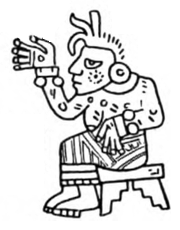 |
||
| Tonacatecuhtli | Xolotl | Ilamatecuhtli | ||
| Codex Borgia, 61 | Codex Borgia, 43 | Codex Vaticanus B, 33 |
As Spranz has pointed out, since Xolotl is a psychopomp, he can be expected to lead the "dead" Sun into the underworld. A scene that suggests this role is displayed in Codex Borbonicus 16, where Xolotl is shown opposite Tlalchitonatiuh, the dead Sun, who is represented as a mummy.
The whole scene is surrounded by a strip of water. The mortuary bundle represents the dead sun, that is, hidden, who is conducted by Xolotl over the waters to the underworld in the same way that the dog (Xolotl) is also the conductor of dead men to the realm of the dead. The corresponding scenes of Borgia 65 sq. and of Vaticanus 64 lack the mortuary bundle; there is a change over to the date 4-Motion, the name of the sun, with both figures of Xolotl.4
The matching of Xolotl with Four Motion, Tonatiuh, suggests that he may also have had some connection to the ascending Sun, the Sun of the upper diurnal world. There is a scene in Codex Borgia 34, analyzed by Boone, in which all the Caiman-connected gods appear together, and Xolotl presents himself in solar aspect.
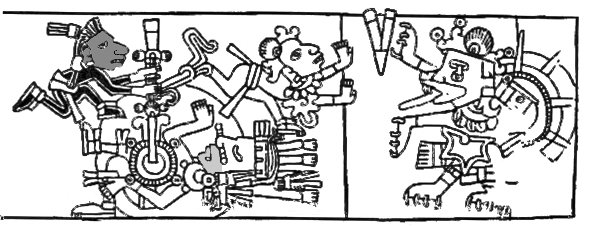
Boone has a rather bold interpretation of this scene.
In the sanctuary of the Red Temple on the next page [of the Codex Borgia] (34) the sun is finally born. Against the background of a solid red disk, a black warrior drills a fire on the chest of Tonacatecuhtli, lord of our sustenance, and from the smoke emerges a red curly-headed solar being. Immediately to the right, the being is enthroned in the temple. He now has canine claws and feet, a canine mouth mask, and a distended eye that identify him as a red Xolotl, and he bears the sun on his back. This birth of the sun is less dramatic than Sahagún's detailed account,5 for here the sun is simply drilled into being. But Sahagún describes the sun as red when it first breaks over the horizon,6 and the red disk behind the drilling may refer to such a burst of red at the first dawning. Xolotl also plays a role in two of the legends about the sun's creation, but he figures differently in each. Sahagún describes how, when the gods were asked to sacrifice themselves in order to start the sun on its journey across the sky, Xolotl fled and hid. In contrast, Mendieta assigns to Xolotl the honor of orchestrating that mass sacrifice himself.7 In either case, Xolotl figures prominently. In the Borgia, the red Xolotl is the sun.8
The New Fire ceremony involves the practice of starting the fire on the chest of a sacrificial victim. Since this is the beginning of a (not "the") Sun, the sacrifice is made by the primordial god of creation himself, Tonacatecuhtli. The being who floats horizontally in the air is painted entirely red. He and Xolotl himself both wear a butterfly pendant that is a standardized representation of fire (as we see in the illustration in this note).9 The foot of this spirit of fire melds into a stream of smoke, which may seem strange given that smoke emanates from fire, but it may be recalled from common experience, that when using a drill, smoke occurs before the punk bursts into flame. Xolotl assumes a stylized pose with his two mani that indicates that his nature embraces what falls between them. The two sticks represent the tlecuahuitl or fire drill set, and the red being in front of him is the fire-spirit of this heliogenesis. It may also seem strange that the red hair of the fire-being and of Xolotl both, take the standard contour of water, with a mollusk shell inserted as a determinative. The combination of fire and water, in Nahuatl, atl-tlachinolli ("water-fire"), is the standard symbol of war. This is reduplicated in the protruding red, canine tongue of Xolotl (dogs pant when hot), which is also presumably wet. This scene represents the emergence of a victorious Sun, either as Xolotl or guided by him, one that will fight the darkness back into retreat. This is the Sun of the Vernal Equinox. As we have seen, Tonatiuh is born on the Winter Solstice (4-Motion), and also is a Sun who fights successfully against the forces of darkness which had reached their peak at the moment of his birth.10 Therefore, the Sun of the Vernal Equinox is the twin of the Sun of the Winter Solstice, and is of the spiritual essence of the god of twins, Xolotl. We can now appreciate that the two 1-Caiman days, that give rise to the shared calendar name for Xolotl and Ilamatecuhtli, form bookends to the first Tonalpohualli year. The events of 1-Caiman of 13-House depict the New Fire ceremony, which in this instance not only creates the first Sun in the person or care of Xolotl, but initializes a new calendrical regime. The end of this sacred year is seen in the figure of Ilamatecuhtli, whose age reflects the full and complete passage of time. Her role as a terminator of temporal units is reflected in the fact that her festival occurred during the last veintena of the Aztec year. At the end of a 52 year calendar cycle she played an important role in the succeeding New Year's fire ceremonies when the past yearbundle was buried.11
The analysis of the Tonalpohualli's beginnings now gives us the missing Sun whose placement in the Vernal Equinox completes the full set of Suns needed to define the solar turning points.
|
|||||||||||||||||||||||||||||||||||||||||||||||||
Xolotl has some similarity to Yacatecuhtli, since both gods play an important part in travel. Xolotl is a psychopomp and guide, activities founded on skills typically employed by dogs on the hunt; and Yacatecuhtli is also called upon to guide travelers successfully to their destination. It is an obvious conclusion to have set the calendar in motion by two gods of guidance.  However, the matter is more complex than suggested by this line of thought. The counterpart of the Caiman sign among the Maya is Imix (Ymix).11.1 As a hieroglyph it is the same as the XE1 and XE2 glyphs denoting water, and we can see the dots representing droplets falling from the symbol within the glyph for God L, the ancient merchant god of the Maya. "A representation of a water lily flower, the imix sign is a well-known water symbol, and it is probable that the black dots represent falling water or rain."12 This means that God L, the most ancient precursor to Yacatecuhtli, is intimately bound to Imix. As an ancient creator god, it is he who stands at the head of the calendar, just as Tonacatecuhtli stands as both patron of the day Caiman, and the trecena Caiman. It should have been God L, the Toltecs' Yacatecuhtli, who started off the first Tonalpohualli count on 1-Caiman (= 1-Imix). Although Yacatecuhtli is the equivalent of God L as a deity of merchants, he is not equivalent to him as a god of creation. God L's true counterpart in this context is Tonacatecuhtli, although the former's associations with Venus as well as the realm of the dead may also tie him to Xolotl.13 Therefore, the Toltecs could not start this calendar off with Yacatecuhtli, but ultimately used Xolotl as the solar deity of the Vernal Equinox who obtained his New Year's fire from the very wellspring of creation, the body of Tonacatecuhtli. Nevertheless, the Toltecs honored the connection of the Vernal Equinox to God L, and derivatively to Yacatecuhtli, by assigning their own merchant god to the first Vernal Equinox of the Xiuhpohualli calendar. This broke his connection to the Imix-Caiman sign, but not to the water which the Maya sign represents. We see that Three Deer stands at the Vernal Equinox precisely because that marks the half-year in which the rains fall and signals the time when the distant pochtecas must contemplate their return.
[Revise: ...] The date 7-Water2 of 1-Rabbit (727 June 7) happened to fall on the very first day of Panquetzaliztli (XVI) in the Xiuhpohualli solar calendar. In later times, 1-Panquetzaliztli marked the Feast of the Raising of the Banners, which among the Aztecs honored their god of war, Huizilopochtli. This god is the successor to the earlier Camaxtli (Mixcoatl) of the other Nahua tribes. By a happy coincidence, the day for the god of the Autumnal Equinox happened to fall in the same veintena in which the Summer Solstice fell. So Macuilxochitl, the god of the Summer Solstice, had his name day fall on 12-Panquetzaliztli. The trecena in which 5-Flower fell was that of the Vulture, whose patron was Xolotl, the Sun god of the Vernal Equinox. The two gods Yohualtecuhtli and Macuilxochitl are both nocturnal Suns. Five Flower begins his career on the Summer Solstice, the day on which the Sun achieves its greatest power, but which in some sense marks an excess or overreach,14 since from that point on, he begins his decline and fall. He suffers the misfortune of witnessing the gradual triumph of darkness over light, until at the Autumnal Equinox, Yohualtecuhtli experiences the Sun's ultimate reversal of fortune, and darkness overpowers light. These are the times that the Sun must fight on in a losing battle, but one which, once the next solstice is reached, he will begin to win.
When, every fifty-two years, the ancient Mexicans lit the New Fire to guarantee the sun's return, they also reenacted its creation. In 1507, the ceremony took place during the Panquetzaliztli veintena, in which each year the creation of the sun and its triumph over darkness were reenacted.15
In a Toltec context, the Raising of the Banners symbolized the time of the year, running from the Summer Solstice (Five Flower) to the Autumnal Equinox (Seven Water) and on to the Winter Solstice (4-Motion), when the true battle by the Sun for his survival would take place. Like Summer Solstice celebrations elsewhere in the world, it marked the decline of the Sun, and its struggle to be reborn at the opposite solstice. In 1507, 1-Panquetzalliztli fell on November 24, so the veintena contained no turning point of the Sun at all. The use of this date had eventually become anachronistic due to the drift of the calendar.
If the days of the two nocturnal Suns fell within the veintena Panquetzaliztli, The Raising of the Banners, then what occurred in the Xiuhpohualli calendar on the day of Tonatiuh, the Winter Solstice of 4-Motion? Durán gives an account of a feast that clearly answers to the calendar day of Tonatiuh.
On the seventeenth day of this [first] month the Feast of the Sun took place16 – a most solemn occasion for the natives. This day fell on the symbol called Ollin, which means Motion, on the number four after the thirteen days had passed. It was called the Feast of Four Motion. Warriors and Knights of the Sun celebrated it, as the reader has seen ... where I dealt with the Feast of the Sun and his knights. On the seventeenth day of the month which we are describing, the symbol venerated was shown in the form of a butterfly. This feast was special; it was not counted among the eighteen contained in the year. It was celebrated twice a year, the second time on the second of December, because the sign for Motion, according to the count of thirteen days, fell again on that date.17
This means that whenever 4-Motion occurred, a feast was given for the Knights of the Sun. These were special warriors, called Cuachics, who had risen up from the ranks to achieve the position of noblemen. They had their heads shaven, except for a lock of hair over their left ear, which was tied by a red ribbon.18 The tie between Tonatiuh and the day 4-Motion can be traced to the Winter Solstice of 726 (4-Motion of 1-Rabbit). So if this practice dates back to the origins of Four Motion, then the first feast of the Knights of the Sun took place on 726 December 17. At this time there was only one 4-Motion day in a solar year (q. v.). Just as the Summer Solstice of 5-Flower marked the decline of the Sun, and his readiness to do battle against a foe sure to hem him in, so the Winter Solstice of 4-Motion marked the day when the Sun was in ascent, and would rise from the lowly origins (like a Cuachic), in the deepest pit of darkness, by the sheer dint of his warrior skills, to a great military triumph over the forces of darkness. So the two opposite sides of the year had been balanced by similar military festivals, as each is a turning point in the war between light and darkness.
Before leaving the topic of the Suns in relation to the 1-Rabbit calendar, we need to examine an interesting coincidence arising in the first Burner Cycle in connection with this calendar. The first Tonalpohualli began with the Vernal Equinox, with Xolotl as a solar counterpart to Yacatecuhtli, who occupied the same equinox in the first Xiuhpohualli year. It may be recalled that there are four Burner Lords: Four Snake, Four Dog, Four Eagle, and Four Flower. With what we must consider the most uncanny good luck, the first year of the Sacred Calendar worked out so that it not only started on the Vernal Equinox, but the calendar date of one of the Lords of the Burners, Four Eagle, fell precisely on the Summer Solstice.
| Date | 726 June 17 | 726 June 18 | 726 June 19 | 726 June 20 |
| 3-Jaguar | 4-Eagle | 5-Vulture | 6-Motion | |
| Azimuth @ Sunrise | 64° 35.665' | 64° 35.168' | 64° 35.055' | 64° 35.418' |
| Azimuth @ Sunset | 295° 24.674' | 295° 24.959' | 295° 24.772' | 295° 24.158' |
Times and azimuths are set for Cacaxtla, the times at Tula differing only by minutes. According to modern standards for determining the solstice, 90° 0.00' of ecliptic longitude was reached at 21:14:48 hours on June 18. At sunset, the difference in azimuth between 4-Eagle and 5-Vulture is 11 seconds of arc, whereas at sunrise, the difference is 6.8 seconds, showing that the solstice fell just barely within the day 4-Eagle. This makes Four Eagle a counterpart to Macuilxochitl, but did it make him a solar deity?
In Cacaxtla, Four Dog is God L, but who is Four Eagle? In Caso's list of calendar names, nothing answers to this designation.19 The Maya identity of Four Eagle is not known, and assigning a Nahuatl equivalent is greatly hampered by the fact that contemporary scholars make no mention of Seler's hypothesis that pages 42-46 of Codex Borgia allude to the Ah Toc rite. Scholars today disagree on a fundamental level as to what this section (and indeed the whole codex) is about. The central figure in the "Eagle House"20 of Borgia 45 is thought to be either Tlahuizcalpantecuhtli (Morning Star)21 or Camaxtli as Morning Star.22
|
||||||||||||||||||||||||||||||||||||||||||||||||||||||||||||||||||||||||||||||||||||||||||||||||||||||||||||||||||||||
All the solar "slots" are here filled by significant figures, although the identity of Four Eagle remains unsettled, and the Nahuatl candidates for his counterparts are not particularly solar. It is of interest to note that if Four Eagle is Tlahuizcalpantecuhtli, the latter is also the Nahuatl counterpart to one of the Bacabs,23 and is therefore associated with one of the cardinal points of space.
Before leaving this topic, we should note that if Seler is right in reading the inscription above Itzpapalotl on the Rock of La Capana as "4-Flower,"24 this would make Itzpapalotl one of the Lords of the Burner Cycle. In the first cycle, this date (726 August 22) happens to fall within both the first Tonalpohualli and the first Xiuhpohualli. That she is a Burner Lord is certainly appropriate to her mythology, as she ends in a conflagration when she is captured and incinerated by the Mimixcoa.25 One of the Nahuatl counterparts to the Bacabs may be related to her, specifically Otontecuhtli, a male counterpart to Itzpapalotl whom the Aztecs derived from the Otomí.26
§6. The Stars of the Wrist and Hand. Among the Hidatsa, a Western Siouan tribe, there is a myth that sets out the very origins of the Orion constellation.
A god named "Long Arms" (the Milky Way ?) was the chief among the stars. One day he reached down to earth and scooped up Spring Boy, one of the Hero Twins. He pulled him up through a hole in the sky and held him captive in the world above. The other Twin, Lodge Boy, finally discovered what had happened to his brother, and made a ladder of arrows to this celestial hole. After many adventures, he was able to recapture his brother from the tree upon which he was crucified.
They went out as spiders and the holy man knew all about it but could do nothing because the two together were too powerful for him. Long Arm went and placed his hand over the hole by which they passed through so as to catch them. Spring Boy made a motion with the hatchet as if to cut it off at the wrist and said, "This second time your hand has committed a crime, and it shall be a sign to the people on earth." So it is today that we see the hand in the heavens. The white people call it Orion. The belt is where they cut across the wrist, the thumb and fingers also show; they are hanging down like a hand. "The hand star" it is called.2
The three stars of the Cingulum are found on the wrist, as shown here.
 |
 |
|
| The Hand Constellation | ||
| Oglala Lakota Version | Crow Version | |
| Starry Night Software | ||
The story of the stellar hand is also known to the Lakota, who locate the hole in the sky in the trapezium of the Big Dipper. This is summarized below:
Fallen Star's mother was taken into the heaven to marry the brightest star of the Dipper's bowl, Dubhe (mag. 1.78). She had extracted a forbidden terpsin from heaven's ground, and it opened a hole from which she could see the earth below. She attempted to return with her infant son, but fell from the sky to her death. Her infant son survived, and later returned to his father's land through the hole in the Dipper. In this celestial land he visited the Star people. In one village the chief had lost his arm in a raid by the Thunderbirds, so Fallen Star undertook to bring it back. When he reached the Thunderbird villages, he changed into a wren, and in that form snatched the arm from the pot of boiling water in which it rested, then made good his escape by the use of several magical objects. The arm was rejoined to the chief, who then gave his daughter to Fallen Star in marriage. Their offspring was "the biggest star of the universe."3 The Hand (Nape) constellation in Orion represents the hand that was lost by the chief.4
In another version of this story, from Ella Deloria, the plot takes a very different twist, rather closer to the Western Siouan tales in some respects.
There were once two friends one of whom disappeared. The friend who was left behind set out to find him. One day in his travels he chanced upon a woman who led him to her teepee. There inside was a large man who had only one arm. He and his daughter were Buffalo People. They told him that his friend had gone off to retrieve the lost arm, so the man went out after him. He eventually came to a village at night where some kind of festivity was in progress. There tied near the top of a pole was his friend, and above him was fastened the arm of a buffalo (tatáŋka istó). So he turned into a mouse and gnawed through the ropes that bound his friend and secured the buffalo arm. When the dance became frenzied, they made their getaway. Finally, they arrived at the teepee of the Buffalo Man (tatáŋka-wićàśa), and there they glued back his arm with gumbo mud. Once they returned to their own village, they discovered that they had great luck killing large numbers of buffalo (pté).5
At this juncture, we can well appreciate that the asterism Three Deer overlaps with the Hand constellation. Three Deer among the Oglala is a ta-táŋka, and in the Deloria variant of the severed arm myth, the "Hand" (or rather manus) is also that of an anthropomorphic tatáŋka. Here, finally, we have a bridge between Tayamni and the severed Hand; but of equal importance, the figure who forms this connection is more than a ta, he is also a humanoid spirit. In Central Mexico, where Three Deer originated, he is one of the Belt Stars, and therefore also overlaps with one of the sticks of the Fire Drill constellation. It is this latter, the Mamalhuaztli, that has the intimate connection to the (severed) hand, the hand whose wrist replicates the three stars of the Cingulum. As we have already noted, the ancient Central Siouan translation of mazatl ("deer") is *ta. The asterism said by the Osage and Omaha to be Three Deer (Ṭa Thábthiⁿ) is none other than the Cingulum of Orion.6 The Osage Three Deer remains a single deity, addressed as "Grandfather." The three deities of the Mexican asterism, each associated with an individual Belt star, have among the Dhegiha become conflated and only one of them remembered to posterity.
The confusion of man (divinity) and beast may have arisen in a coincidence. We can now see that there is a sound correlation between part of the Oglala Tayamni and another Osage-Omaha constellation, called Ta-Pá, the "Deer Head." Probably cognate by inversion is the Hocąk Ca-šic, "Deer Rump." Both of these refer to the Pleiades. This star cluster is known to the Lakota as Tayamnipa, the "Head of Three Deer," which we know to be a ta, now a buffalo, but in antiquity a *ta or deer. It therefore seems likely that the Pleiades in Central Siouan antiquity were known as the "Deer Head." Over the centuries, the proper meaning of "Three Deer" as a calendar name was eventually lost. It is then a short step to seeing the Cingulum as the animal contained in the name "Three Deer." This process was accelerated by the existence of the asterism Deer Head not far distant. The Dakotan branch amalgamated Three Deer as a *ta with what was assumed to be its head. Then the bright white tail of the Virginia deer was added in the form of Sirius. So *Ta-Pá became "Three Deer's Head," and Sirius became "Three Deer's Tail." All this is the logical outcome of taking "Three Deer" to denote the animal called *ta, which gradually transmuted in meaning to "buffalo." The Cingulum then became Tayamnićaŋkahu, "Three Deer's Spine." This designation could simply be the result of the central position of the Cingulum in the overall image of the Great Ta constellation. However, given the ultimate origin of Three Deer, it could also have arisen from the name Yaca-huitztli, which we had already identified as another name for Three Deer himself. Yacahuitztli comes from yacatl, "nose"; and huitstli, "spine"; but yacatl functions as a metaphor meaning "slender." Therefore, Yaca-huitztli can mean, "Slender Spine."7 This is a reference to the three stars of the Belt of Orion, which form a thin spine. If they knew that Three Deer was also called "Slender Spine," that would surely have accelerated the amalgamation process that led to the giant Three Deer constellation of which the Cingulum is the Ćaŋkahu or Spine. Once knowledge that "Three Deer" was a calendar name disappeared, the process of amalgamation that led to the Lakota Three-Ta constellation seems inevitable. What is surprising, therefore, is that it did not take place among the Dhegiha, who continued to recognize Three Deer as both a star and a deity residing in the Cingulum of Orion. In the Winnebago-Chiwere (Wi-Chi) branch, the last of these Central Siouan language groups, the whole complex appears to have evaporated. However, as we shall see further on, important parts of it did in fact survive among them.
The Hand constellation myth of the Crow and Hidatsa is an episode embedded in a lengthy Twins myth, the outline of which we have already given. A Twins myth, very similar in many particulars, is also found in the Popol Vuh of the Maya. This story is rather disjoint in the Popol Vuh, but when it is put in proper temporal order, its resemblance is self-evident.
The Heart of the Sky, Huracán, was not happy with the world as he now found it. Instead of containing humans, it was inhabited by a race of wooden manikins that bore the mere outward appearance of human beings. These wooden people worshipped a giant scarlet macaw who lived in a silver nest. His name was "Seven Macaw" (Vucub-Caquix). He had puffed himself up, declaring that he was both Sun and Moon. This incurred the wrath of Huracán, who enlisted the support of the Twins (Hunaphu and Xbalanque), his loyal servants, to bring this pretender down. So the Twins went out hunting with their blowguns. They came upon the great nance tree upon which Seven Macaw was wont to feast. Hunaphu shot the giant bird with his blowgun. The projectile hit the macaw in one of his jade inlaid teeth, yet the blow was enough to send him to the ground. Hunaphu rushed forward to grab his prize, but in a sharp reversal of fortune, Seven Macaw grabbed the boy's arm and wrenched it out from its socket. He took this to his home, where he hung it over the fireplace. The Twins commanded an old married couple, who were itinerant doctors, to go with them to Seven Macaw. The Twins disguised themselves as little boys. When the couple arrived at Seven Macaw's dwelling, they offered to cure him. He was reluctant, since his teeth and eyes were his ornaments.8 The bird, who was most anxious for relief from his pain, had no idea that the two little boys with them were the very perpetrators of his misery. The doctors pulled all of his jade teeth out, and in the end, this resulted in his death. Once this false Sun and Moon was gone, Huracán unleashed a flood upon the wooden race. It was at this time that the three hearthstones exploded into the sky, where they are now seen as some of the stars of Orion. The wooden manikins that survived were transformed into monkeys.9
In the reversed Crow-Hidatsa stories, it is the Twins who pull off the arm of the bad spirit, but in the Lakota version, where there are no Twins, it is a chief who loses his arm to another race of supernatural birds, the Thunderbirds, who eventually place it into a kettle of boiling water. The hero who retrieved the arm was the son of the star Dubhe of the Big Dipper, and his son, born by the grateful chief's daughter, was "the biggest star of the universe." One of the Crow Twins was also said to be Dubhe. The Quiché maintain that Seven Macaw was the Big Dipper.10 His wife was named Chimalmat, clearly borrowed from the Nahua Chimalman, who was the wife of Mixcoatl and the mother of Quetzalcoatl (Venus). So in both cases, the grandson of the star Dubhe is connected to Venus. The extensive parallels in these stories are set out on a separate page.
| The Story of the Lost Arm |
The cognate Maya story is the oldest Twins myth in the Western Hemisphere.11 Within Mesoamerica it has a counterpart in a short Mixe myth,12 but even that story does not have as intensive an isomorphism to the Maya story as the Central Siouan versions do. It is hard to avoid the conclusion that myth of the detached arm, which has many associations with Orion as well as Ursa Major, grades into the Carribean myths in which, not an arm, but a leg is cast into the sky to form the Cingulum of Orion.13 These myths have a complementary version in which Orion is marked by a deity missing a leg or foot.14 This leg is often said to have been bitten off by a crocodilian, thus recalling Tezcatlipoca's lost foot, snapped off by Cipactli, and also recalling his counterpart,15 Huracán, whose name means "One-Legged One."16 Huracán, as Heart of the Sky, is connected to the Hearthstones of Orion.17
It is not especially puzzling that a group of stars known as "Three Deer" might come to be seen as a deer asterism. The real puzzle is how a deer asterism can have an alternate form as a severed hand. The Aztecs had a rite that fit into this pattern, uniting the human hand with these same stars of Orion. Orion, it may be recalled, was also worshipped as the Fire Drill (Mamalhuaztli), whose two sticks are the three Cingulum stars and the two stars and nebula of the Gladius Orionis. Sahagún tells us how everyone once honored Mamalhuaztli:
[Translation of the Nahuatl text:] And hence was it said that they resembled the fire drill (Mamalhuaztli): because when fire was drawn with a drill, and the drill bored, thus fell, ignited, and flared the fire. And also for this reason all burned [spots on] their hands [-matl-]; for this reason were we men burned on the hands [-matl-], to show awe of him [Mamalhuaztli]. He was feared and dreaded. It was said and considered of any whose hands [-matl-] were not burned that on his hands [-matl-] fire would be drilled in Mictlan (Spiritland), when he died. Therefore we men — every one — were burned on the hands [-matl-]. On both sides of each hand [-matl-] they arranged in order, in rows, the hand burns. Thus they represented the fire drill (Mamalhuaztli). In the same manner as [the stars] were arranged in order and in line, so also they placed in order, in rows, their burns on their hands [-matl-].18
[Translation of the Spanish text:] They name these stars mamalhuaztli, and by that same name they call the sticks with which they drill a fire: because it seemeth to them that they somewhat resemble [the stars] and that from them there came to them this manner of producing fire. From this is was customary that the men make certain burns on the wrist (muñeca) in honor of those stars. They said of him who was not marked by those burns that, when he died, there in hell they would produce fire on his wrist (muñeca), drilling it as those do who here drill fire with the stick.19
Sahagún's Drawing of Mamalhuaztli The Orion "T" of Cingulum
and Gladius StarsA Bow Drill Firestarter Florentine Codex20 Starry Night Software
In the illustrations above, Sahagún's drawing shows two lines of stars forming a slanted "T" which meet each other at an angle of 50°. This agrees well with the similar "T" derived from the astronomy program, where the angle measures 55°. Part of the ritual of this worship is, on the appropriate day, to burn marks on the wrist to create a likeness of the divine stars in Orion's "T". The Nahuatl word (ma) translated as "wrist" also means, "arm, hand,"21 but the Spanish text makes it clear that the wrist (muñeca) is meant specifically. It does not seem reasonable to suppose that all six stars are burned into the line of the wrist, since the inner stars of Orion form two sidereal lines at a significant angle to one another. The three stars of the Cingulum ought to have been cauterized on one side of the wrist and the stars of the Gladius on the other, otherwise the two angled rows would take up a significant part of the forearm. This is confirmed by the fact that Sahagun says that they were made in rows or lines, and that the three offerings to the mamalhuaztli were of that number "... because there are three stars." So when Sahagun says that an image of "the stars" was rendered in burn marks, it is highly likely that he means a row of three dots on each wrist, dorsal and ventral.
Much of Aztec mythology, and no doubt its associated rites, were strongly influenced by their Toltec kinsmen and predacessors. The Toltecs in turn, in the early days when their calendar count was initiated, were outright vassals of the Olmec-Xicalanca.22 These basic facts put us in a position to understand why the wrist was the object of attention in a rite that honored a god of these Orion stars. We know from the reflexes of Three Deer in the far north that this deity was associated with the Cingulum. The northern reflexes ultimately derive by an unknown agency from the Olmec-Xicalanca god Three Deer seen depicted in one of their cities, Cacaxtla. This god received his calendar name from the Vernal Equinox, which fell on the date 3-Deer in year 1-Rabbit of what has hitherto been called the "Toltec count." We can now see that at least in the city of Cacaxtla, this count had been in place among the Olmec-Xicalanca peoples at a time when they were at the zenith of their power and influence, at a time indeed when the Toltecs were probably nothing more than Chichimec vassals. The Olmec-Xicalanca represent a kind of half-way house between the Maya and the Central Mexicans (such as the Toltecs). Their gods are generally Maya, as is much of their style of art; but most of their day signs are rendered in the fashion established in Central Mexico. Of special interests to us, of course, is the day sign Mazatl, "Deer." In Central Mexico, this sign is rendered by various glyphic synechdoches for a deer. Usually it is a depiction of a deer's head with or without antlers, but in some cases it is simply antler or a lower leg with hoof.23 Among the Maya, the sign for this day, which due to the mathematics of the order of their signs is one of the four year holder signs, is generally called "deer." [intensive discussion] ... Therefore, they seem to be equivalent signs, except that the Maya sign, as with their Rabbit day sign, does not match the expected iconography. Instead we have an image of a slightly cupped hand. Where its wrist is located, we find instead a circle with a dot in its center. This actually represents a wrist bracelet,24 but it gives the hand the appearance of having been cut off at the joint. As a hieroglyph, this cupped hand has its own meaning, viz., "to grasp, receive."
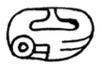 |
 |
|
| Manik Glyph | Manik Glyph, Central Mexico | |
| Codex Tro-Cortesianus 25 | Tepoztecatl, Tepoztlan, Morelos, Mexico26 |
It can be seen that at least one city in Central Mexico carved a more profile view of the hand as its Deer glyph on one of its temples. Let us imagine this hand with the Cingulum stars burned on its wrist:

Dots are the standard coefficient glyph in Mesoamerica, so a real hand with three dots on its wrist would denote a particular day in the symbolism of the calendar. Three dots ("spots" in the rite) prefixed to a hand glyph is a standard enough way of rendering 3-Manik, which is to say, 3-Deer. The obvious, if somewhat esoteric, meaning of placing three spots on the wrist is to represent the Maya 3-Manik sign, and the calendar name of the god Three Deer. Even though the 3-Manik sign was not used by the Olmec-Xicalanca of the early VIIIᵀᴴ century, their priests surely knew of it, since their participation in things Maya was quite extensive, and knowledge of this sign is elementary. As we have seen, it was actually used in a Central Mexican temple at Tepoztecatl. So we can say with certainty, that in Maya iconography at any rate, three spots in a row on the wrist of a hand can serve as a symbol of the calendar designation 3-Deer. What the Aztecs called Mamalhuaztli, and most particularly the three divinity-stars of the Cingulum, were the stars that the Olmec-Xicalanca, and no doubt their vassals the Toltecs, called "Three Deer." That an Aztec rite honoring these stars of Orion "spells out" the calendar name "Three Deer" in Maya symbolism strongly argues for an origin among the Olmec-Xicalanca who are a "bridge people" between the Maya and the Central Mexicans. By "spelling out" the calendar name "Three Deer" on their own bodies, they become living exemplars of the deity. Thus, the rite makes every man somewhat like an Ixiptlatli, or god-impersonator. The Aztecs seemed to know nothing, as far as we can tell, of Three Deer and of the reason for using the hand for cauterizing his calendar name's coefficient precisely on their wrists. This may be due to the fading "Three Deer" as an equinoctial name. After having marked the Vernal Equinox at 42 year intervals from +727 to +1063, on account of its very slow calendrical drift, the day 3-Deer lost its connection to the equinox altogether.
In the versions of the Lost Arm story in the northern plains, the Hand constellation that is the counterpart of Three Deer, belongs to Long Arm, who in the story grasps one of the Twins in order to receive him into his heavenly domain. It is this precise travesty that the hand in the stars is meant to commemorate. The northern versions have created a hand-grasping event tied intimately to the hole in the heavens that passes directly beneath the star group otherwise known as "Three Deer." The Maya representation of the day, or name, Three Deer, would be a detached hand with three coefficient discs. Instead of the iconographic transparency of the Central Mexican deer head, we have a Maya calendar name that might be better described as "Three Hand." If such an equivalence were known, the insistence that Three Deer is a deer asterism would have to have been accompanied by a recognition that it is also a (severed) hand asterism. This is exactly what we find among the Sioux, who have a Three Deer constellation and at the same time its proper alternant, the Hand stars of Orion, which found its way into the sky by the presumptuousness of the ruler in illo tempore. The northern versions of the Orion story of the Lost Arm have gone further and have explained exactly how the Three Deer stars are not only connected to the image of the hand, but to grasping.
The hole in the sky would be located near the palm. Here we have something similar to the drill hole in the palm of the hand as well as the three stellar marks on the wrist of the worshippers of Mamalhuaztli. So in the north, the Belt Stars form a sidereal image of the wrist, whereas in the south, the human wrist is used to form a sidereal image of the Belt Stars. Both images are created in the Otherworld, and both are the product of a crime whose punishment is for the edification of those on earth. The punishment consisting of the institution of the manual image of Orion is for a transgression against the god who commanded this space. The hands are those of wrongdoers, and it is through their hands that they suffer the punishment. The myth-rituals, north and south, seem to tell different stories, yet at another level they are highly isomorphic. As we shall see, both the Mexican concept of Orion, and that of some of the Boreal tribes, have to do with transit from the Otherworld.
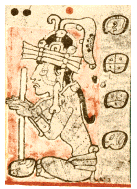 There are pictures of deities drilling fire into the manik-hand in Codex Dresden 6b [inset]. The actual meaning of this panel may be rather remote from our present consideration, if it can be known at all,27 but we also find pictures of deer being drilled by fire sticks, and in some cases, by scorpion stingers. In Central Mexico, the deer was used as a symbol of fire, or of the Sun itself.28 The Nahua peoples, as we have mentioned, also image an otherworldly state-of-affairs in which fire is drilled into an actual hand. If Yacatecuhtli were the inspiration of God M, whom the Maya later designated Ek’ Chuah, and if Yacatecuhtli is one of the stars of the Belt of Orion, then Ek’ Chuah might well have retained a scorpion identity as well. As the Cingulum is one of the sticks of the Mamalhuaztli Fire Borer, it therefore produces the fire. Consequently, Ek’ Chuah would be expected to have been associated with the production of fire. We actually find this in his very name: ek’ means "star" or "black," and chuah means "scorpion," yielding the translation, "Black Scorpion."29 Nevertheless, "Scorpion" fits well enough with "star," to make Ek’ Chuah (God M) the Scorpion Star. The Scorpion asterism is essentially the same as the Old World's Scorpius, but the name is also compatible with just a single star. Because a scorpion sting produces an intense burning sensation, its stringer was associated with fire. If Ek’ Chuah was in origin an outgrowth of Yacatecuhtli, then this initial identity with the fire stick in Orion will have made him, in the shared symbol system, a god of the scorpion sting. So we find him, or at least a god exactly like God M in every other respect, depicted in the codices as having a scorpion tail terminating in a stinger.30 To the Quiché, Orion is "dispersed fire" (je chi k’ak’), and the Belt Stars are said to be the tail (je’) of the Three Fire Lords.31 These facts help confirm the proposed identity of Yacatecuhtli with Yacahuitztli, and his placement, therefore, in the Cingulum of Orion. This pyrrhic feature is also found in God M's other predecessor and counterpart, God L, the Maya merchant god of Classic times. The black color of the god probably also derives from his associations with the dark clouds that carry the fire of lightning.32 God L often carries around a manikin deity given the designation "God K," a god of lightning and fire, known in recent times as Kauil.33 The old merchant god's connection to Kauil not only recalls God M's association (as Three Deer) with the manikin Bacab, but aligns God L with the ignition of fire. These considerations may explain why the merchant god of the Nahua tribes was included among the stars of the Fire Drill.
 |
 |
|
| The Three Hearthstones Over the Turtle Asterism (Orion) |
The Hearthstones and the Principal Stars in the Area of Orion |
|
| Madrid Codex 71a | Starry Night Software |
§7. The Hearthstones. In the myths of "The Lost Arm," some northern versions relate how the hand of a malefactor was thrown into the sky to form some of the stars of Orion. This episode corresponds in the Maya story to the explosion of the Hearthstones into the firmament to create a part of this same Orion constellation (although otherwise, the detached hands of the Boreal tribes match the detached arm of Hunaphú). These Hearthstones were at the time in the possession of the manikin people whose overlord was Seven Macaw. Huracán, whose flood cause their ejection into the sky, is the counterpart of the Nahuatl Tezcatlipoca. Tezcatlipoca turned himself into Mixcoatl and created the first fire using the fire drill.26 Since the stellar Fire Drill is Orion, Huracán aligns with Mixcoatl through this asterism. The Hearthstones themselves were integrated into Nahua religion, although they may not have originated there. In the very beginning of the Aztec peregrinations, Itzpapalotl ordered the assembled tribes to shoot arrows in the four directions, "And when you have done your shooting, lay them [the arrows] in the hand of Xiuteuctli, the Old Spirit, whom these three are to guard: Mixcoatl, Tozpan, and Ihuitl. These are the names of the three hearthstones."27 Xiuhtecuhtli is, of course, the Fire. Among the Maya, "Alnitak (in the belt), Saiph, and Rigel, are known as the 'Three Big Stars' / oxib nima ch’umil /. [Our informant] Andrés described these as the three original stones [oxib xc’ub] surrounding the indoor cooking fire, on which women balance their clay cooking surfaces and pots.28 He interpreted the Great Nebula, M42 in Orion, located just below Theta on the sword, as hazy smoke from the cooking fire between these stones."29 The smoking star (as even the distant Blackfeet call it),30 no doubt is the place of Xiuhtecuhtli, and the three Hearthstones must be, by definition, surrounding him. Since Alnitak is one of the three Belt stars of Orion, forming one of the Fire Sticks with which Mixcoatl(-Tezcatlipoca) drilled the first fire, it appears that Mixcoatl has a special relationship to the star Alnitak, both as Fire Drill and Hearthstone.
When we align the veintenas to the seasons, so that the Vernal Equinox falls within Tlacaxipehualiztli, in Year I of the Toltec count, we find that the whole of Mamalhuaztli had ascended into the sky after sunset. We may recall what Sahagun had said about the tribute paid Mamalhuaztli:
These people paid particular reverence and [made] special sacrifices to the Mastelexos in the sky ... when they newly appeared to the east after sunset.
When did this first occur on the ancient Toltec calendar? We can track the complete rising of Mamalhuaztli just after sunset, which coincides with the heliacal rise of Nair al Saïf, the last star of the Gladius of Orion:
| Heliacal Rise of Alnitak | 18:02:30 | 17:59:33 | 18:00:33 | ... | 18:01:36 | 17:58:39 | ... | 17:58:43 | ... | 18:01:54 | 17:58:58 |
| Heliacal Rise of Nair al Saïf | 18:05:08 | 18:02:12 | 18:03:12 | ... | 18:04:14 | 18:01:17 | ... | 18:01:21 | ... | 18:04:24 | 18:01:29 |
| Sunset | 18:01:00 | 18:01:13 | 18:01:09 | ... | 18:01:02 | 18:01:18 | ... | 18:01:18 | ... | 18:01:08 | 18:01:25 |
| Julian Date | 6 Dec 726 | 7 Dec 727 | 6 Dec 728 | ... | 6 Dec 733 | 7 Dec 734 | ... | 7 Dec. 738 | ... | 6 Dec 812 | 7 Dec 813 |
| Tonalpohualli | 6-Death of 1-Rabbit |
8-Grass of 2-Reed |
9-Motion of 3-Flint |
... | 2-House of 8-House |
4-Water of 9-Rabbit |
... | 9-Dog of 13-Rabbit |
... | 10-Flint of 9-Flint |
12-Lizard of 10-House |
| Xiuhpohualli | 18-Tepeilhuitl | 19-Tepeilhuitl | 19-Tepeilhuitl | ... | 20-Tepeilhuitl | 1-Quecholli | ... | 2-Quecholli | ... | 20-Quecholli | 1 - Panquetzaliztli |
The Heliacal rise of Nair al Saïf represents the new appearance of Mamalhuaztli after sunset. It can be seen that from the year 733 through 812, the rites of Mamalhuaztli fell during the veintena of Quecholli. This veintena was devoted to honoring the god Mixcoatl-Camaxtli, the god of the hunt, of war, and the tribal god of the Toltecs and most other Nahua tribes. The first Yearbundle ended with the year 778, so for 45 of the 52 years, the rites of the Fire Sticks coincided with the rites of Mixcoatl. This may well be how Mixcoatl was introduced into the Hearthstones, and reinforces the impression taht the Hearthstone in question is that positioned at the star Alnitak, the third star of the Cingulum of Orion.
[Ek’ Chuah and the Hearthstones. Yacatecuhtli, successor. Gabrielle Vail, "Cacao Use in Yucatán Among the Pre-Hispanic Maya," in Chocolate: History, Culture, and Heritage, edd. Louis E. Grivetti and Howard-Yana Shapiro (John Wiley & Sons, 2011) Chapter 1, 1-21 [6]. Note: pages were unnumbered in the copy viewed, so the page numbers refer to Chapter 1 only. Chantico and Orion. Yacatecuhtli is aligned with the Vernal Equinox because that Sun was bored into existence. He is the vanguard for the rise of the victorious Sun.] It does seem odd that a merchant god would be connected to the complex of symbols surrounding the Cingulum of Orion and neighboring stars, but the earliest merchant god with whom we are acquainted is at the very root of both the transit of souls and the celestial Hearthstones. As the principal lord of the underworld,31 we see God L in the Vase of the Seven Gods and in the Vase of the Eleven Gods sitting on a jaguar throne presiding over subterranean deities.32 Here the jaguar is the creature of the underworld. God L seems to have originated as a chthonian god. In this respect he shows similarities to the Greek god Ploȗtos. As one of the great gods of the Lower World he also governs the riches found there, the veins of metal and of valuable stone. Like Demeter and Persephone, he is responsible for the fertility that arises from the earth, for the abundance of grains and fruits. He is lord of darkness, and as a dimension of his powers of fertility, he is in some way responsible for the dark storm clouds that supply the life-giving waters to the earth. These expressions of his nature cause him to be paired with the rain god Chac. As a Plutonic god of wealth and abundance, God L can easily find expression as a god of merchants who are purveyors of such goods at the peripheries of their cultures.
It is clear from a number of Classic era depictions and inscriptions, that God L, as Lord of the Underworld, had an important role in the creation of the cosmos itself. Some of these inscriptions tell us that the world was created on 13.13.13.0.0.0.0 in the long count, which is the date 4-Ahaw 8-Cumku, -3113 September 20 OS.33 The events described in the Maya version of our "Lost Arm" myth took place sometime prior to the recreation of the world. A Classic period vase
depicts one of the Hero Twins ... and a great bird who is trying to land in a huge ceiba tree heavy with fruit. The mythical bird is Itzam-Yeh, Classic prototype of Wuqub Kaqix, "Seven-Macaw," of Popol Vuh fame. In that story, in the time before the sky was lifted up to make room for the light, the vainglorious Seven-Macaw imagined himself to be the sun. ... This pot shows One-Ahaw [≈ Hunaphu] aiming at the bird as he swoops down to land in his tree. As Itzam-Yeh lands on his perch, the text tells us he is "entering or becoming the sky." ... It is the final event that occurred in the previous creation before the universe was remade. ... If the date on this pot corresponds to that pre-Creation event, as we believe it does, then Itzam-Yeh was defeated on 12.18.4.5.0 1 Ahaw 3 K’ank’in [-3150 June 23 OS].34
Itzam Yeh is often depicted as holding something in his mouth that the inscriptions call a ki, "heart." Ki can also refer to the Heart of Heaven, which in more recent times is the North Star, Polaris (α Ursa Minoris). However, in the late IVth Millennium b. C., Polaris was not the North Star. Instead, there was a blank space around which the field of stars rotated. This was the Heart of Heaven,35 and may have also been what Itzam Yeh carried in his mouth. In later versions of the story, where the bird is called Seven Macaw, he carries the arm of Hunaphu in his mouth, suggesting that this arm may represent the Little Dipper of Ursa Minor, which is shaped like an arm and hand. On the Creation Day of 4-Ahaw 8-Cumku,
Under the aegis of First Father, One-Maize-Revealed, three stones were set up at a place called "Lying-down-Sky," forming the image of the sky. First Father had entered the sky and made a house of eight partitions there. He had also raised the Wakah-Chan ["Raised-up-Sky"], the World Tree, so that its crown stood in the north sky. And finally, he had given circular motion to the sky, setting the constellations into their dance through the night.36
The house of eight partitions refers to the cosmos divided into its cardinal and semi-cardinal points, and the three stones set up where the sky lay prostrate on the earth, were the three Hearthstones.37 So, before the present cosmos was created by First Father, the three stones were placed on the ground where the collapsed sky had fallen, and when the sky was once again raised up, the stones too found an image in the Above World as the Hearthstone stars of Orion. The Classic period Stela C of Quirigua in Guatemala tells us about the setting of these stones in their places. It opens with the Creation date: 13-0-0-0-0, 4-Ahaw 8-Cumku.38 They go on to say,
The Jaguar Paddler and the Stingray Paddler seated a stone.
It happened at Na-Ho-Chan, the Jaguar-throne-stone.
The Black-House-Red-God seated a stone.
It happened at the Earth Partition, the Snake-throne-stone.
Itzamna set the stone at the Waterlily-throne-stone.39
So at the place and time of Creation, the three Hearthstones were set by three gods, and each stone was also a throne. All this occurred at the place called "Lying Down Sky, First Three Stone Place." The vases of the Seven Gods and of the Eleven Gods are also dated 4-Ahaw 8-Cumku.40 Here we learn, however, that the deity presiding over those who set these stones in place is none other than God L.41 He himself is seated on the Jaguar Throne Stone.42 These facts connect God L, who also developed into a merchant god, to the celestial hearthstones of Orion, one of which is found in the Cingulum of that asterism and functions as the place where he is seated. That the god who may have been the prototypical god of subsequent merchant deities in Mesoamerica is also enthroned among the stars of Orion may help explain how Yacahuitztli (= Yacatecuhtli ?), a presumed merchant god, was himself situated in the Belt of Orion, where he was likely known at one time by his calendar name, "Three Deer." Furthermore, God L, as ruler of the underworld of Xibalba, receives the souls of the departed who trek there via the Milky Way. This may help explain how Yacahuitztli also became concerned with the transit of souls, albeit with the emphasis on the other direction (birth).
The Lakota have ideas similar in some ways to those of the Maya. They believed that the first world was destroyed by a flood. "Only the heart of Everything That Is [the Black Hills] remained and it stood higher still as the first of all places."43 In the very center of the Black Hills, "the first of all places," there exists a great outcrop of rock called "Slate Prairie," which is known to the Lakota as Tayamni ("Three Deer").44 It cannot escape our notice that this bears the name of the noted asterism. The Lakota believe that the hill resembles the Tayamni constellation and that it, and the rest of the Black Hills generally, can be mapped onto the asterisms of the night sky.45 This Mesoamerican-like view could perhaps be dismissed as convergent evolution of thought were it not for the name Tayamni, here both the name of the center of creation and the constellation containing the stars of Orion that bears this famous calendar name. Just as the Maya Hearthstones were at the center of the world, then raised into the sky as stars in Orion, so Three Deer was the first of all places raised into the sky to form the center of the Orion constellation.
We have supported the contention that the asterism called Mamalhuaztli ("Fire Drill") is to be identified with the Belt and Sword of Orion as its two constituent sticks. We are now in a position to understand why this set of stars would naturally be conceptualized as a fire starter of some kind.
1. The Cingulum, which is like a bow, is nearly at a right angle to the Sword stars, which form the bore stick. Within the line of these stars is the smoking star, the Orion Nebula (M42). It is this smoke-like patch that is identified by the Maya as being the fire around which the Hearthstones were set. Therefore, the Mamalhuaztli stars are exactly in the position to start the fire contained within the celestial circle of the Hearthstones. Given the position of these Orion stars, it would seem that they must be integrated and bound to the important fire that constitutes the Heart of the Sky.
2. In the far north, the deity or animal Three Deer is centered on the Cingulum of Orion. This means that the stars of Three Deer overlap those of Mamalhuaztli. Among the Olmec-Xicalanca people, we discovered that the feast day of Three Deer was originally 3-Deer of 1-Rabbit, which fell precisely on the Vernal Equinox. In colonial times, it was during the Vernal Equinox that the New Fire ceremony was enacted. The first Tonalpohualli year began on the Vernal Equinox of 13-House, which probably favored this time in Year I of the calendar, just as it had in much later colonial times, where we may see it as a persistence of an ancient practice. Therefore, as a god of the Vernal Equinox, Three Deer will have been associated with the New Fire. Consequently, the star(s) of Three Deer will have been associated with the fire borer with which the New Fire is ignited. We thus see how this equation stimulated the conception of these stars as a fire drill.
3. The (presumably Olmec-Xicalanca) rite in honor of the Mamalhuaztli was esoterically conceptualized not in terms of the Central Mexican iconography of 3-Mazatl, but the Mayan iconography of 3-Manik, a hand with three dots representing the coefficient "3." The image of the stellar hand asterism among the boreal tribes places the three stars of the Cingulum precisely at the wrist (in all versions of the Hand). Among the Dheghia, this is specifically where the god Three Deer dwells. Therefore, when we find the god of these stars honored by cauterizing an image of two sets of stars (Cingulum and Gladius) on opposite sides of the wrist, we see the exemplification of the identity of this god and his own stars with fire.
These considerations reinforce the identity of these Orion stars with Mamalhuaztli and show how a systematic set of ideas congealed around the Cingulum of Orion, the original calendar of the Toltec count, and the Vernal Equinox. It is out of this that Three Deer emerged as a deity integral to an asterism set not in the Central Mexican image of a deer, but in the Mayan image of a hand.
§8. The Portal of Souls. [Drilled with Mamalhuaztli. Hole in hand a punishment. Connected everywhere with Orion. Mixcoatl & Redhorn. Maskettes are souls. Human Head Earrings presides over souls (maskettes). Mixcoatl presides over souls. Milky Way as Path of Souls is both Mexican and Central Siouan. "Modern Yucatec references to the Big Dipper or Ursa Major as the "seventh sacrament" seem to link the Big Dipper to the Catholic last rites performed just before death (Redfield and Villa Rojas, 1962: 206)." Milbrath, Stars Gods, 274a. Vacub Caquix = Big Dipper (Tedlock). Uncertain. Milbrath, 274a-b. Same alternance between Dipper and Orion. The hand of Long Arms captures an earthling and transports him to heaven = Orion. The hole allows for a return trip. Mississippian hand with hole. Merchant gods and navigation in the Otherworld. Redhorn guardian of souls: master of "arrows"; cures wounds; has souls on ears. All that is really needed is a deity in the Cingulum who presides over souls. Natural association: dead Sun should govern dead souls.]
In Central Mexico, the Belt Stars of Orion have much to do with newborns. Although the goddess of the cradle also sees to the welfare of the neonate, yet "it is true that our mother, our father Yoaltecutli, Yacauitztli, Yamanyaliztli sent it." Here the two gods and the goddess of the Cingulum, collectively called "mother and father," are responsible for having transmitted the soul of the child down to earth. Once born, this divine triad continues to govern the children, helping them to fall asleep at night when these deities are among the stars above. Since the stars of the Cingulum pass the soul of a child down to earth, it follows that Orion represents the transit point of souls descending from the higher heavens. As a transit point, we may view it as an opening between heaven and earth. To show that this is not just a happy coincidence, there is yet another striking parallel among the Western Siouan Hidatsa.
The boys went back to the place where they had left the arrows sticking in the ground, pulled out the arrows and went home to their mother. She told them that the people in the sky were like birds, they could fly about as they pleased. Since the opening was made in the heavens they may come down to earth. If a person lives well on earth his spirit takes flight to the skies and is able to come back again and be reborn, but if he does evil he will wander about on earth and never leave it for the skies. A baby born with a slit in the ear at the place where earrings are hung is such a reborn child from the people in the skies.21
So it is through the hole in Orion that souls come to earth. This is true in both Mexico and in the far north, and not just among the Hidatsa. Similar views are held by the famous Oglala Band of the Lakota nation, a people of Central Siouan stock.
While cleansing the baby for the first time, the midwife and her helpers carefully examined the child for any marks. For example, ear lobes already pierced or Sun Dance scars on the chest. If these were found, they knew that this was an old soul reincarnating.22
However, among the Oglala23 as well as the Crow (who are closely related to the Hidatsa),24 the hole in the sky has shifted to the square of the Big Dipper (Ursa Major). This switch from one side of the Milky Way to the other has to do with one of the functions of the hole in the sky. It is through this portal that the dead reach the Path of Souls, which among a vast number of tribes is the Milky Way.24.1 To enter the Milky Way from Orion, one must turn left, the side almost universally associated with the wrong direction. By placing the hole in another trapezium, in this case that of the Big Dipper, the soul can access its path to Spiritland by making a right turn. This two-way path is presided over in part by a goddess rather similar to Yamaniliztli-Yaolticitl.
"The Wanagi [Ghost] comes up into the spirit world through this hole which was made when Fallen Star's mother dug out the first wild turnip. ... Prayed to by Lakota midwives, Ṫo Wiŋ, "Blue Woman," is a spirit who inhabits the area around the hole in the Big Dipper. Ṫo Wiŋ (or Ṫoŋ Wiŋ, "Birth Woman") is called on to aid women in labor, easing the pain of childbirth. "Blue Woman" also assists the spirits of newly deceased humans in being born back through the hole into the spirit world."25
Although Birth Woman is primarily concerned with the descent of the souls of children into the womb, her regency naturally expanded to include the transmigration of souls in either direction. She is present as the wanagi come up as well as go down through the hole in the sky where she is seated. She is positioned like God L, and like the Maya, the Lakota believe that the souls of the dead pass on to the Milky Way road. She is most similar to Yamaniliztli, stationed at the hole in the sky in order to pass a soul from its celestial place of genesis into the womb of the pregnant mother on earth. This hole has been switched from the right side of the Milky Way (Orion) to its left side (the trapezium of the Big Dipper). The existence of the Lost Arm Myth among the Lakota, where the constellation of the Hand is still Orion, suggests that the Big Dipper has replaced an earlier Orion as the hole through which souls transit. This is reinforced when the exact path is explicated. The Big Dipper is also known as the "Stretcher" (Wiċak̇iyuhap̄i), where the four stars of the bowl are seen as four men carrying a dead man.26 They carry him to the Milky Way, which he enters through the Sacred Hoop (Ċaŋ Gleṡk̇a Wak̇aŋ),27 a great circle of stars also known as the "Race Track" (Ki Iŋyaŋk̇a Oċaŋk̇u).28 They run from Procyon to Gemini (Castor and Pollux), then to Menkalinan (β Aurigae) and Capella to the outer stars of Tayamni (Pleiades, Rigel, and Sirius), returning to Procyon to complete the hoop.29 This Sacred Hoop is said to purify the souls who pass through it, and is therefore homologous to the lodge of purification, the sweat lodge.30 Even though the hole in the sky through which the transmigration of souls takes place is found in the Stretcher, they still retain a role for Three Deer in the progress of the soul to or from Spiritland. Indeed, it is said that Tayamni is an "animal, perhaps the buffalo, symbolizing all life, [as it] appears to be emerging (or being born) out of the hoop of stars."30.1 This recalls the Aztec concept of the supervision of birth through the agency of the deities enthroned within this same set of stars.
The Oglala have correlated the stars of the Big Dipper with stages in the progress of life. We know the names given the stars and the stages of the Women's Life Path (Wiŋ Oye Ya) in order, but we only know the names for the Men's Life Path (Ća Oye Ya).31
| Order | Star | Wiŋ Oye Ya | Ća Oye Ya |
| 1 | Alkaid | Oiŋ Śa (Red Earring) | Tokahe (First), Hoġan Luta (Red Fish), He Iŋkpa Luta (Red Tipped Horn), He Haka Luta (Red Elkhorn), Ziŋtkala Luta (Red Bird), Waŋbli Luta (Red Eagle), Wićaśa Ya Ta Pika (A Man Whom Everyone Praises) |
| 2 | Mizar | Wáćiŋhe Śa (Red Headdress) | |
| 3 | Alioth | Paŋkéska Śa (Red Shell) | |
| 4 | Megrez | Isaŋ Śa (Red Knife) | |
| 5 | Phecda | Śuya Śa (Red Feather) | |
| 6 | Merak | Nape Śa (Red Hand) | |
| 7 | Dubhe | Wiŋyaŋ Śa (Red Woman) |
All of these nominal variations on the theme of red recall the name "Redhorn" whose referent is placed in a star in the counterpart asterism of Orion on the opposite side of the Milky Way. In the Lakota stages of life, red becomes the focus of interest from the color of life-giving blood. It's as if one's life were handed off from one stellar red spirit's patronage to another's until finally the sojourners realize the fate of all mortals by returning to the center out of which they were born. Just as life traces a path through time, so this Road of Life and Death is reflected as a path through the stars, a path ultimately leading to the Path of Souls in the Milky Way.
In the Lakota versions of the Lost Arm myths, a red Spirit is able to ascend through the hole in the sky by being drawn up by a twister. This was Red Calf, whose buffalo form mirrored the tataŋka in the stars of Tayamni. The whirlwind exemplifies the Lokata concept of the kapemni, the "V" shaped vortex that expresses at once holiness and centrality.31.0.0 In Plains Indian sign language it is this "V" made with the fingers with the hand rotating upwards in a spiral that denotes wakaŋda, "holiness, medicine."31.0.1 In Central Mexico, much the same concept is expressed by the malinalli, a double helix, in which one strand represents ascent, and the other descent.31.0.2 The malinalli is an instance of the well known Cosmic PIllar or Column of the Old World.31.0.3 It is found in connection with the Hand and other symbols asssociated with the Path of Souls in the famous Willoughby Disk from Mississippian Moundville, Alabama.
 |
| The Willoughby Disk, Ala-Tu-M231.1 |
Appropriately enough, the Cosmic Column on the WD is located in the center of the composition. This set of twisted cords, best described as a malinalli, goes straight up and down, connecting as such columns do, the Above World with Earth. The heads (which are not skulls since they have noses) are facing opposite directions, the one on top is proceeding downward, since the spiraling cords point in that direction; the lower head is going up in the direction that his spiral inclines. The head is elliptic for the soul almost everywhere on earth.31.2 Therefore, the top head represents the soul coming down to Earth from the Above World, and the lower head represents the soul of the departed rising upward from Earth to the Above World where the Path of Souls is found in the stars. And where is that path? As we have seen, the entrance to the MW was in earlier times found in the opening below the Cingulum of Orion, which was represented as a Hand asterism. The Star Boy elements found in the northern versions of the Lost Arm myth all have episodes in which the mother of Star Boy uproots a terpsin that plugs the hole between cosmic levels. Upon its removal, she is able to peer down through the opening and see the earth below. Frequently, the Mississippian Hand representations show a stylized eye in the center of the palm just below the wrist stars of the Cingulum,31.3 just where the hole is located. In other instances, a mere hole is represented there,31.4 or a symbol of the Center.31.5 It may be considered puzzling that there are two hands shown, but this is to depict both the Hand as seen from above, and as seen from below, to capture the two directions in which souls transit, just as we saw in the central malinalli composition. The general theme of up vs. down is carried through with the remaining two images. Pointed straight down is a picture of a Lepidopteran (a butterfly or moth) which archaeologists have nicknamed "Mothra," and pointed upwards is what is known as a "bilobed arrow." The name "Mothra" was intended to be applied to a new supernatural, but there is some question as to whether this oversimplifies the problem. For instance, in one gorget a figure generally accepted to be Morning Star (of Venus) is shown holding two mothras.31.6 This would make it impossible that it is a single deity, and may call into question whether it is a deity at all. The claspers at its distal end are male sex organs. The back wing is not outlined, although the spot on its surface is rendered as a target design. Lankford has argued that such a design often functions as a representation of the Cosmic Column as seen from above or below.31.7 The completely counterfactual proboscis, which has a rasp-like structure, curls into a spiral, again recalling the malinalli version of the Cosmic Column. Given the theme of the transposition of souls exemplified by the column of two heads and the double version of the Hand, we must lean towards the obvious interpretation of the mothra figure as involved with the descent of the soul from the Above World, where it exists as a winged creature. It is appropriate for a soul going to be reborn on Earth to be symbolized by the paradigm of metamorphosis. Here, though, it is metamorphosis in reverse. The cocoon becomes the living body, and the soul-stuff is the marrow of the bones, where in most cases it lays out like a caterpillar. In death, we find representations of bones cracked open and arrows issuing from where the marrow lay. These arrows are evidently the soul shooting forth into the Above World to complete the cycle. Thus the WD shows a bilobed arrow sailing upward in the direction of the Hand. [connect RH to arrow through Heroka.]
In Central Mexico the hand was a symbol of death.32 It is often treated on par with the most notable sacrificial object, the heart. In Codex Magliabecchi 76v, a Tzitzimitl is shown with a necklace as well as a headdress of alternating hearts and hands. This same combination is found near Cacaxtla in an altar in Tizatlan, Tlaxcala.33 Mictlantecuhtli, the god of death, is often portrayed with detached hands hanging from his ears.33.1 Thompson has a sound explanation of the origin of the hand as a symbol of death.
The Mexican god of human sacrifice was Xipe, who was the god peculiarly associated with the gruesome custom of donning the flayed skin of the sacrificial victim. It must have been difficult to step into the skin of the victim; it was practically impossible to insert one's fingers in the human gloves. Accordingly the human skin was cut at the wrists, so that the wearer's hands were not encased. The skin of the victim's hands hung from the wearer's wrists. These dangling hands form a prominent characteristic of Xipe and his impersonators. In that way the hand may have become a symbol of death and sacrifice through its conspicuousness in the Xipe costume.34
[Mayan examples from Thompson ...] [Tlalxipehualiztli - rites taking place during 3-Deer. Life and death, the hand symbolizing the portal of the dead.]
[Hunahpu [Hun Ahau in Yucatec ≈ One Flower] Miller and Taube, 182, s. v. Vucub Caquix. Redhorn as arrow spirit. Arrows as souls. Medicine Rite: arrows = shells.] In the north, the hand of Long Arm is associated with death. In the Hidatsa concept of the Above World of Long Arm, he is the ruler of a realm in which the souls of the righteous flit about like birds, but only thanks to the hole between the world levels, can some of them return to life on earth. Before this hole was secured, there was no way for a soul to return to earth. When the Twins attempted to escape through this hole, Long Arm tried to cover it with his hand, but one of the Twins tore it from its socket and turned it into the Hand asterism. The hole in the center of the hand remains eternally open as a result. This secured the hole as a passageway for those souls who were so inclined to return to life on earth. Therefore, the Hand represents death contravened. The manik hand among the Maya also has the hieroglyphic meaning of "to grasp," and in the north it has the similar meaning, "to capture, to seize."40 Since breath is life, a hand painted across the face so that its palm covers the mouth symbolized that the one so painted had captured an enemy.41 This can be read hieroglyphically as "hand = capture," and "mouth = breath, life" – the compound reading "captured alive." The Hand asterism in Orion captures the souls of the departed, but the fact that it has a hole in it means that they are, so to speak, captured alive, in the sense that they have the power to return to life on earth. The Twins' defeat of the hand of Long Arm is an abridgement of death's captivity.
We see that the Manik constellation, the constellation of the Deer/Hand, made of the central stars of our Orion, is a transit point for the transmigration of souls, both in birth and in death. Why is this? Lankford proposed an answer to this problem when considering the meaning of the many hand designs painted on Mississippian pottery, frequently in a funerary context. [...] We have seen that the three Hearstones are all Orion stars, and that their placement in the heavens was supervised by God L, who holds the status, perhaps ironically, of being the chief god of Xibalba, the underworld. Yet among the Hearthsones in the welkin, he sits upon the stone called the "Jaguar Throne." Therefore, God L of Xibalba, sits upon a throne whose sidereal identity is with one of the stars of Orion. God L is also a god of travelers. His counterpart among the Nahua, Yacahuitztli, also has a star in the Cingulum of Orion, and presides over the transit of souls who are to be born on earth. His name associates him with Yacatecuhtli, god of travelers and merchants. We have argued that Three Deer belongs with this set of merchant/traveler gods, and judging from his reflexes in the far north, is yet another expression of the Manik concept of Orion as at once both deer and hand. We have also seen that those who fail to honor the coextentional composite god of the Fire Drill Orion (Mamahuaztli) will be forced to drill a fire in their own hand in the underworld. Following Lankford's line of reasoning, Orion is connected intimately with the underworld because it is a gateway to the Path of Souls (the Milky Way). If the Maya held a similar view, this would explain why a god of the underworld would have to have a star and a throne in the constellation of Orion (the Turtle). As god of the underword, he presides over the fate of the soul after death. It would be in keeping with this role that he should preside over the transit of the dead to their ultimate destination in the lower world. Consequently, he would have his own throne in Orion because it is through this asterism that souls pass in order to enter the Maya Path of Souls. Therefore, the god of the underworld must, in this context, also be a god of travelers, since it is a great trek across the sky to reach the opposite ends of the earth where the Milky Way path descends into the underword of Xibalba. Given that God L is a deity of travelers, he would, of course, be the guide of those travelers par excellance, the merchants. The supposition, which seems well founded enough, that Orion was a portal to the Maya as well, is sufficient to explain how an underworld deity could extend his purview to travelers and merchants.
§9. Redhorn, Orion, and the Long Nosed God. [Mixcoatl is one of the stones of the hearth. Mixcoatl ~ Redhorn. Therefore, Redhorn has some correlation with Orion. Redhorn's wife is the Pleiades ≈ WS woman. Better argument for Redhorn = Orion. Three who look alike, but one a little different. Moons passing by Orion. Maskettes are stars, so where are these stars? Obvious answer: on either side of Redhorn's head. Parallel: Polaris & hummingbirds. Redhorn and the Greek myth of the pursuit of the Pleiades.]
Hall had noticed that there were very peculiar artifacts that seemed to have no explanation except when we turned to the recent mythology of Redhorn. These artifacts were called by Williams and Goggin, "Long-nosed god maskettes," and now abbreviated as "LNG maskettes."10 These were not masks to be worn on the face, but were pieces of jewelry typically worn on the ear.
 |
 |
 |
 |
 |
 |
 |
| Maskette from Alabama11 | Maskette from the "Big Boy" Sculpture12 | A Damaged Maskette from Iowa13 | A Maskette from Pike County, Illinois.14 | An Engraving of a Maskette, N. W. Iowa15 |
Drawing of a Maskette from Picture Cave16 | An Engraving from Spiro.17 |
Many of them had preposterously comical noses, some were repoussé, curving upward like a thorn or an antler tine, whereas others were straight and sharp like a spine. Some were even wavy like a rippling cloth banner that flutters in the wind. This is what led to them being designated "long-nosed god maskettes." This was perhaps a poor choice of names, since we can't say with certainty that they represented any god, and it turns out that a great many of them simply do not have long noses. [Hall & Redhorn]
The first to notice the affinity of the LNG maskettes to the god Yacatecuhtli were two prominent archaeologists of the last generation, James Griffin and Michael Coe.
Some of the religious symbolism was probably derived from Mexico, during the Post Classic maximum northward expansion of Mesoamerican culture, but it is extremely difficult to be more precise in terms of the specific source area, or of the way in which the Mexican concepts arrived, or of the area in the Southeast where they were first adopted. ... The earliest appearance of this pan-Southeastern Ceremonial Complex is around A.D. 1000, when the long-nosed-god masks cut from sheet copper appear with burials in Florida, Louisiana, Oklahoma, and Missouri, and at the Aztalan site in Wisconsin (Fig. 7j). Michael Coe suggested to me that these representations of a "long-nosed god" may be the result of Mexican influences introduced into the Southeast by pochteca or traveling merchants, whose extensive activities in Middle America are well known. The God of the Aztec pochteca was Yacatecuhtli, who is sometimes portrayed with a prominent nose. He is sometimes shown with a group of arrows and a disk, which suggest the bilobed arrow, and with a barred staff, suggestive of a serpent, which resembles a possible serpent staff, held by priests, on shell engraving from the Spiro site in Oklahoma.50
We can appreciate that this is not too much more than a straightforward observation of a correlation. We are now in a somewhat better position to elaborate. Hall was surely correct when he suggested that "Three Deer" was a Central Mexican calendar name, and was probably correct to point to the god of that name so magnificently portrayed in the murals of Cacaxtla. The Three Deers of the north are all associated with stars in Orion. We may now add that there is an extensive range of myths in which a severed hand replaces Three Deer, which mirrors the alternance between the calendar name Mazatl, "Deer," and the iconographic representation of its exact Maya counterpart as a hand. How did the day sign 3-Deer, a deer, and a hand, all come to be represented in the core of the Orion constellation? The considerations thus far adduced force us to look to the civilizations far to the south.
Whether as Yacahuitztli or as Yacatecuhtli, this second star of Orion's Belt is surely a "nose" god of the pochtecas. Yet oddly enough, he is also a god of the transit of souls. We have seen that among the Maya, God L was also lord of Xibalba as well as patron of merchants. This long heritage is an expression of the almost universal notion that once a person dies, his soul becomes a traveler on a long road that ends in the land of departed spirits. Therefore, we should not be too surprised to find that Yacahuitztli is a god of temporal travelers and spiritual travelers alike. We know that Yacahuitztli and Yohualtecuhtli were responsible, as stars, for the ushering down of souls into This World. Since these Belt stars had the role of sending souls down to earth, we may infer that they passed through the opening in Orion where these stars sit astride. Therefore, Orion plays the same role as the hole through which souls descend to be born as it does in the far north. It would be surprising if they did not also play the same role in the reverse trek. As in the north, the Milky Way was viewed by both the Maya and Central Mexicans as the Path of Souls. The reason that Orion is a gateway to Spiritland is that it is adjacent to the pathway that must be taken by the departed to the Otherworld. Its mirror counterpart on the other side of the Milky Way is the Trapezium of the Big Dipper. We have seen in the "Lost Arm" myth that both the Dipper and Orion are conspicuously featured in the story. This certainly suggests what perhaps cannot be proven: that both these asterisms played a role as portals through which the departed might ascend to the Path of Souls. In the north, in any case, we have ample examples showing that this is precisely the role that they did play.
What, then, did the Long Nose star-god in the Belt of Orion have to do with the LNG maskettes? The key can be found in a simple gloss given by the narrator of the Ioway cycle on Human Head Earrings, also known among the Hocągara as "Redhorn." "Human-head-earrings was only a man like the rest of us, but he said that when he died his little heads should live always. So now when we die the little person invisible to us that dwells in us (the soul) goes to the other world."51 Unlike Redhorn whose faces were integral to his own flesh, in the Ioway account Human Head Earrings actually had maskettes which, once he put them on his ears, became living heads. We are told in the Ioway gloss that these earbobs are in fact souls, or at least may be taken to represent the same. Nothing like this is said about the ear-heads of Redhorn, who is the exact counterpart of Human Head Earrings. However, this is not to say that the Hocągara do not have a concept similar to the Ioway in this respect. There is a generally overlooked episode in "Bluehorn's Nephews" which connects the soul with the ears.
(57) There was a very large village [of Thunderbirds]. (58) There they [the Twins] went under the earth. Where their uncle [Bluehorn] was sitting, there they came up from the earth and in each of his ears they entered. "Uncle, we have come," they said. "Oh my nephews, I said they were clever," he said. In the middle of a long lodge, (59) he was bound. He was bound with iron, and the long lodge was seated fully. They were in the midst of the smoke made by their smoking. And the attendants were putting on the kettles as they were about to boil him. Then there they arose and stood. "Now then, we shall fight as you have caused our uncle much pain. And you have done it to us," they said. (60) And they scattered in every direction and the doors were overcrowded. "Try and save yourselves," they said to one another. Then they broke up his iron fetters and they carried him and started home.52
This has a striking resemblance to the episode in which Redhorn breaks his iron bonds and frees himself, not from the Thunderbirds, but from their opposites, the Waterspirits. The two nephews who have come to rescue Bluehorn (Evening Star) are none other than Ghost and Flesh. So one of them, who represents the wanąǧi, the soul of the dead, has become small enough to sit in Bluehorn's ear. This must remind us of the soul-heads found on the ears of Redhorn and the Ioway Human Head Earrings. There is an echo of the ghost in the ear among the Ioway's remote Siouan cousins, the Hidatsa. In the Hidatsa Twin myths, the cycle concludes with the Twins shooting themselves back down to earth through the hole (in Orion) that they made permanent in the sky, as it says here:
The boys went back to the place where they had left the arrows sticking in the ground, pulled out the arrows and went home to their mother. She told them that the people in the sky were like birds, they could fly about as they pleased. Since the opening was made in the heavens they may come down to earth. If a person lives well on earth his spirit takes flight to the skies and is able to come back again and be reborn, but if he does evil he will wander about on earth and never leave it for the skies. A baby born with a slit in the ear at the place where earrings are hung is such a reborn child from the people in the skies.53
So when souls descend from the Above World through the hole in the sky to be born in the flesh on earth, they leave an earbob hole in the earlobe as though they had left their symbolic station on the ears to become interiorized in the child, or perhaps the symbol of the absent person now ready to return. It also turns out that the Oglala Lakota (more closely related to the Ioway than to the Hidatsa), have this same belief. "While cleansing the baby for the first time, the midwife and her helpers carefully examined the child for any marks. For example, ear lobes already pierced or Sun Dance scars on the chest. If these were found, they knew that this was an old soul reincarnating."54 All of these Siouan traditions firmly connect certain earpieces with the soul. Among the neighboring Arapaho, the children's ear piercing ceremony is designed to make them proof against arrows and to secure their general health.55 In effect, the pierced ears are guardians of the soul. This practice was said to have been borrowed from the Cheyenne,56 who also neighbor upon several Siouan tribes. The maskette earbob already finds itself in a context in which it represents the guardian of the soul, and its embodiment as a human head, makes it after the Ioway model, a representation of the soul. The Hocąk Ghost and Flesh sitting in the ears of the Evening Star makes this valence explicit. In addition to the ears, the nose (yaca-) of the physical maskettes, with its long spine-like nose (huitztli), may also partake of the same valence. The Caddo counterpart to Ghost, who plays the part of the wild Twin, is actually distinguished by a long huitztli-style nose.57 In Nahuatl, at least in later times, the word yacatl, "nose," takes on the extended meaning of "point, extremity, growing tip, shoot, bud," and figuratively means, "ghost warrior, revenant."58
Hall was surely correct in matching Redhorn's ear-heads with the Mississippian prosopic earpieces, yet it should be clear that there is also a significant measure of divergence. In the mythology of Redhorn, the ear-heads are primarily meant to represent stars. [...]
The initial thought may be that the Ioway model makes the maskettes souls rather than stars. This is a false dichotomy, especially given their probable origins. We have seen that among the Aztecs and presumably among their kindred predecessors, the Toltecs, that the three Belt stars of Orion were three gods responsible for guiding the souls of children to earth: Yacahuitztli, Yamaniliztli (Toci Yaolticitl), and Yohualtecuhtli. These are gods, stars, and protectors of souls. That one of these stars should be Spine-Nose, a merchant god by his nominal associations, is not a surprise, since the acquisition of a soul from its distant source in the sky is a long distance trek over which a god of such commerce might well preside. Therefore, as stars, the little heads of Redhorn and the quickened maskettes of the Ioway Human Head Earrings, correlate as exactly as we could hope with the LNG Yacahuitztli, who is also one of the same three stars in Cingulum. Redhorn, as will be shown (forthcoming, and here), is the counterpart of Mixcoatl-Camaxtli, the god of the hunt among the Nahua tribes. It is here that we should note that God M, a counterpart to Yacahuitztli, is himself also a god of the hunt.59 As we have seen, Mixcoatl is one of the three Hearthstones, which according to the Maya are three stars in Orion (Alnitak, Nair al Saif, and Rigel). Mixcoatl is already associated with Alnitak, since that star forms the terminal of one of the Fire Drill sticks (Mamalhuaztli). It was Mixcoatl who used these sticks to ignite the very first fire. Mixcoatl not only commands the Orion Fire Drill asterism, but commands the host of stars formed by the souls of dead warriors. When we conjoin the two traditions of the Wi-Chi Human Head Earrings, we see stars and souls reunited in the prosopic maskettes, reflecting the unity that stars and souls had under the command of Redhorn's counterpart Mixcoatl-Camaxtli.
Redhorn's maskette-heads, being more purely stellar in character, diverge significantly from the LNG maskettes of archaeology. Instead of winking eyes expressive of the twinkling of stars, the LNG maskettes have what some scholars call "fish-eyes" – large, perfectly circular eyes sans eyelids, which are never depicted as shut. Otherwise, they might equally well be described as "owl eyes." This may be found more appropriate, since the foundational merchant god, God L of the Maya, is particularly associated with the Moan owl. This owl captures the dual aspects of God L: the lord of the underworld, and source of the riches of the earth. The Moan owl, which often forms a headdress for the god, is associated with caves and therefore the mysteries of the chthonian realm.60 This owl is often paired with signs of death,61 but perhaps paradoxicallly, with the fertility of the earth, with maize and even with the dark rain clouds62 that emanate from the mountains and their Stygian portals to the underworld. It is the Moan's large, round eye that exemplifies his power to navigate the several realms of darkness: the underworld, the night, and the dark storm clouds. Both God M and the related Yacatecuhtli have inherited this style of eye. We have no physical description of Yacahuitztli, but we can hardly think that he alone would diverge from this set of merchant gods. The god Yacahuitztli, as a stellar and therefore nocturnal deity responsible for the transit of souls, is not radically different from the dark, chthonian aspects of God L. Missing as well from the description of Redhorn's ear heads is the presence of an odd nose, a feature found on the maskette artefacts as well as on depictions of both God M and Yacatecuhtli. This is not a universal trait, but it is common despite being rather unnaturalistic. The Mississippian maskettes have a wider range of variation than do the depictions of merchant gods in the codices, but the northern artifacts very frequently have noses in both the huitztli and the repoussé styles. The northern artifacts and the paintings of Yacatecuhtli in the codices are reasonably similar in significant respects, but taken as a group, can they to be associated with the mythical ear-heads of Redhorn?  It would indeed be incorrect to conclude that the maskette artifacts and the mythical prosopic maskettes of Human Head Earrings are not intimately connected. Ancient Mississippian drawings and sculptures of Human Head Earrings show him with prosopic maskettes very like the artifacts worn by his devotees. What is very likely the head of Redhorn is seen in the inset at left.64 He not only has a prosopic maskette, but wears a Mixcoatl mask. The horn styled ornament hung near his ear was still worn in historical times by the Hocągara. This engraving depicts an exotic maskette with a wavy trunk for a nose. Perhaps the oldest representation of such a maskette, at once both mythical and a perfect image of the common artefact, is the depiction of the deity from Picture Cave in Missouri, not far from Cahokia. In my essay on this painting, I showed that it was a close preform of the Hocąk deity Hérokaga, a form of Redhorn who is most particularly a god of the hunt, whose maskette has a long, upward curving nose like the tine of a deer antler. His ear piece is both that of the (earlier form of the) deity Redhorn, and a typical member of the set of carved maskettes dating from the Mississippian period of this region. To some extent, it therefore bridges the gap between the evolved stellar versions of the maskettes found in late mythology, and the more Mesoamerican-like exemplars unearthed by archaeologists. We may say the same, with slightly less assurance, about the maskettes on the sculpture known as "Big Boy," which can with some confidence be identified as a preform of Redhorn. Its owl-eyes and bulbous nose are much more in keeping with the attributes of God M and Yacatecuhtli; and the overall wealth of the young man depicted in the sculpture practically demands his classification as a rich merchant, perhaps even a native version of a pochteca. We may now see that Redhorn's persistent identity with a star in conjunction with the eventual extinction of artifactual exemplars of his ear piece, would naturally lead to the divergent evolution of the mythical concept of these maskettes such as we find in the recent literature.
Our detailed investigation suggests that the maskettes, whether mythological or artifactual, represent stars in the Cingulum of Orion. One of these stars is associated with Mixcoatl, the Nahuatl god of the hunt, and the counterpart of Redhorn. The maskettes of Redhorn and those worn by living people in the north, correspond to the Nahuatl god also found in the Belt of Orion in the form of the merchant deity Yacahuitztli-Yacatecuhtli. Yacatecuhtli, we have shown, is at least the counterpart of the ancient Central Mexican deity Three Deer. In his ancient form, he was a mazatl/manik, a deer by calendar name, and iconographically (via Maya hieroglyphics) a hand. Since one of the functions of the god Yacahuitztli (Three Deer) was as a kind of psychopomp, the Hand Constellation of Orion was necessarily bound up with the transmigration of souls. The extremely widespread Twins myth of how the Cingulum originated as a leg or arm of a deity (good or bad), was readily adapted in the north to account for its adopted Mexican role as a portal and conduit of souls. Thus, one of the deities of the Cingulum (Yacahuitztli) persisted as a god, taking on the form of a living maskette that carried his features and, as among the Ioway, his attachment to souls as well; or in his allomorph as Three Deer, transmuted into a deer (mazatl = manik = *ta), or into a hand (manik hieroglyph); or persisted as a stellar spirit of Orion, his calendar name intact, as among the Osage. The other commander of souls, who also had associations with the Cingulum, and who was in effect a Yohual-Tecuhtli, a Lord of the Night, was Mixcoatl-Camaxtli, the leader of all those departed stellar souls who fell in battle, god of the hunt and of war, whose interpretatio septentrionalis is Human Head Earring (Redhorn). Thus, Human Head Earring is found wearing the maskette of Yacahuitztli on either side of his head, just as the central star (Alnilam) has positioned a star on his left side (Alnitak) and another on his right (Mintaka). As the Ioway alone remember, these maskettes, whom the Hocągara recognized still as deities, were bound up with the fate of the soul.
What were the functions of the human headed earrings? One purpose that I've argued for elsewhere is the product of the relationship between Redhorn and Mixcoatl. In Mexico, both soldiers of high standing and sacrificial victims, would dress themselves in the arraignment of their god, the god of war and leader of the souls of those who were killed in action. [...] [LNG maskettes are the counterparts of Yacatecuhtli. Consistent with being a soldier: vanguard of the army. Guide of souls, those born again, among the Hocągara, are the same who constitute the following of Mixcoatl. Redhorn himself, like Mixcoatl, was sacrificed. There was no counterpart of Yacatecuhtli. He was made an adjunct to Redhorn. Pochtecas did not exist. They were integrated to Redhorn. God of travelers, apotropaic protectors of the soul. Protectors (Arapaho) of the soul in battle. Wampum.]
[Wampum. What is done with wampum? How is it used? The old prosopic "wampum" existed before wampum came into being. Hidatsa: babies are born with slits in their earlobes for earrings. This distinguishes them as born again. The maskettes are symbols of the Orion stars. One is the merchant god. LNG wampum. Symbolizes Ghost, à la Ioway. Those born again are soldiers. Wampum is livery marking a soldier. Yacatecuhtli is a soldier. Could be given like wampum as a ceremonial gift. Taught: the art of the pochteca. Wasn't wampum given as a treaty symbol? This would be similar to adoption. Wampum, mythically, derives from the dried soul-stuff (brain = marrow = muelos) from the brains of Giants. But wampum is "that which is worn on the ears," so these are the transformed soul-stuff of Giants. The Ioway version has the maskette-wampum as representing the soul. They come alive again because this is the god of resurrection, the shepherd of souls in the night sky. In the Hocąk version, it is his saliva that has the value of the muelos of the Giants.] The LNG earpieces are found scattered over a huge territory from the Atlantic coast to Oklahoma, and from Florida to the Dakotas. ...
Redhorn's creation of his little heads by rubbing his own spittle on his earlobes would appear to be unique, unmatched even by the closely related Ioway account, which treats the living faces as having derived from the animation of prosopic maskettes. Yet we soon discover that even this fits into the overall pattern that has emerged in our investigations. Among the Maya, One Hunter ("One Hunaphu") is also the progenitor of twin beings, the Hero Twins, Hunaphú and Xbalanque. In an astute piece of scholarship, Hall observed,
The skull of One Hunter impregnated Blood Girl by spitting into her hand. To understand this one must know that the human hand cupped upward was the glyph of the day Manik in the Mayan sacred almanac. This day corresponds to the day Mazatl in the Aztec Calendar, and Mazatl translates as "deer." The word mazatl entered the language of the Quiche Mayas as the loanword mazat, with two meanings. The primary meaning was "deer." The secondary meaning was "woman's genitals."73 I interpret this semantic set to mean that in Mayan thought spitting into the hand equated with intercourse.74
In Central Mexico, the stars corresponding to the deer and the hand of the north and of the Mesoamerican calendar, are those of the Cingulum, at once Three Deer and the Hand. Among these is found the place of Yoalticitl, the midwife who shepherds the descent of the infant's soul to the world below. She has an almost exact counterpart in the Lakota Blue (or Birth) Woman, who is situated near the hole in the sky. In earlier times this hole was almost certainly in Orion. The unnamed wife of Redhorn is also the mother of the Chief of the manikin hunting spirits, the Heroka. Their chief is mystically a form of Redhorn himself, replete with living faces on his earlobes. Redhorn's wife is the Pleiades, called Ca-šįc, "Deer Rump," because they resemble the upraised tail of the Virginia white-tailed deer when it lifts its tail during "flagging," to expose the white underside of its tail and buttocks. Her flagging is acted out in myth. As the Pleiades move west, they rotate upside down. Thus when she goes west contrary to her husband's wishes, she is caught in one of her deer traps. This hoists her upside down into the air, causing her skirt to flag by falling towards her head. Redhorn, who had tracked her, comments upon the lascivious appearance of her exposed buttocks. Redhorn's wife becomes the flagging deer that gives rise to the star cluster's name. In a version in which Redhorn has two wives, which shows some resemblance to the head of Hunaphu and its impregnation of Blood Woman, his wives are asked to sleep with his skull, but they refuse. Nevertheless, Redhorn returns to life the next morning, along with his two ear-faces. The spit omitted here is transposed to another scene. A double meaning exists in Hocąk for saliva, which is called "mouth water," ’i-nį́.75 The word nį also means "to breathe, to be alive; breath, life."76 When Redhorn spit into his hands and rubbed the spittle onto his earlobes, he brought to life "twins," albeit of a very singular sort. Given the Ioway concept of these heads as souls, they would bear some resemblance to the Hocąk Ghost and Flesh, the Hero Twins. It was Blood Girl who gave birth to the Maya Hero Twins from the spittle of their father. The correspondence may run deeper than the coincidence of the creation of life from saliva. The constellation Three Deer is either in or includes the Cingulum of Orion, and not only is the day sign 3-Deer synonymous with 3-Manik, but the asterism Three Deer is partly coextentional with the Hand asterism, both being centered on stars of Orion. We have identified Redhorn with a star in Orion, and One Hunter himself arose as the maize god out of a crack in a turtle's carapace. The Turtle asterism (ak ’ek) is Orion. The Maya primordial birth through the carapace that is Orion becomes a kind of prototype for the Aztec view that everyone is born through the Orion portal. So in both the north and in Mexico, spittle from an Orion god created dual living beings. It is also through Orion that the connection to merchants can be made. The Underworld-Merchant-Orion deity, God L, supervised the placement of the three Orion Hearthstones and occupied one of them as his throne. As the Lord of Xibalba, God L is concerned with the transit of souls to his underworld realm via the trek over the Milky Way ghost-road. In the North, and apparently in lands of Mississippian culture, Orion is the portal to the Path of Souls (the Milky Way). The Nahuatl god Yacahuitztli(-Yacatecuhtli), a counterpart to God L with respect to being a god of merchants, travelers, and the Otherworld generally, like Redhorn is identified with one of the stars of the Cingulum of Orion, and like God L, governs the transit of souls through this asterism. Since Yacahuitztli(-Yacatecuhtli) can be correlated with a star in the Cingulum, and the maskettes can be connected likewise to Yacahuitztli(-Yacatecuhtli), it follows that the maskettes are likely stars in the Cingulum themselves, a conclusion already arrived at by other considerations. Therefore, the Ioway maskettes which spring to life when attached to Human Head Earring's earlobes, correspond to the Nahuatl god Yacahuitztli(-Yacatecuhtli). This closes the gap between generation by spittle (tied up with mazatl/mazat) and the Mississippian LNG maskettes. From a synchronic perspective, it also closes the seeming unbridgeable gap between the Ioway version of the generation of the human headed earlobes, and the account given by the Hocągara of the same thing.
Olivier identifies Yacatecuhtli with Tezcatlipoca, but admits that he is generally identified with Quetzalcoatl (337a, nt. 19). If the maskettes are counterparts to Redhorn's sons, then they would also correspond to Quetzalcoatl.
§10. Transmission. [A Hocąk account of the transmission of secret, esoteric matter, both physical and narrative, form one tribe to another. Is this not a model? Transmission of maskettes. (They may not have had the same meaning to everyone who acquired one).]
Among the human remains at Cahokia are a number of people who have strangely filed teeth.15 Their incisors have very fine serrations rather like the edge of a modern steak knife. This style of tooth modification "is typical of teeth from Michoacán and Veracruz in Mexico, as well as from Honduras and elsewhere in Central America."16 So the unlikely presence of a Mesoamerican calendar name in the north is matched by the even more unlikely presence of what appear to be the mortal remains of actual Mesoamericans. If these people had been natives of Cahokia who had returned from a long visit to Tula or points south, that would surely have been even more amazing. The most obvious alternative to these extraordinary Odysseys is parallel evolution. Could the practice of this style of filed teeth have simply been a local innovation that happened to match that of the distant Mesoamericans? It can't certainly be ruled out, but one must wonder why only a handful of individuals had such teeth. They appear to be either an exclusive local group, or foreigners. It's a pity that mineral studies have not been done on a sample tooth to determine where its possessor had been raised as a child. If they were foreigners, we could not escape the conclusion that Cahokia had long range contact with Central Mexico effected by the pochtecas or other ex patriots of Mesoamerican provenance. Relevant to this issue is that the great supernova of 4 July 1054, whose remnant is the Crab Nebula, occurred on the Central Mexican date of 1 Reed of 4 Rabbit, the name day of Quetzalcoatl, the Morning Star. It was around this time that the Morning Star figure, so widespread in prominence within the Mississippian cultures, began his ascent as the preeminent deity in those lands heavily influenced by Cahokia. The presence of an influential Mesoamerican ex patriot community at Cahokia when something miraculous happened in the heavens on that date, gives us an immediate explanation of why One Reed rather suddenly became the greatest deity in these remote northern lands. Be that as it may, we must respect the fact that coincidences are always possible; yet only a fool would rule this out as a possibility.
Notes are found in a separate file.